


The recent simultaneous decline in both sales volumes and prices across the three traditional luxury automotive brands - Mercedes-Benz, BMW, and Audi (collectively known as BBA) - has become a hot topic of discussion. Why are these former benchmarks of luxury cars now showing signs of falling behind collectively in the era of electrification and smart technology?
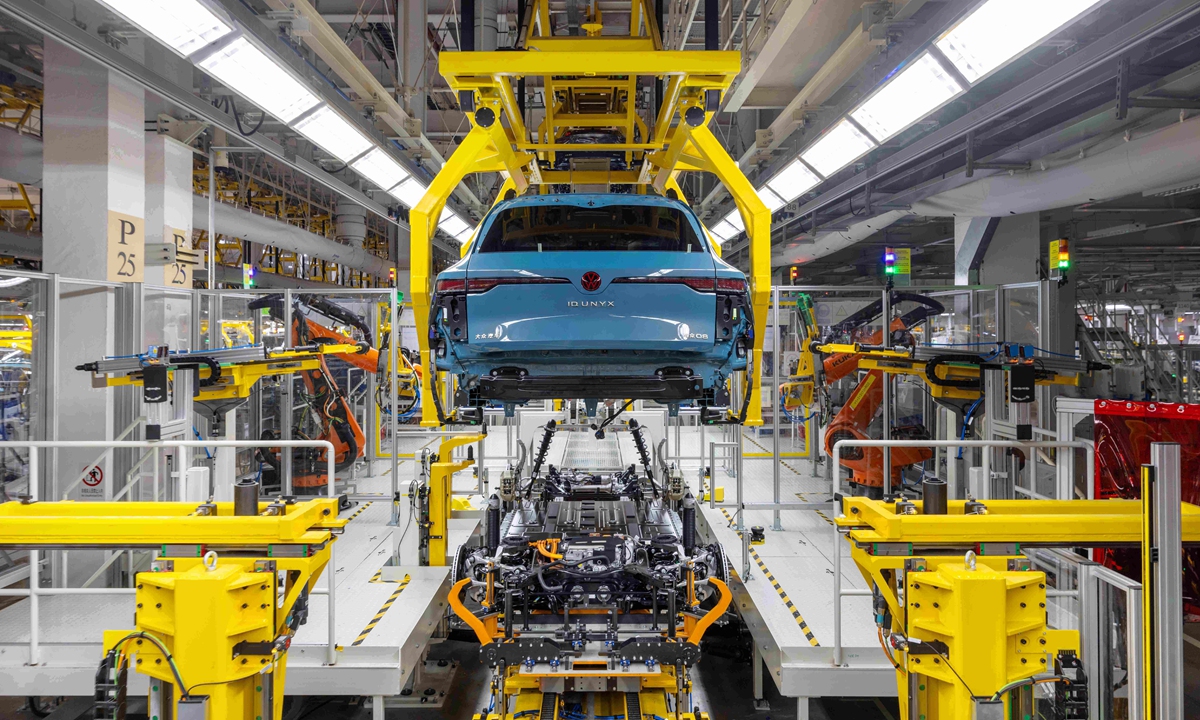
An ID.UNYX 08, the first model co-developed by Volkswagen Group China and XPENG, rolls off the production line in Hehei, East China's Anhui Province. (Photo: Volkswagen Group)
The sales comparison between the Aito M9 and the BMW X5 is particularly telling. Since the 2025 edition of Aito M9 launched in March last year, it has sold nearly 120,000 units, while the similarly priced BMW X5 moved around 70,000. Domestic Chinese models have so far held the top spot in sales among luxury SUVs priced at 500,000 yuan ($72,500) and above for 21 consecutive months. Consumers have voted with their feet, signaling that the underlying logic of automotive consumption is being rewritten.
Today, when a new generation of consumers opens a car door, what they care about is no longer the added value attached to a badge. Their focus is on the human-machine interaction of the intelligent cockpit, the sophistication of driver assistance systems, the safety and reliability of the electric vehicle (EV) power train - the seamless, cutting-edge technological experience delivered by hardware, software, algorithms, and connectivity working in concert.
This reflects a profound transformation within the automotive industry: Technological innovation is redefining the standards of value, reshaping brand perception, and changing consumer preferences - and in doing so, rewriting the landscape of the entire automotive sector.
When people no longer pay for brand premiums but instead are drawn to innovation premiums, market position cannot be "inherited," and brand recognition is anything but fixed. The driving force of technological iteration is the only true foundation for "staying out in front." Last year, the penetration rate of China's domestically produced new-energy passenger vehicles reached 57 percent. Features like "five-minute flash charge" and "three-minute battery swap" are rapidly overcoming the shortcoming of charging times. It is precisely through relentless innovation, iteration, and technological progress that China's domestic EVs have progressively moved from the lower end to the higher end of the market, opening up a new landscape on a new track.
The innovative vitality of China's domestic EVs bears witness to the power of the "Chinese innovation paradigm."
On one hand, it leverages market strengths to ignite the innovative passion of business entities and encourage decentralized, diversified innovation attempts. On the other hand, it harnesses institutional strengths to provide support for the EV industry in areas such as industrial planning, policy frameworks, and new infrastructure construction. The combination of an effective market and a proactive government, a vast market unleashing the innovative energy of enterprises, and efficient new infrastructure accelerating industrial application, together constitute the "Chinese innovation paradigm," one that holds infinite potential for nurturing technological innovation and industrial growth.
China's market is an open market, one that provides a sound environment for fair competition and the evolution of innovation.
During his visit to China, German Chancellor Friedrich Merz experienced firsthand an urban and highway pilot driver-assist system co-developed by Mercedes-Benz and Chinese tech company Momenta, describing it as "amazing." Innovation advantages cannot be built behind closed doors. It is precisely because China has kept its doors wide open - competing on the same stage with the world's top enterprises - that the innovative capabilities of Chinese EV companies have kept improving and their competitive edge has continued to consolidate.
Volkswagen Group CEO Oliver Blume remarked that the Chinese market "has become something of a fitness center for us… We have to work harder and faster to keep up." By letting all kinds of enterprises compete vigorously, and by allowing all manner of innovations to debut and be applied in the country first, China, this global "innovation testing ground," is only going to become more attractive.
In market competition, there are no permanent winners - innovation alone is the timeless key to success. We have used innovation to redefine what a "luxury" automobile means. We have every reason and every condition to use innovation to define the future of many more industries as well.
This article was originally published by the Opinion Department of the People's Daily.