


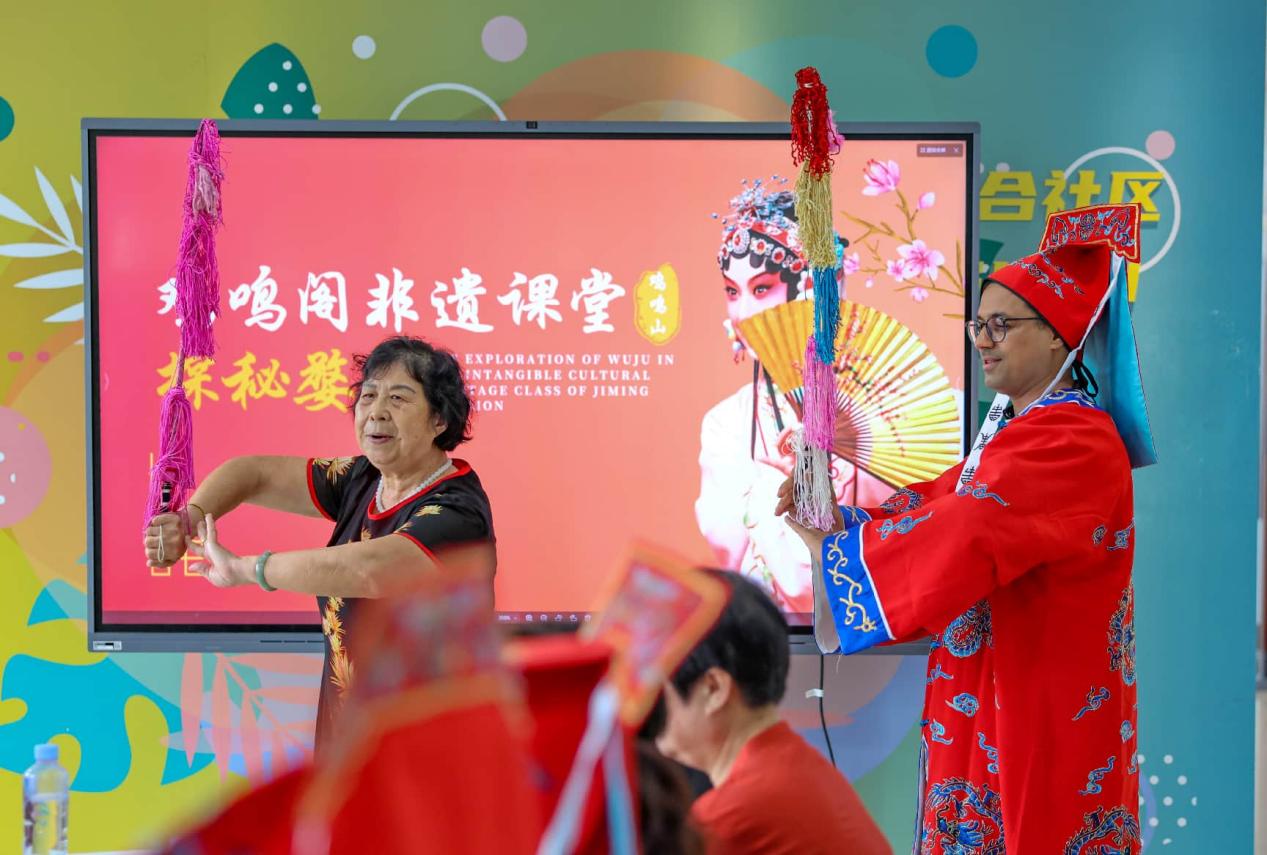
A foreigner learns Wuju opera in Jimingshan neighborhood, Yiwu, east China's Zhejiang province. (Photo/Hu Panxue)
Since the start of this year, diverse cultural exchange activities have been bringing people worldwide closer, fostering mutual understanding and shared values. They are bringing trust and friendship to the world, showcasing the vitality of the Global Civilization Initiative (GCI).
From film festivals to singing competitions, cultural exchanges between China and Africa have flourished this year, designated as the China-Africa Year of People-to-People Exchanges. Around the world, more and more people are embracing Chinese New Year traditions and making the Chinese festival a truly global celebration. Wellness tea and traditional Baduanjin exercise are going viral overseas, while the cultural phenomenon of "becoming Chinese" is capturing hearts and minds.
On March 15, 2023, Chinese President Xi Jinping proposed the GCI at the Communist Party of China (CPC) in Dialogue with World Political Parties High-Level Meeting. The initiative advocates the respect for the diversity of civilizations, the common values of humanity, the importance of inheritance and innovation of civilizations and robust international people-to-people exchanges and cooperation.
Rooted in the rich heritage of Chinese civilization, the initiative advocates seeking common ground while respecting differences and promoting harmonious coexistence, principles that resonate with the multicultural diversity and concepts of coexistence found in many countries.
Over the past three years, the GCI has fostered global consensus in cultural and civilizational spheres. It has been translated into vibrant exchanges and cooperation, gathering momentum to bridge misunderstandings, enhance mutual understanding among peoples, and inject positive energy into the joint effort to address global challenges.
How civilizations are viewed has a profound bearing on human progress as well as world peace and security. Today's world is facing multiple challenges and crises, and one of the important reasons for current conflicts and disputes is a few countries' advocacy of notions such as the "clash of civilizations" and "civilizational superiority," which equate cultural differences with confrontation and further widens the development gap and governance imbalances.
At this new crossroads in human history, it is increasingly urgent to transcend estrangement through civilizational exchange and overcome conflicts through mutual learning among civilizations.
The GCI emphasizes that civilizations are diverse, advocating harmony in diversity and mutual appreciation for common progress; that civilizations are interconnected, promoting shared commitment and advancing along the path of common development; that civilizations are evolving, encouraging people to understand where they come from and chart a course for the future; and that civilizations are inclusive, advocating dialogue, cooperation, mutual understanding, and affinity.
The values and approaches embedded in the initiative point the way forward for strengthening civilizational exchanges and for advancing human civilization.
Focusing on the reality of diverse world civilizations and addressing the urgent need to move beyond civilizational confrontation, the GCI has received broad recognition from the international community. It has been incorporated into multiple United Nations resolutions as well as various bilateral and multilateral documents.
The 78th session of the United Nations General Assembly designated June 10 as the International Day for Dialogue among Civilizations, incorporating civilizational dialogue into global institutional arrangements.
In June 2025, a world-wide event marking the first International Day for Dialogue Among Civilizations was held. The following month, the Global Civilizations Dialogue Ministerial Meeting convened in Beijing and issued the Beijing Declaration along with a list of action plans, providing a clear roadmap for turning the idea of civilizational dialogue into institutionalized practice.
China has helped build a range of international platforms at different levels, including the Conference on Dialogue of Asian Civilizations, the Liangzhu Forum, the World Conference of Classics and the Global Civilizations Dialogue Ministerial Meeting.
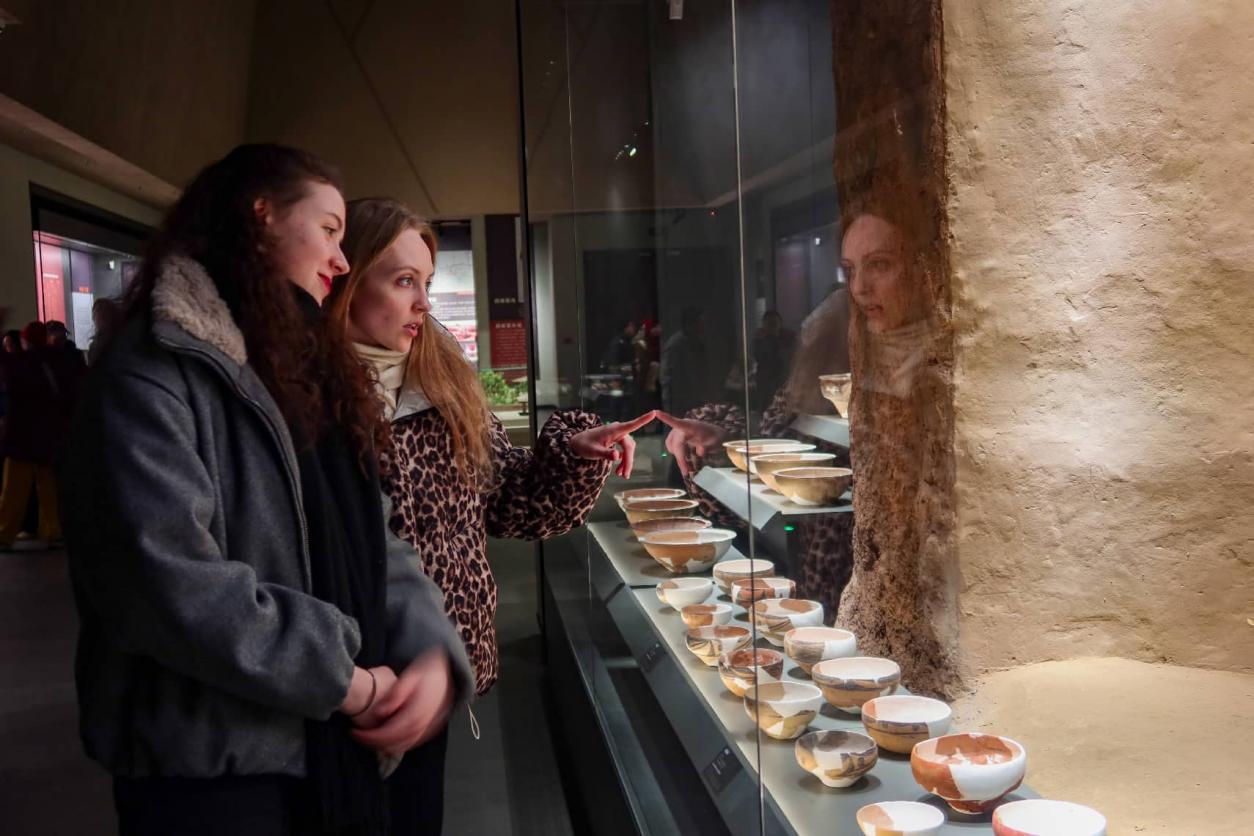
Foreign tourists visit the Miaodigou Museum in Sanmenxia, central China's Henan province. (Photo/Sun Meng)
It has signed cooperation agreements in fields such as culture, cultural heritage and tourism with more than 100 countries, while deepening cooperation in areas such as joint archaeological research, world heritage protection and the mutual translation of classic works.
Through these efforts, China and its partners are working together to safeguard the cultural treasures of humanity and promote global dialogue among civilizations through concrete actions.
Humanity's exploration of modernization involves civilizational inheritance, innovation and mutual learning. As a new form of human advancement, Chinese modernization draws inspiration from other civilizations while contributing its own experiences to the global community, enriching the diversity of world civilizations and offering insights for addressing global challenges.
China has hosted forums like the CPC in Dialogue with World Political Parties High-Level Meeting and the High-level Dialogue on Global Development, and taken the lead in establishing the Global South Think Tanks Alliance. It is also working with its African partners to jointly advance 10 partnership action plans and build platforms for sharing governance experience between China and Africa.
Exchanges on governance and development practices have become an important part of implementing the GCI, offering valuable lessons for countries pursuing their own paths to modernization.
Resolving humanity's conflicts and challenges requires sincerity and the power of shared values. China is ready to work with all parties to put the GCI into action. Through this effort, the light of civilization can guide development and renewal; its strength can enrich humanity's pursuit of modernization; and its wisdom can advance the building of a community with a shared future for humanity. China hopes to contribute even more to building a better world.