


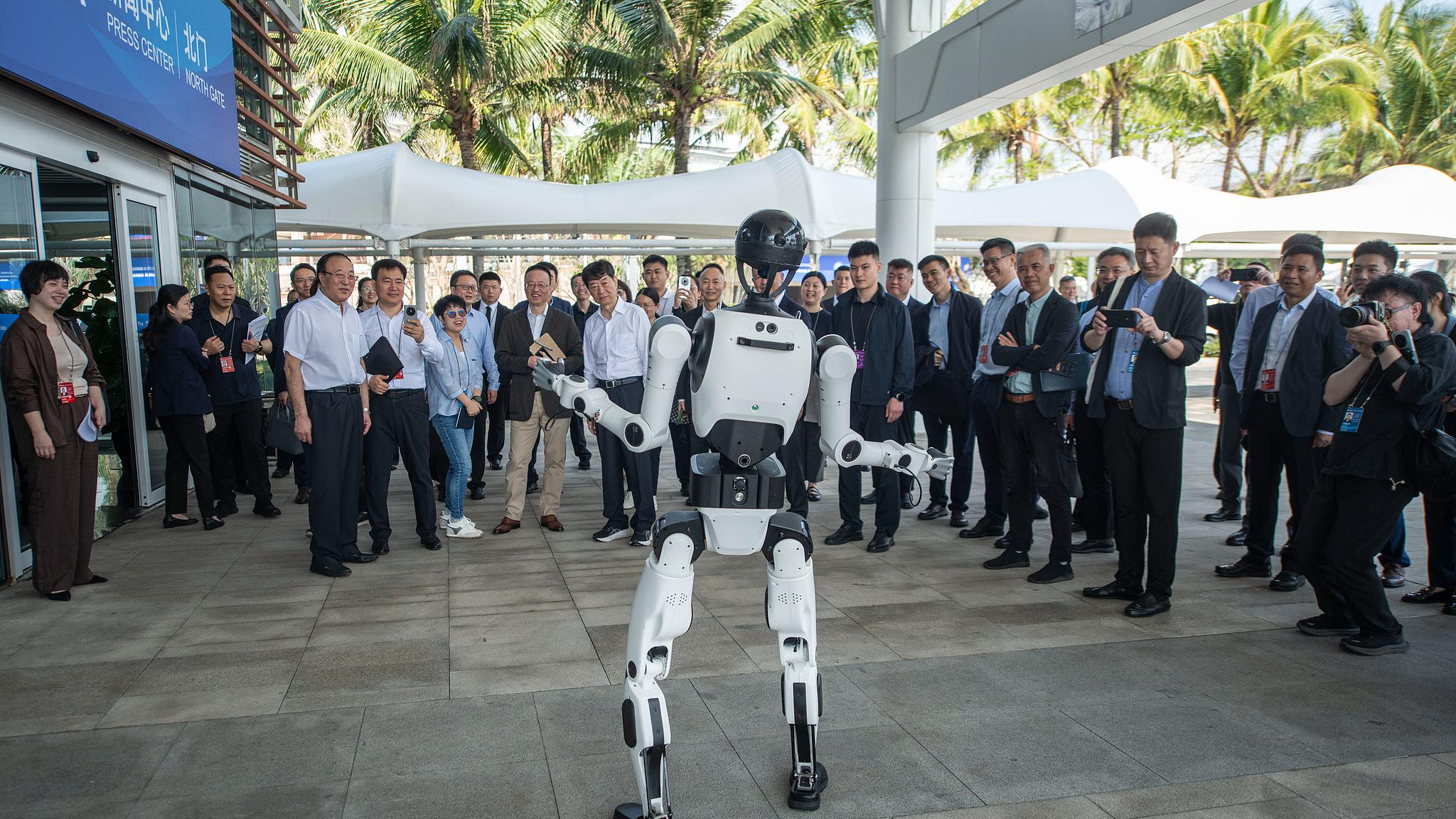
Guests watch a robot performance at the Boao Forum for Asia Press Center in Qionghai, Hainan Province, south China, March 23, 2026. /CFP
Editor's note: Andy Mok, a special commentator for CGTN, is a professor at Beijing Foreign Studies University and a Senior Research Fellow at the Center for China and Globalization. The article reflects the author's opinions and not necessarily the views of CGTN.
With the 2026 Boao Forum for Asia (BFA) Annual Conference being held in Hainan from March 24 to 27, international observers are once again parsing the "signal-to-noise" ratio of Asia's premier economic gathering. For many, Boao is seen as a venue for "declaration-like" consensus. However, for those tracking the structural transformation of the region, the 2026 agenda revealed a systematic move to turn "new quality productive forces" into standardized, investable, and scalable industries.
To understand this shift, one must look beyond the individual technologies and toward the "joints" of the system. As I argue in my forthcoming book, The Innovation Machine: How China Creates and Adopts Technology Through Governance, technological power is not merely a product of talent or capital. Instead, it is built at the interfaces – where philosophy becomes policy, and policy becomes national capability. I call this the I5 model: a continuous chain of Ideas, Institutions, Instruments, Infrastructure, and Impact. This framework is on full display in the 2026 Boao program, particularly in the twin "sunrise" clusters of Artificial Intelligence (AI) and the Green Transformation.
The ideational foundation: AI+ as a systemic redesign
In the I5 model, the first layer is the Idea. At Boao 2026, AI is no longer narrated as a standalone novelty, but as a systemic "industrial operating system." The conference's emphasis on the "AI Plus" initiative – the deep integration of AI across manufacturing, logistics, and healthcare – reflects a civilizational understanding of order where technology is pulled into use to solve societal-scale problems.
The most potent signal here is the rise of Embodied Intelligence. With a dedicated sub-forum on "Humanoid Robots: Advancement and Breakthroughs," the forum is moving AI from screens to the physical world. This isn't just a technical achievement; it is an institutional one. By releasing a national standard system for the full lifecycle of humanoid robots, China is creating the Institutions and Instruments – the rules and standards – necessary to turn experimental prototypes into interoperable, insurable industrial fleets.
Infrastructure and the materialist reality
The third and fourth layers of the model – Instruments and Infrastructure – are where policy becomes physical. At Boao 2026, the "Green Transformation" is being stripped of abstract rhetoric and rebranded as a production-and-trade reconfiguration. This includes a "Blue Economy" storyline that links ocean industries to port-and-shipping modernization – the I5 model's "Infrastructure" layer in action.
The scale of this infrastructure pivot is underscored by data from the International Energy Agency (IEA), which projects that 2025 global energy investment will reach $3.3 trillion, with $2.2 trillion flowing specifically into clean power, grids, and storage – roughly double the investment in fossil fuels. For Asia, this isn't just about "going green"; it is about securing the supply chains of the future. By linking ocean industries to port decarbonization and digitalized shipping corridors, Boao signals that the region's trade "plumbing" is being rebuilt to run on this new energy mix. Hainan is already operationalizing this as a pilot, deploying clean-energy fleets and autonomous logistics vehicles to serve the conference itself.
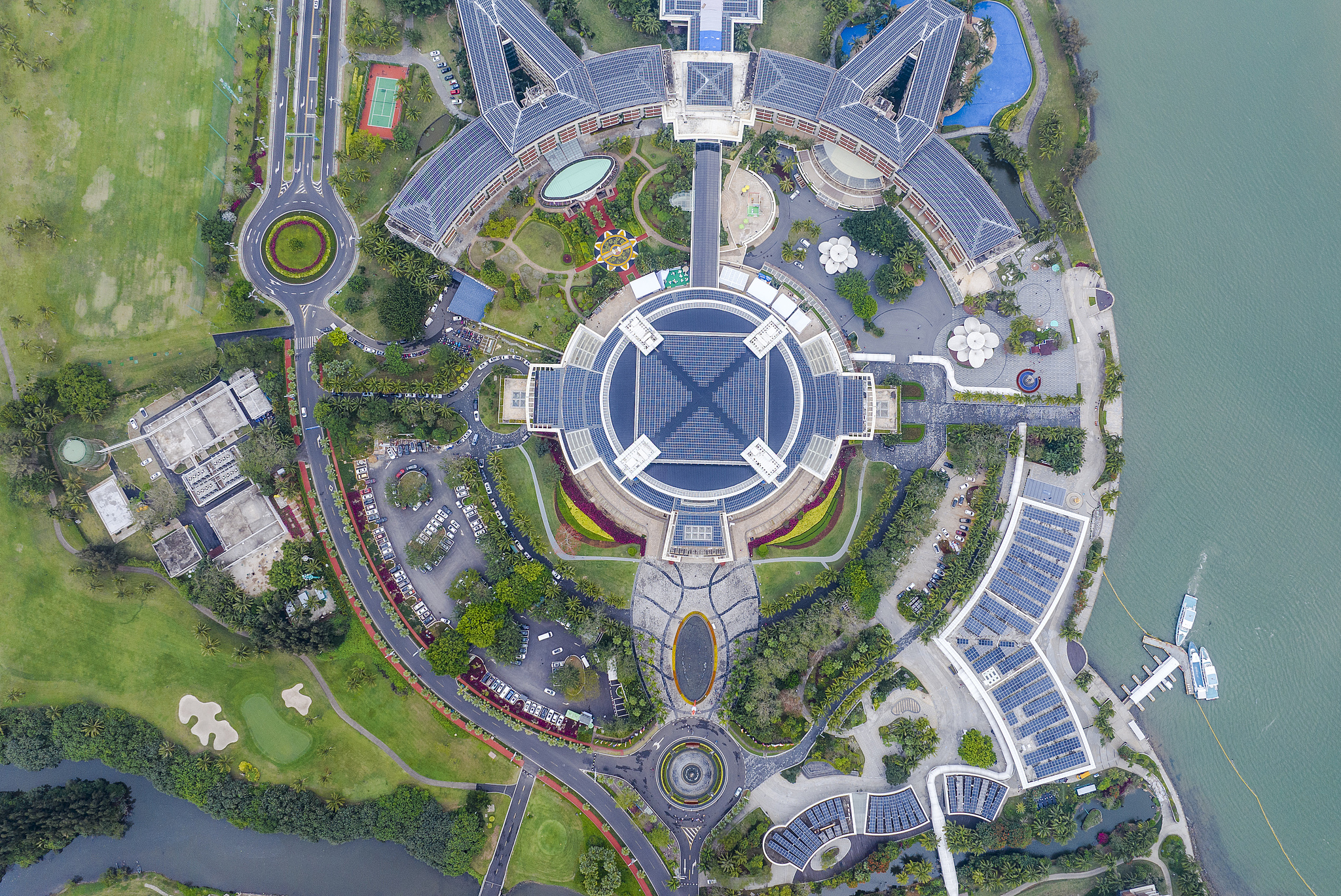
On the roof of the Boao Forum for Asia International Conference Center, rows of blue photovoltaic panels produce clean energy under the sunlight, in Qionghai, Hainan Province, February 26, 2024. /CFP
Impact: Shaping the future of global competition
The final layer of the I5 model is Impact: where implementation becomes national capability and sets the terms of global competition.
The Global Free Trade Port Development Forum at Boao is operationalizing this impact through "trade-and-standards plumbing." Concrete partnerships, such as the Memorandum of Understanding (MOU) between Catalonia and Hainan or the partnership agreement between Haikou and Mongolia's Khosig Valley, are the institutional corridors that will define future capital and data flows. These are the primitives of a new regional integration that prioritizes materialist connectivity.
However, significant risks remain. Trade-and-technology fragmentation is the dominant macro risk, exacerbated by regulatory divergence. This fragmentation in the West creates a strategic opening for the Boao Forum to act as a "coordination node" for the rest of the world. While the EU and US are preoccupied with their own internal regulatory debates, the 2026 Boao Forum is moving to establish the "plumbing" for Asia's own industrial future.
The lesson of Boao
Ultimately, Boao 2026 teaches us that innovation is a function of governance. Those who can shape the "joints" between ideas and action will lead the next growth wedge. As The Innovation Machine highlights, China's approach is a structured method with deep historical roots. By aligning philosophy with standardized implementation, Boao is not just signaling a new era of technology – it is building the machinery to govern it.
(If you want to contribute and have specific expertise, please contact us at opinions@cgtn.com. Follow @thouse_opinions on X to discover the latest commentaries in the CGTN Opinion Section.)