


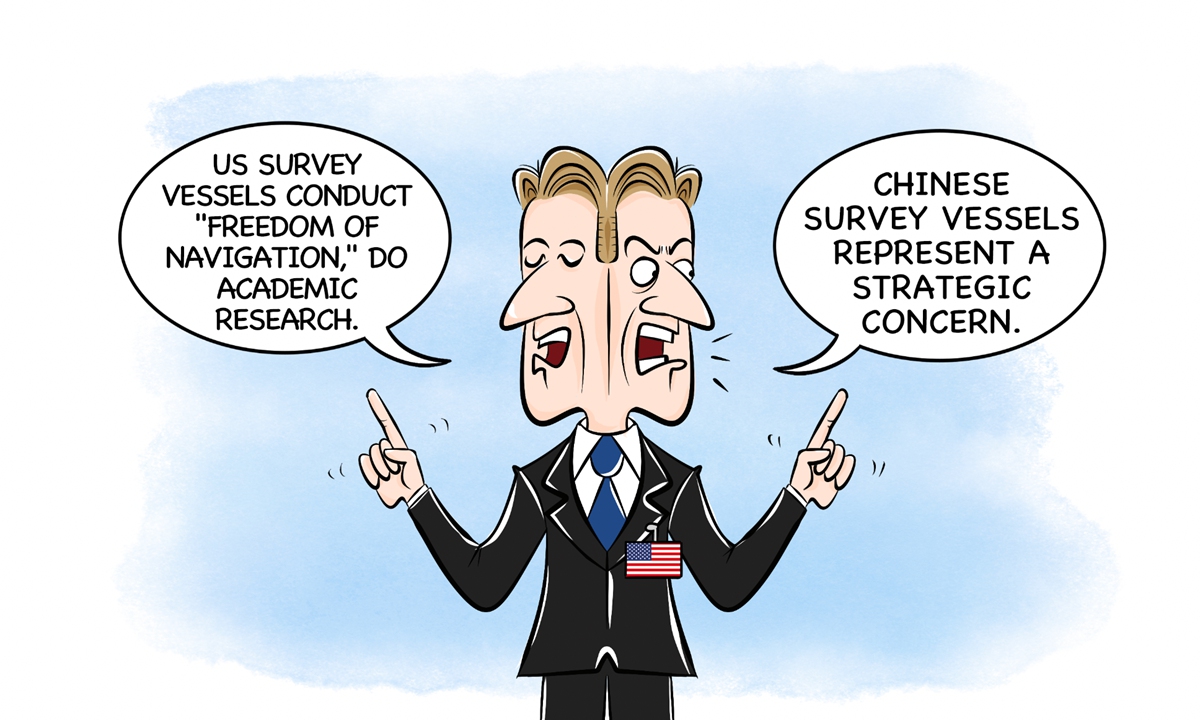
Illustration: Chen Xia/GT
A Reuters investigation published recently opens with a vessel cutting through the Indian Ocean. The ship is the Dong Fang Hong 3 - "The East is Red" - a research vessel operated by Ocean University of China. According to Reuters, the ship spent 2024 and 2025 sailing back and forth in the seas near China's Taiwan island and the US stronghold of Guam, mapping the ocean floor, measuring water temperature and salinity, and tracking currents.
In March 2025, the vessel crisscrossed the waters between Sri Lanka and Indonesia, covering approaches to the Malacca Strait. According to the university, it was conducting mud surveys and climate research. However, Washington sees something else entirely.
China's ocean surveying worries US Navy officials. Rear Admiral Mike Brookes claimed that "potential military intelligence collection" by Chinese research vessels "represents a strategic concern." Ryan Martinson, an associate professor specializing in Chinese maritime strategy at the US Naval War College claimed that it "threatens to erode" the US naval advantage.
Beneath the alarm, a familiar anxiety reveals itself.
Ocean surveying - measuring depth, salinity, temperature, and current - is the work of maritime nations and scientists. Humanity, remarkably, knows less about the ocean floor than about the surface of the moon.
Exploring the deep sea is a scientific endeavor that, in any other context, would be celebrated.
The US Navy maintains the world's largest and most sophisticated ocean database, assembled over decades by survey vessels that routinely operate in waters off China's coast.
Washington calls this "freedom of navigation." It calls it "academic research." It calls it "protecting the global commons."
When China does the same, the vocabulary changes completely.
The same instruments, the same measurements, the same slow transects across open water are now described as "preparation of the battlespace," and the information is said to be "potentially invaluable," a phrase used in the Reuters piece by Peter Scott, former chief of Australia's submarine force.
The double standards are not subtle. It would be easy to dismiss this as media sensationalism, but the pattern is too consistent and too convenient to be accidental.
Behind the language lies a deeper refusal - one that is psychological as much as strategic. For centuries, from the age of European exploration through Alfred Thayer Mahan's theories of sea power to today's carrier strike groups, Western nations have treated the world's oceans as a natural domain of their dominance.
They have grown accustomed to a one-way transparency: They see the ocean floor; others do not. They track submarine movements; others cannot follow them. It is a monopoly so long-standing that it has come to feel like a natural right.
China's entry into deep-water oceanography breaks that monopoly. That, more than any specific data point about salinity or sonar propagation, is what produces the alarm in the US.
Every step China takes in the world is filtered through a lens that transforms development into menace, science into espionage and presence into aggression.
The real question is why every action by China is interpreted through the worst possible frame, while equivalent American activities are treated as self-evidently benign.
Washington lacks the honesty to admit that the US-built international order primarily serves American interests and bolsters US dominance.
China's deep-sea mapping, from the Pacific to the Arctic, makes it difficult for the US to contain China within "the First Island Chain," exposing the limits of the US containment strategy.
China has not started a war in more than four decades. Its rise has been built on manufacturing, infrastructure and trade, not military conquest. A civilization of over 1.4 billion people developing the capacity to understand the oceans is not, by itself, a declaration of war. Treating it as such is not a sober security assessment. It is a failure of political imagination.
Losing its monopoly over oceanic knowledge, the US securitizes rival activities as threats, unable to compete openly. This pattern is seen in semiconductors, telecom, electric vehicles, and now ocean research.
The cost of this reflex is not merely diplomatic. Every escalation in the "threat" narrative makes genuine cooperation harder to sustain.
Lasting stability in the Pacific will not come from American naval supremacy alone. It will come, if it comes at all, from a recognition that the ocean is large enough for more than one power to understand it - and that understanding the ocean is not, in itself, an act of war.
The author is a senior editor with the People's Daily and currently a senior fellow with the Chongyang Institute for Financial Studies at the Renmin University of China. dinggang@globaltimes.com.cn. Follow him on X @dinggangchina