


'Five-Year Plans are the basis of China's modern development'
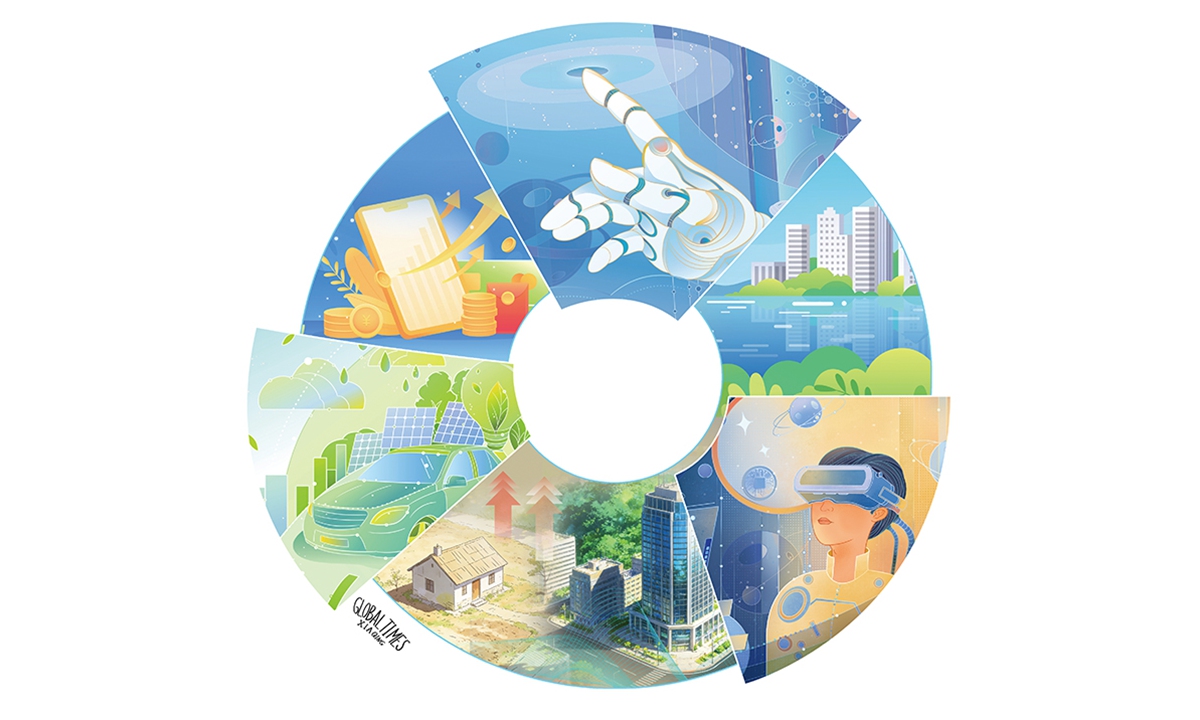
Illustration: Xia Qing/GT
Editor's Note:
2026 marks the commencement of China's 15th Five-Year Plan (2026-30), a pivotal phase in the nation's medium- to long-term development. A successful venture starts with a good plan and clear goals set. At this critical juncture, where a profound restructuring of the global order converges with a tipping point in the technological revolution, China's Five-Year Plan is poised to inject momentum and certainty into global development, charting a steady course for the new journey ahead.
In its newly launched "New Blueprint, New Opportunities" series, the Global Times ( GT) invites Nobel laureates in economics, former central bank governors, core decision-makers of international organizations and renowned economists from countries with diverse civilizations, different economic systems and stages of development to deeply analyze how the China's 15th Five-Year Plan will reshape the underlying logic of China's interaction with the rest of the world and to explore the "anchor of certainty" and "new paradigm of development" this plan offers to a turbulent world. In the fifth installment of the series, Stephen Perry (Perry), chairman of 48 Group Club, a British business association committed to promoting China-UK trade, shared his views on China's 15th Five-Year Plan with GT reporter Ma Ruiqian.
GT: China began implementing the Five-Year Plans more than 70 years ago. Your father visited China in 1953, the first year of China's very first Five-Year Plan (1953-57). Over the decades, China has undergone tremendous transformation through successive Five-Year Plans. Based on your own and your father's experiences in trade with China, what role have the Five-Year Plans played in driving these changes?
Perry: If you go back to 1953, when my father first visited Beijing, he saw nothing but the harsh conditions left by the Chinese civil war [1946-49] and the Chinese People's War of Resistance against Japanese Aggression [1931-45].
During that journey, my father gradually came to understand the enormous challenges facing the Chinese people. Among those he met were leaders who were already thinking about how to build a new, modern China. These were the people who began forming what later became the state planning authority and started the process of drafting the first Five-Year Plan.
The conditions they faced were extremely difficult. They had very limited means of collecting data, and they may not even have had an accurate understanding of China's population. Yet they drew on their experience with the Russians, as well as their own knowledge and study of books, to figure out what should be done at the very beginning.
They worked it out step by step. They made mistakes and corrected them. Planning is at the core of everything, and the recognition of mistakes is also at the core of everything. Gradually, China began its long march toward a modern economy and a modern society.
Five-Year Plans are the basis of China's modern development and one of its most important assets. If you are driving a car around a bend, you cannot do it successfully unless you can see the other side of the corner and know where you are going. You may change your destination, but you still have to have one. That is what the people doing the planning are working with - clear destinations.
GT: 2026 marks the opening year of China's 15th Five-Year Plan period. In this new stage, what key features do you think are worth paying attention to?
Perry: China is transformed by innovation everywhere, and the commitment to continuous innovation and development is deeply rooted in the minds of China's leaders.
We can talk about artificial intelligence, or high technology, or many other significant areas in China today. But I think it is less about which sector is getting attention, and more about what that attention represents. The intention is to make China self-reliant and capable. I think China will continue to plan for the long term in the years ahead. We are beginning to see that China is embracing a much bigger concept of its role and its relationship with the rest of the world.
GT: You have previously mentioned that China's leadership has a very clear understanding of its mission. How does the close connection between the Communist Party of China (CPC) and Chinese people contribute to China's long-term development?
Perry: What my father noticed during his first three-day journey in China in 1953 was quite striking. He saw men in blue jackets everywhere, working in ditches and clearing rubble left behind by years of war. He asked who these people were and why they were dressed that way. He was told they were Party members.
When he asked what it meant to be a Party member, he was told that it meant having a deep commitment to the people of China and putting them before oneself. It also meant having the relevant experience and capability to help guide the country toward the right path.
Throughout the 1950s, whenever my father visited China, he observed that the Party was present in nearly every aspect of development - whether it was constructing buildings, building reservoirs or carrying out other major projects. This left a strong impression on him: If you do not understand the people of China, you cannot fulfill this role.
Today, there are over 100 million CPC members. Their deep, lived experience and their close connection with the people have been crucial in helping the country find its path forward. This, in turn, has contributed to the larger amount of successful content in China's Five-Year Plans. The Party plays an incredibly significant role in working out, in practical detail, how to achieve what is widely regarded as one of the miracles of the modern world - the development of a modern economy in China.
GT: Although the 15th Five-Year Plan is a domestic development blueprint, it has attracted wide global attention. What lessons can other countries draw from China's development plan?
Perry: The one thing the West has to learn from China is that effective central planning is the key to China's success. The West has to stop talking nonsense about it having something to do with democracy. It has everything to do with what your priorities are and how to carry them forward. China is showing every day how to do it. Who has the cars, the railways, the transportation? The answer is China. And what is driving that? It is efficient, organized and caring central planning, which includes a party at the top, made up of people who are very well chosen to be able to do the jobs they do. They are modest, they are humble, and they care about the people of China.
The Five-Year Plan is a proper democratic process in which wisdom is respected. The leaders of China depend a great deal on the wisdom and experience of the people involved in the planning process to help them make better decisions. It recognizes who the wise individuals are and invites them to provide comments on what is being proposed. In the end, these ideas have to pass through a lot of judgments and controls in order to be included in the Five-Year Plans. China operates this system, which is also embedded in its broader planning and decision-making structure.