


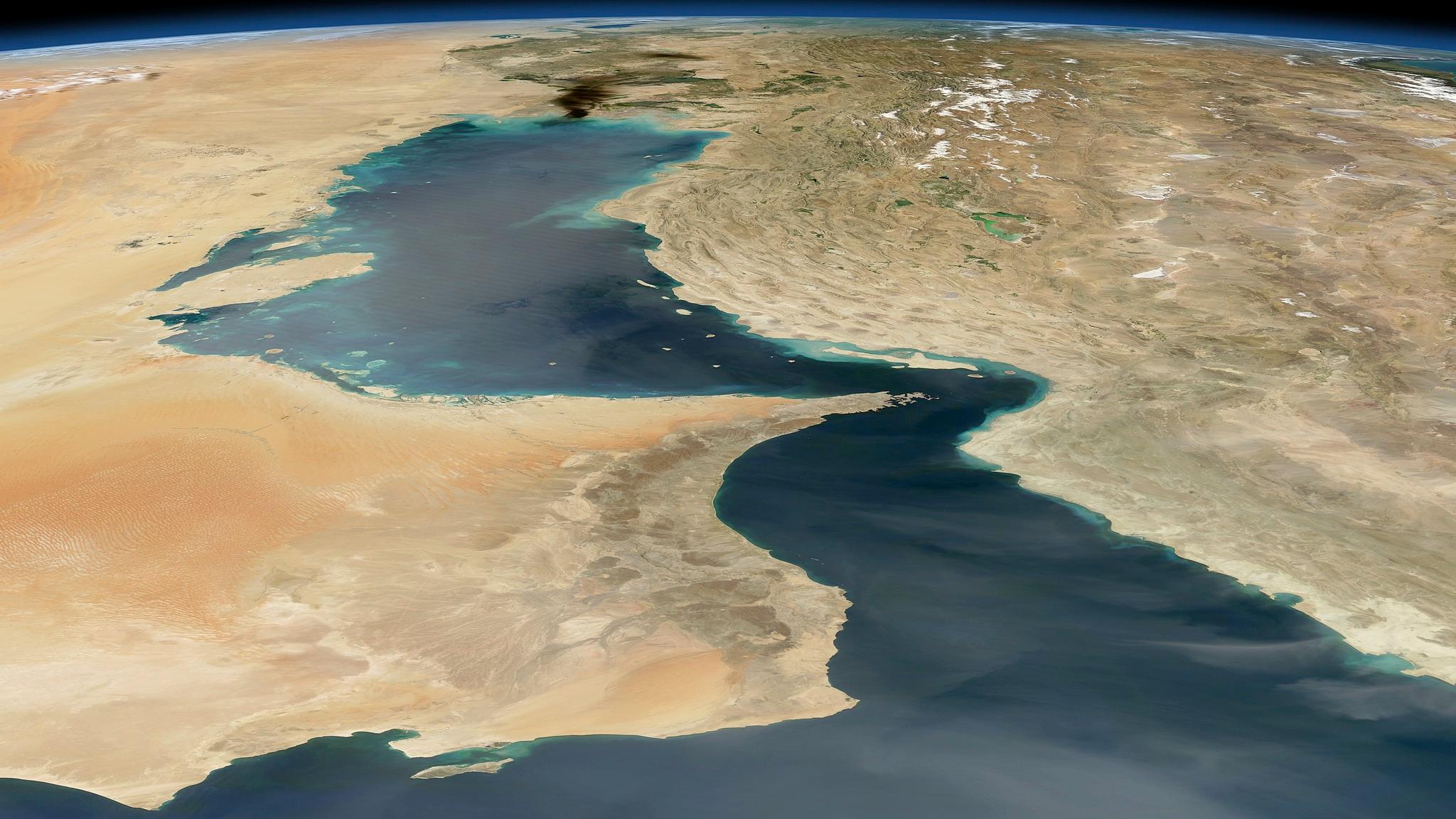
A satellite image of the Strait of Hormuz, April 10, 2023. (Photo: CFP)
Editor's note: Zhang Jianping, a special commentator for CGTN, is the deputy director of the academic committee of the Chinese Academy of International Trade and Economic Cooperation of the Ministry of Commerce. Li Junyi is a master's student in International Business at the School of Economics, Peking University. The article reflects the authors' opinions and not necessarily the views of CGTN.
The US-Israel war on Iran that erupted in February 2026 marked a decisive turning point in modern energy history. Brent crude oil prices surged by nearly 60% in March, directly triggering severe volatility in the global crude market. Faced with a sharp decline in shipping volumes through the Strait of Hormuz – a critical global energy "choke point" – international observers initially expressed concerns about China's vulnerability as the world's largest energy importer.
However, this perspective failed to account for China's deliberate strategic pivot over the past decade: a shift away from debt-driven demand-side stimulus toward a supply-side transformation focused on quality, efficiency, and structural optimization. Standing at the threshold of 2026, the inaugural year of the 15th Five-Year Plan, China's energy performance proves its resilience against systemic shocks. Moreover, through a composite strategy of "diversified external supply, robust strategic reserves, structural transformation, and technological efficiency," China is emerging as a "green engine" for the global energy transition.
The first line of defense for this resilience is rooted in all-dimensional, diversified import channels and robust supply capacity. Dai Houliang, Chairman of China National Petroleum Corporation, noted that despite the tensions in the Strait of Hormuz, oil and gas supplies passing through the strait account for only about 10% of the company's total operations, which remain stable overall. In fact, through domestic production, transnational pipelines, and diversified supplies from non-Middle Eastern regions – particularly Russia, Central Asia, West Asia, Latin America, Africa, and parts of the Asia-Pacific – most of China's crude oil and natural gas sources are now reliably secured. This diversified import landscape has substantially reduced China's dependence on any single source or maritime route, effectively alleviating the historical "Malacca Dilemma."
Furthermore, in the extreme scenario where Middle East conflicts disrupt sea and air routes, the China-Europe Railway Express – dubbed the "Steel Camel Fleet" – saw its freight volume grow by 32% and 25% year-on-year in January and February, respectively. It has assumed a pivotal role in anchoring global supply chains and is becoming increasingly vital within the international logistics architecture.
A vast reserve system and mature regulatory mechanisms serve as the core cushion for China to navigate price volatility and supply disruptions. Over the past two decades, China's strategic oil and gas reserve infrastructure has steadily matured. Current reserve scales are sufficient to provide a 180-day supply buffer for crude oil and natural gas, with efforts underway to extend this long-term security capacity further. This diversified architecture – which integrates government strategic reserves with commercial inventories from major refining enterprises, and is reinforced by a coal-to-chemicals defense line leveraging domestic resources and controllable costs – effectively mitigates the transmission of international oil price fluctuations to the domestic market.
In response to the risk of sustained high global oil prices, China is strengthening regulatory mechanisms by vigorously promoting energy conservation and emissions reduction. Since the 11th Five-Year Plan, China has established a macro-control matrix encompassing legal, administrative, and market-based economic instruments, elevating energy conservation and emission reduction from a mere initiative to a national strategy. Against the backdrop of the 15th Five-Year Plan and the mid- to long-term "two-step" strategic goals, targets for energy efficiency and environmental protection have become mandatory and binding. These are not only vital for low-carbon green development but also serve as the primary impetus for forcing technological advancement and equipment upgrades.
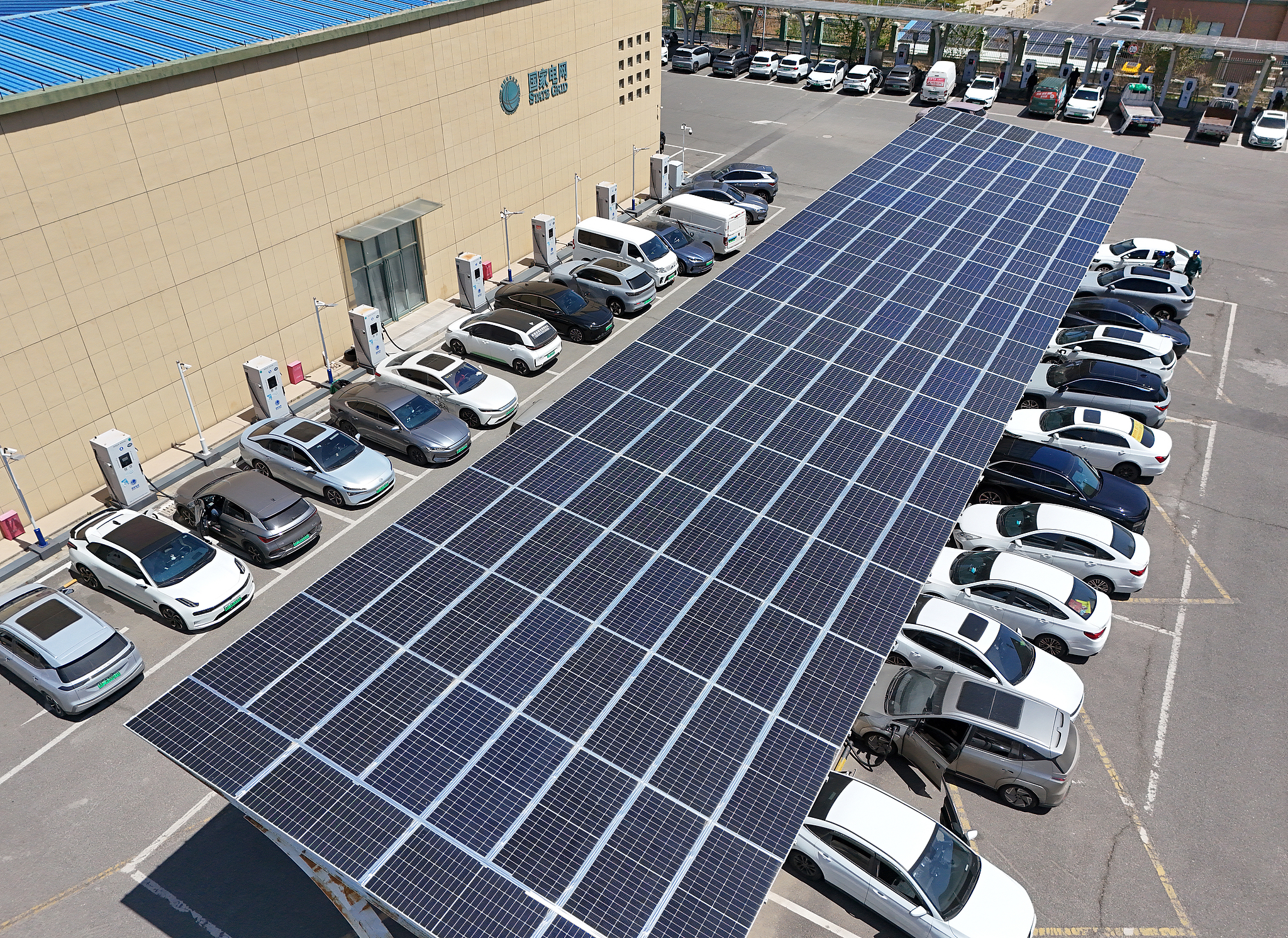
New energy vehicles are being charged at an electric vehicle charging and battery swapping station in Yantai, Shandong Province, east China, April 28, 2025.
The accelerating adoption of new energy vehicles (NEVs) and the "endogenous revolution" within the energy structure signify that China is systematically reducing its reliance on fossil fuels at the source. In 2025, China's NEV production and sales both exceeded 16 million units, securing the global top spot for the 11th consecutive year. This industrial upgrade has directly pivoted the gravity of energy consumption toward electrification, significantly decoupling the transportation sector from its long-standing dependence on petroleum.
A landmark was reached in 2025, when China's share of non-fossil energy consumption surpassed that of petroleum for the first time. Furthermore, installed capacity for new energy storage exceeded 100 GW (100 million kW), representing around 50% of the global total. This milestone indicates that by increasing the share of clean energy, China has built an internal "structural hedge" against cost-push inflation driven by external energy volatility.
The energy crisis catalyzed by the Iranian conflict serves not only as a stress test for China's domestic supply resilience but also as a testament to China's burgeoning international leadership in the global energy transition. Departing from previous cycles in which it functioned as a passive price taker, China is now proactively steering the global energy governance agenda, advocating for a "fair and reasonable global energy governance system" within frameworks such as the BRICS and the Shanghai Cooperation Organization (SCO). By offering a predictable demand market and stabilizing global supply chains through the export of high-quality green energy technologies, China is spearheading the development of a more diversified and resilient international energy governance architecture.
In summary, the geopolitical upheavals of 2026 demonstrated how strategic foresight can transmute external risks into catalysts for systemic advancement. Leveraging its diversified channel layouts, robust reserve supports, accelerated new-energy transition, and leading-edge technological equipment, China has successfully defined a new paradigm of contemporary energy sovereignty. As China advances into the 15th Five-Year Plan, an intelligent energy architecture – grounded in smart grids and high-efficiency storage technologies – will further erode the constraints of traditional energy. The spillover effect of China's domestic energy resilience has emerged as a stabilizing force for the global economy, ensuring that the momentum toward a clean and sustainable future remains unyielding, even amidst localized geopolitical fractures.