


The growing arms race across the East China Sea
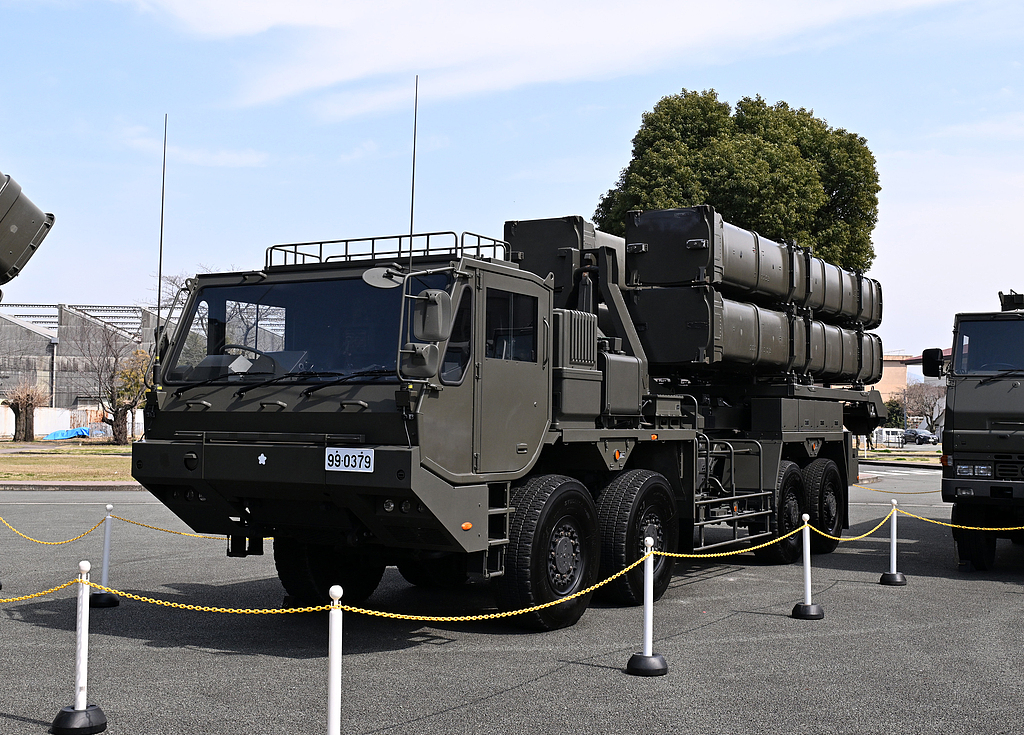
The launch system for the Type 12 surface-to-ship missile is on display at the Japan Ground Self-Defense Force Kengun Garrison in Higashi Ward, Kumamoto City, Kumamoto Prefecture, southwestern Japan and Kyushu Island region, March 17, 2026. (Photo: CFP)
Editor's note: Imran Khalid, a special commentator for CGTN, is a freelance columnist on international affairs. The article reflects the author's opinions and not necessarily the views of CGTN.
For decades, the geopolitical architecture of East Asia was defined by a predictable, if uneasy, equilibrium. Japan, bound by its post-war pacifist constitution, maintained a long-standing "exclusively defense-oriented" posture, relying on the United States for offensive deterrence while focusing its own Self-Defense Forces on domestic protection. This week, however, that equilibrium underwent a fundamental shift.
On March 31, Japan's Ministry of Defense confirmed the first operational deployment of long-range standoff missiles at Ground Self-Defense Force bases in Kumamoto and Shizuoka prefectures. These weapons, including the Type-25 surface-to-ship guided missile with a range exceeding 1,000 kilometers, are capable of reaching parts of China. While Tokyo frames this as a necessary measure for "counterstrike capabilities," the move represents a stark departure from the security norms that have governed the region since 1945.
To understand how Japan arrived at this juncture, one must look at the steady erosion of its traditional military restraint over the last decade. Since the mid-2010s, Tokyo has incrementally reinterpreted its constitutional limits. What began as a shift toward "collective self-defense" under former Prime Minister Shinzo Abe has, under the current administration, culminated in a massive expansion of hardware and ambition.
Japan's defense budget for fiscal 2026 has reached a record 9.04 trillion yen (about $58 billion), accelerating a plan to hit 2 % of GDP ahead of schedule. This surge in spending is not merely about maintenance; it is about transformation. By relaxing restrictions on arms exports and investing heavily in hypersonic gliding projectiles and long-range cruise missiles, Japan is building a military that looks increasingly capable of projecting power far beyond its shores.
The rationale provided by Defense Minister Shinjiro Koizumi is so-called deterrence. But for Japan's neighbors, particularly those who carry the historical memory of the early 20th century, recent developments raise a persistent question: Has Japan's commitment to post-war pacifism been permanently traded for a new brand of militarism?
In the aftermath of 1945, Japan was expected to reflect on its past actions, ensuring that its future role would be one grounded in restraint and regional cooperation. The deployment of missiles capable of reaching parts of China from Kumamoto inevitably raises questions about whether those foundational principles have been sidelined in favor of strategic ambition.
The post-war international order was built on the premise that Japan would remain a purely defensive actor. This was not just a legal restriction but a form of regional assurance. The deployment of weapons capable of striking China's coastal areas inevitably challenges the spirit of that arrangement. Critics, argue that while Tokyo rules out "preemptive strikes" in its rhetoric, the technical capability to launch such strikes before damage is even incurred creates a dangerous ambiguity. Misjudgment in such a high-stakes security environment could easily lead to an unintended escalation.
Furthermore, Japan's trajectory toward quickening military buildup has been met with strong localized opposition. Recent polling indicates that nearly half of Japanese people oppose easing their country's export ban on lethal weapons. Residents in Kumamoto and Shizuoka have expressed concern that their communities are now potential targets in a regional conflict they never asked for. There is a palpable tension between the state's grand strategy and the safety of the citizenry.
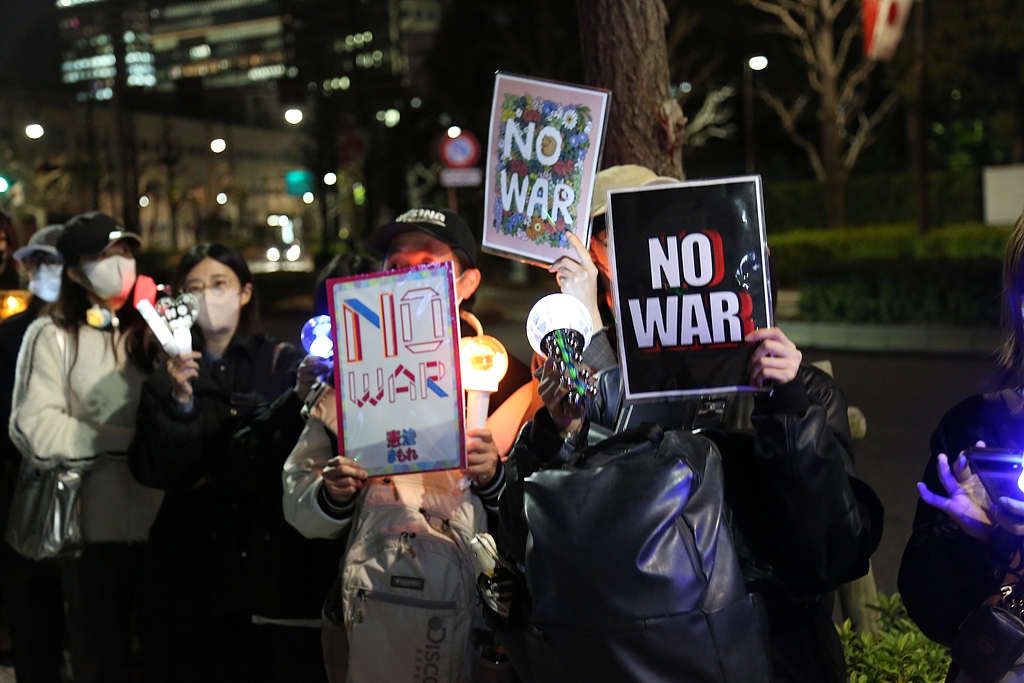
More than 10,000 Japanese citizens protested against the Sanae Takaichi administration's recent signals toward constitutional revision and its decision to deploy long-range missiles outside the Second Members' Office Building of the House of Representatives in Tokyo, Japan, March 19, 2026. (Photo: CFP)
The task for Japan is to avoid going further down the wrong path while face its historical obligations. For 80 years, Japan's major contribution to regional stability was its role as a peaceful, economic powerhouse that eschewed offensive weaponry.
By stepping into the realm of counterstrike capabilities, Tokyo risks fueling a regional arms race that could prove impossible to contain. The recent confirmation by Defense Minister Koizumi that Japan is also operationalizing a Hyper Velocity Gliding Projectile (HVGP) at Camp Fuji, with a reported plan to extend Tokyo's reach to 2,000 kilometers in future variants, further accelerates this trend.
In a world marked by resurgent nationalism and fading multilateralism, the path to peace is rarely secured through the accumulation of evermore sophisticated missiles. Genuine security in East Asia requires a renewed commitment to the very international order that Japan was part for decades.
Reflecting on history, including acknowledgment of wartime actions, is not a sign of weakness; it is a prerequisite for a stable future. As Japan tackles this new military era, it must ask itself whether such deployments truly enhance its security or risk dismantling the very foundations of the peace that has served it so well for so long.