


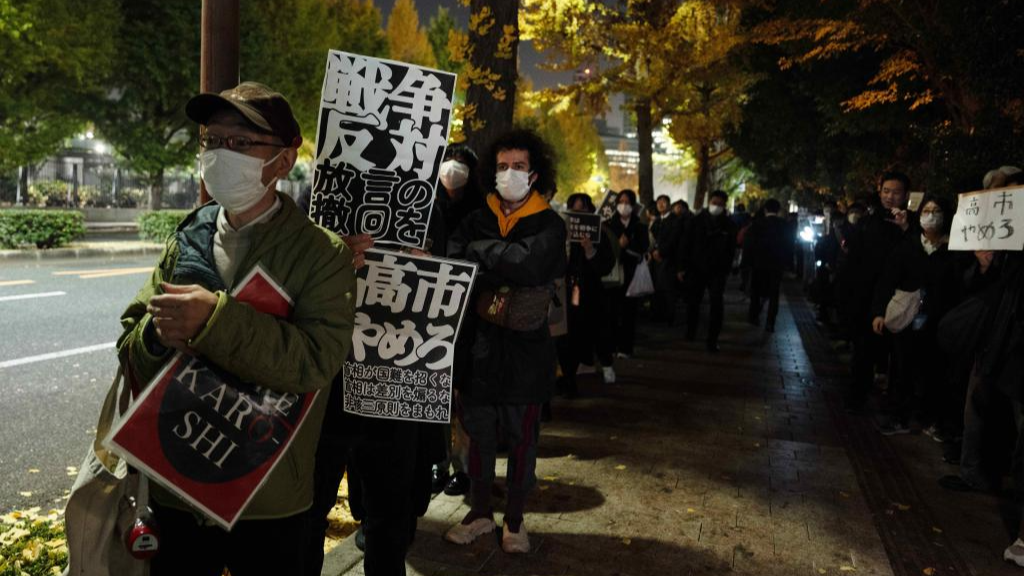
People attend a protest in front of the Japanese prime minister's official residence in Tokyo, Japan, November 21, 2025. (Photo: Xinhua)
"Japan is back," Prime Minister Sanae Takaichi declared. However, it appears that the dangerous version of old Japan has returned.
Recently, a 23-year-old active-duty officer in the Japan Ground Self-Defense Force scaled the wall of the Chinese Embassy in Tokyo and broke in, threatening to kill Chinese diplomats "in the name of God." This egregious incident, unprecedented in post-war Japan, is far from a mere "isolated security issue," as the Japanese authorities have tried to downplay it; rather, it symbolizes the extreme rightward shift in Japan's political landscape and the resurgence of militarist remnants.
The event has not only severely damaged China-Japan relations but also damaged Japan's self-proclaimed image as a "peaceful nation."
Flagrant violation of international law
The intruder's radical actions crossed all legal boundaries, reflecting Japan's failure to purge the toxic remains of militarism and the severe erosion of the Self-Defense Forces by far-right ideologies.
The Vienna Convention on Diplomatic Relations explicitly states that the premises of a diplomatic mission shall be inviolable, and host nations bear an absolute obligation to ensure their security. Allowing active-duty armed personnel to break into a foreign diplomatic mission is a flagrant violation of international law and a crude transgression against another nation's sovereignty and diplomatic dignity. The officer's actions – scaling the wall, concealing a knife and issuing death threats – were clearly a premeditated act of violent provocation and not impulsive.
This incident echoes the pre-World War II (WWII) Japanese military tradition of "gekokujo" – insubordination. In the 1930s, junior officers acted in the name of "patriotism" and "revering the Emperor" to bypass civilian control and military discipline, orchestrating violent events.
Japan's Kwantung Army unilaterally provoked the "September 18 Incident" in northeast China, destroying a section of railway track and blaming China as a pretext for invasion. The act triggered a full-scale war of aggression. That an active-duty officer targeted a foreign embassy raises fears that this dangerous tradition is being revived within the Self-Defense Forces.
The incident is the bitter fruit of the long-term right-wing radicalization of Japanese forces. The Officer Candidate School, where the marauding officer was trained, and the National Defense Academy have long become breeding grounds for historical revisionism.
According to Japanese media reports, the 2024 curriculum at the Officer Candidate School blatantly glorifies the 1945 Battle of Okinawa between Japan and the United States, while remaining silent on the atrocities committed by the Japanese military, such as the killing and forced suicides of civilians.
Mandatory courses at the National Defense Academy openly use militaristic terms like the "China Incident" and the "Great East Asia War," distorting Japan's war of aggression as a "defensive war against Western colonizers." The school also frequently invites far-right scholars to give lectures, and students maintain an annual tradition of marching 70 kilometers to worship at the controversial Yasukuni Shrine that commemorates Japanese war criminals. Under the influence of such ideologies, the radicalization of the younger generation of officers was inevitable.
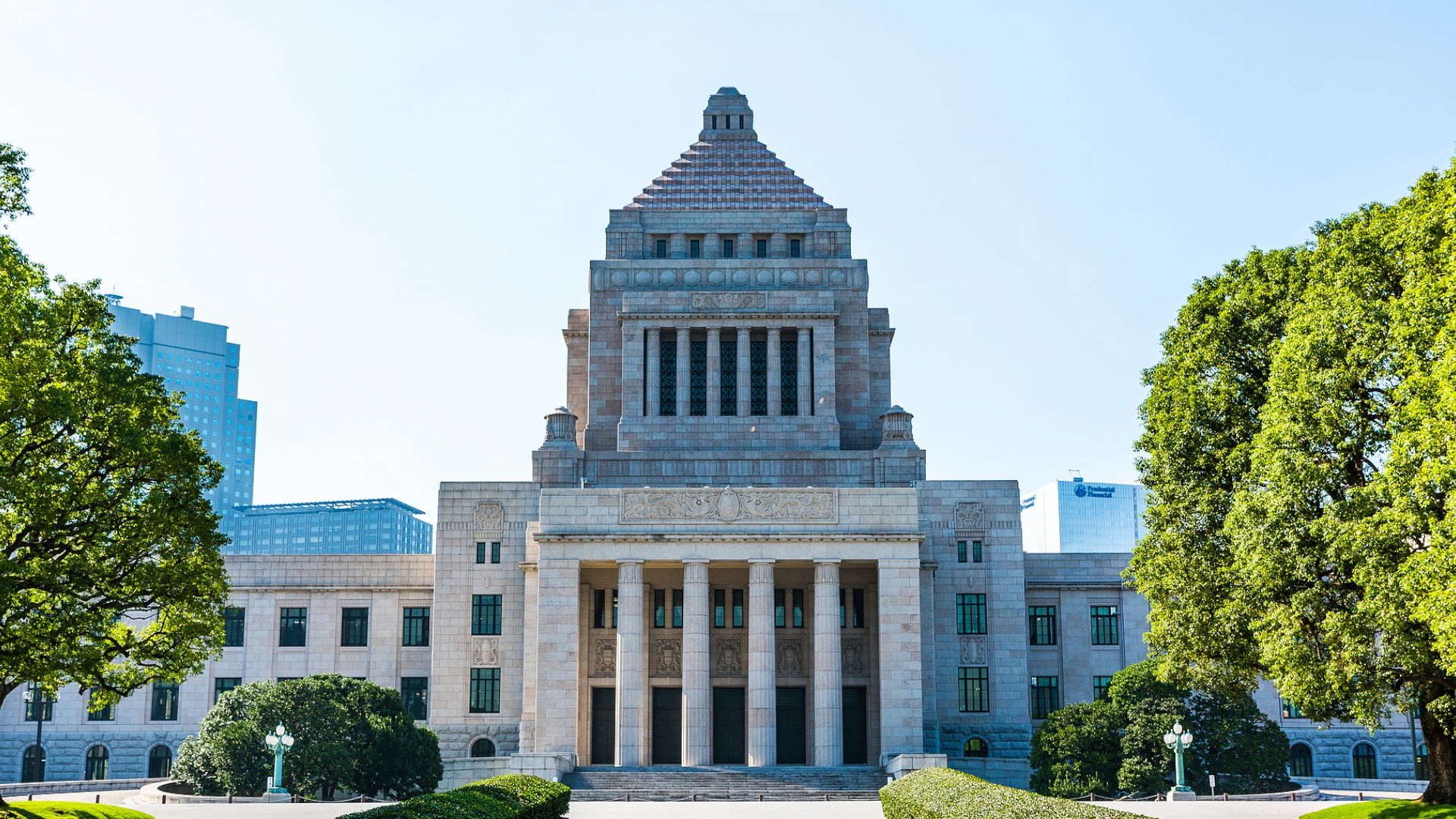
A file photo of the National Diet Building in Japan. (Photo: VCG)
Several Japanese lawmakers and prominent scholars gathered Tuesday evening at the Members' Office Building of the House of Councillors to urge Prime Minister Sanae Takaichi to retract her recent erroneous remarks on Taiwan.
The meeting was held under the theme of demanding Takaichi withdraw her remarks linking a "survival-threatening situation" for Japan to the Taiwan question and return to the starting point of the normalization of Japan-China relations.
Speaking at the event, former Foreign Ministry official Ukeru Magosaki argued that Takaichi's comments undermine the 1972 Sino-Japanese Joint Statement.
Kumiko Haba, professor emeritus at Aoyama Gakuin University, said Takaichi's statements on Taiwan were "extremely dangerous," pointing out that her remarks would clearly violate Article 9 of Japan's Constitution as well as international law.
Member of the House of Councillors Sachika Takara also addressed the gathering, saying Takaichi should withdraw her remarks and make it a starting point to rebuild Japan-China relations and ease rising tensions.
Participants issued a joint appeal calling for Takaichi to retract her statements, return to the starting point of the normalization of Japan-China relations and promote the development of friendly relations between Japan and China, which received strong support from several dozen attendees.
The appeal said Takaichi's remarks had seriously damaged the foundation of bilateral relations since normalization and harmed Japan's national interests. It reiterated that the Taiwan question is entirely China's internal affair and urged Japan to uphold the four political documents between the two countries and adhere to the one-China principle.