



The implementation of independent customs operations across Hainan Island has significantly accelerated the development of China's Hainan Free Trade Port (FTP). A suite of preferential tax policies supports this momentum, designed to foster investment and industrial growth. However, these incentives raise a pertinent question: could the Hainan FTP become a tax haven?
While the zero-tariff policy offers substantial benefits and appeal, all preferential measures come with clear eligibility criteria. These advantages are not universally accessible, as specific conditions must be met.
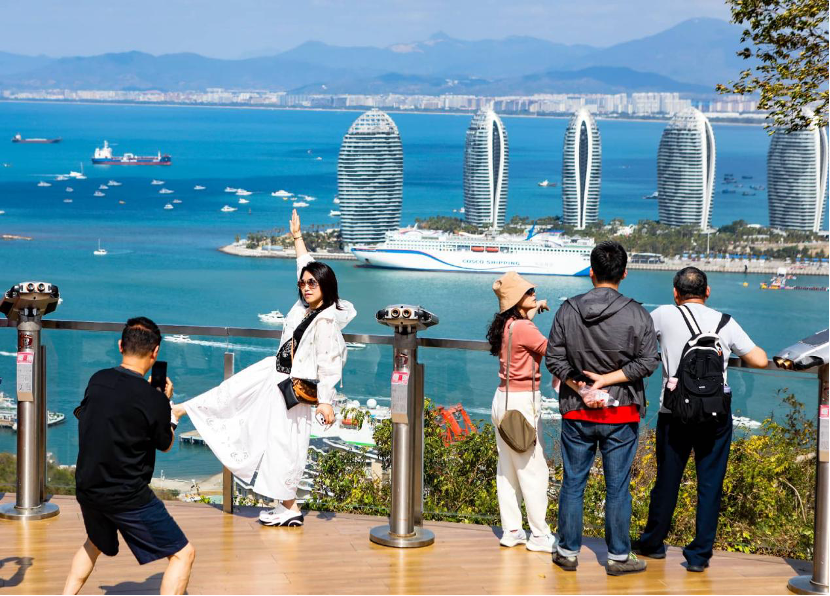
Tourists visit the scenic spot Luhuitou, Sanya, South China's Hainan Province. (Photo: People's Daily)
Take zero-tariff imported vehicles as an example. Rumors previously circulated online suggesting cars could be bought at half price in Hainan, prompting jokes about booking flights to buy cars. In reality, this duty-free policy applies only to transportation and tourism enterprises operating within the FTP.
Qualifying companies must meet compliance requirements. Furthermore, these vehicles must be used for operational purposes: each journey must start or end within the FTP, and their cumulative time on the Chinese mainland cannot exceed 120 days annually.
Hainan residents enjoy access to a wide range of duty-free goods, but policies enforce an annual individual quota of 100,000 yuan (about $14,583). Any purchase exceeding this annual quota or quantity limits is subject to import duties as required. Customs authorities have also emphasized that "quota sharing" and "proxy purchasing for profit" are illegal and will result in legal liability.
These eligibility thresholds prevent policy abuse and provide a clear answer to concerns: the Hainan FTP is neither designed to be nor will it become a tax haven.
What exactly is a tax haven? It generally refers to jurisdictions with extremely low or zero tax rates, lax regulation and limited transparency, which primarily attract external capital seeking to shift profits and evade taxes. The Hainan FTP, in terms of its development positioning, institutional design and regulatory framework, does not fit this definition.
The core purpose of Hainan's preferential tax policies is to serve the development of the real economy, attract high-end domestic and international production factors and build a high-level platform for institutional opening up.

People shop in a duty-free mall in Haikou, South China's Hainan Province. (Photo: People's Daily)
Widely noted policies, such as a reduced corporate income tax rate of 15 percent and a capped individual income tax rate of 15 percent, also come with well-defined conditions.
The 15 percent corporate income tax rate applies only to encouraged industries and requires that the enterprise's actual management body be located within the Hainan FTP, effectively preventing "shell companies" from exploiting policy loopholes. If a company is merely registered in the FTP but any of its production, operations, personnel, accounting or assets are not based there, it will not be eligible for the preferential treatment.
Similarly, individual income tax incentives are targeted only at high-end and urgently needed talent genuinely required by the FTP. Eligible individuals must fall within specified talent categories, meet recognized standards and be jointly certified by relevant authorities. In general, taxpayers must reside in the FTP for at least 183 days within a tax year, and their taxable income must be sourced from within the FTP.
In essence, both enterprises and individuals must demonstrate substantive operations and genuine qualifications to benefit. Such precisely targeted incentives unlock policy dividends while safeguarding the fundamental principle of tax fairness.
Sound institutional design must be paired with rigorous enforcement. The Hainan FTP has also established a "smart" regulatory system: leveraging big data and artificial intelligence, it can automatically flag abnormal cross-border capital flows and transactions involving high-risk regions; with blockchain technology, key transactions are fully traceable; and financial account information is exchanged with over 100 countries and regions.
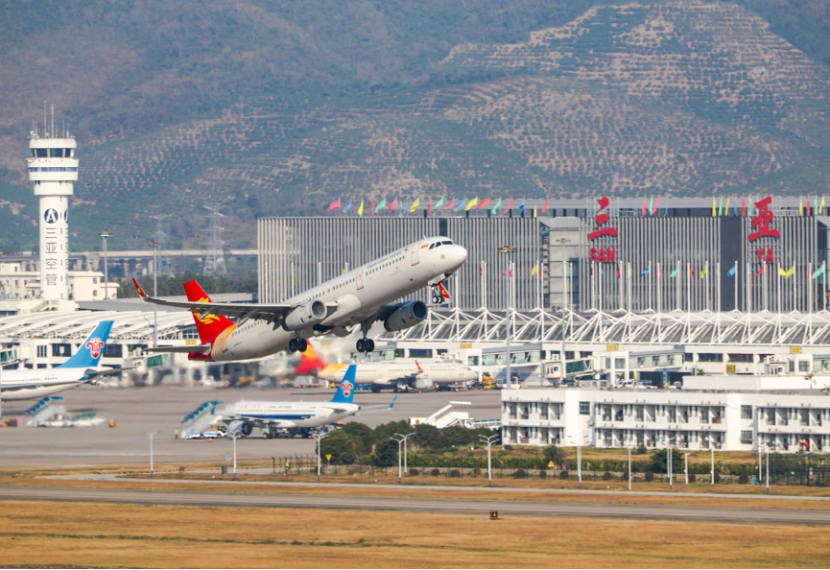
A plane takes off from Sanya Phoenix International Airport in Sanya, South China's Hainan Province. (Photo: People's Daily)
The FTP has built a robust anti-money laundering system integrating institutional oversight, technology and international cooperation, leaving minimal room for illegal activities. It also continuously strengthens international collaboration to enhance tax transparency and combat regulatory arbitrage.
Since its establishment, the Hainan FTP has focused on four pillar industries, namely tourism, modern services, high-tech industries and tropical high-efficiency agriculture, attracting enterprises and talent dedicated to rooting in the FTP and developing the real economy. The effectiveness of its policies is steadily translating into momentum for high-quality development.
On the 100th day since the launch of island-wide independent customs operations, a series of figures were released highlighting the FTP's strong performance: Offshore duty-free sales reached 15.62 billion yuan, up 27.64 percent year on year, 85,000 new market entities were registered, up 39.87 percent, total imports and exports exceeded 80 billion yuan, up 32.9 percent, and 223,000 visa-free inbound foreign visitors were recorded, an increase of 54 percent year on year.
An open and well-regulated Hainan FTP is not a place for opportunistic arbitrage but a dynamic environment where those committed to hard work can pursue their aspirations.