


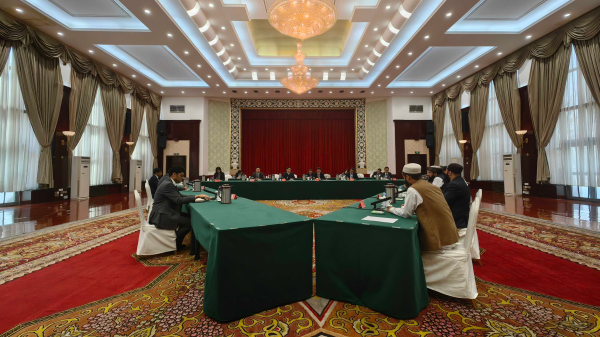
Representatives from China, Afghanistan and Pakistan held an informal meeting from April 1 to 7 in Urumqi, northwest China's Xinjiang Uygur Autonomous Region. (Photo: Chinese Foreign Ministry)
The recent informal talks among Pakistan, Afghanistan, and China in Urumqi, northwest China's Xinjiang Uygur Autonomous Region, have once again underscored China's role as a stabilizing force for peace in Asia.
This dialogue has not only pressed the pause button on the current conflict, but also demonstrated to the world that in resolving complex geopolitical tensions, military means are a dead end, while dialogue and negotiation are the only viable path to peace.
The deep-rooted causes of the Pakistan-Afghanistan conflict extend far beyond simple border disputes, arising instead from a complex mix of historical grievances, security dilemmas and geopolitical pressures.
In such a fraught context, China's role goes beyond providing a venue. As a close neighbor maintaining constructive relations with both sides, China has offered a credible, neutral and trusted platform -- one that prioritizes de-escalation, encourages dialogue, and anchors fragile trust. This is not symbolic diplomacy, but concrete action aimed at stabilizing a volatile region.
Both Pakistan and Afghanistan have increasingly recognized that cycles of violence only deepen insecurity. China's mediation has helped shift the focus from confrontation to consultation.
More importantly, the Urumqi talks once again reflected the China-proposed Global Security Initiative which advocates a new path to security featuring dialogue over confrontation, partnership over alliance, and win-win over zero-sum. Neighbors cannot be chosen, but the way they interact can be.
The road ahead is undoubtedly challenging, but the talks in Urumqi have opened a door that, if carefully navigated, could lead to a lasting peace.