


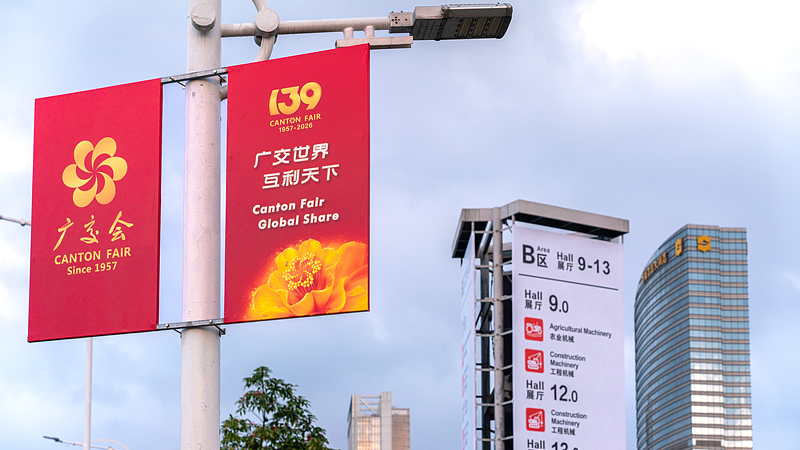
Posters for the 139th China Import and Export Fair (Canton Fair) appeared on the streets of Guangzhou, China's Guangdong Province, April 9, 2026. (Photo: CFP)
Editor's note: Huang Yongfu is a Special Commentator on economic affairs for CGTN. After earning a PhD in economics, he started his career at the University of Cambridge and then moved on to the UN system. His current interests lie in Sino-US links and global development. The article reflects the author's opinions and not necessarily the views of CGTN.
The China Import and Export Fair, often known as the Canton Fair, kicked off its 139th session on April 15 in Guangzhou, China's Guangdong Province. This session sets new records in terms of scale and participant numbers.
At the inflection point for the global economy, characterized by heightening strategic mistrust, mounting geoeconomic fragmentation, geopolitical contestation, and intensifying unpredictability induced by the US administration's economic statecraft. The fair thus showcases China's development strategy, centered on openness, cooperation, and innovation, injecting certainty and confidence into an increasingly volatile world economy.
How high-level opening up can generate shared growth and stability
Launched in 1957, the Canton Fair, held twice a year, has evolved over the decades, with improved quality and innovative services, and has expanded into a larger and more sophisticated platform. The fair is regarded as a barometer of China's foreign trade and as a platform to reaffirm China's commitment to opening up.
China has recently announced its high-level opening-up policies toward institutional openness, trade and investment liberalization, and deeper financial integration. This policy signals policy continuity and sustained global engagement. It represents a strategic response to the ongoing transformation of the global order when geopolitical tensions and protectionist tendencies challenge multilateralism.
By aligning with international high-standard economic and trade rules, expanding free trade networks, facilitating two-way investment flows, and consolidating industrial chains, the aim is to establish a fair, transparent, and predictable business environment that is market-oriented, rule-based, and internationalized.
Rather than retreating from globalization, China's high-level opening up is a concrete step to extend economic transformation beyond borders and remain embedded in regional and global economic integration, as both a production hub and a vast consumption market.
This policy has become one of the defining features of the contemporary global economy and has increasingly shaped global economic dynamics by bolstering international trust, enhancing regional connectivity and trade facilitation, and unlocking development opportunities, especially for the Global South.
China remains the world's largest goods trading nation, with total trade exceeding $6 trillion in 2025, and a major source and destination of foreign direct investment.
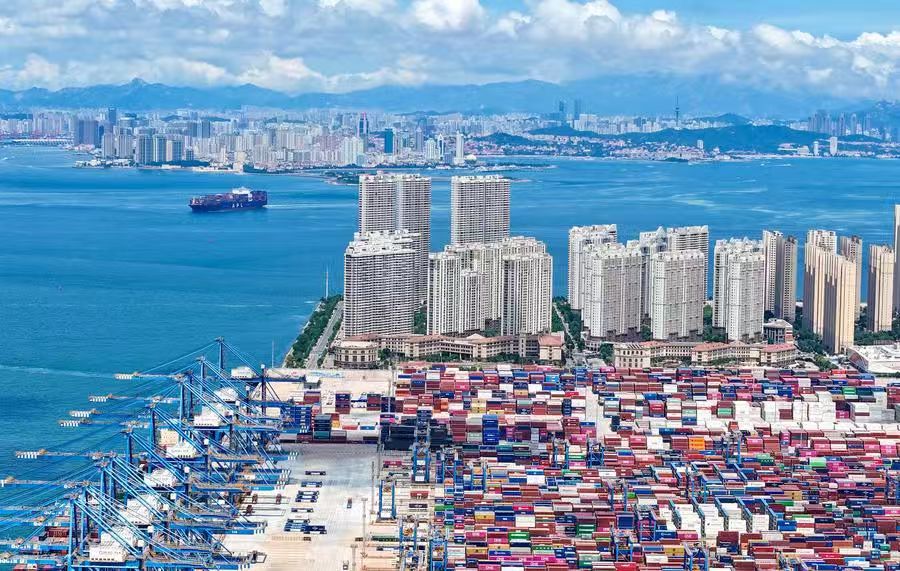
A container ship approaching Qingdao Port in Qingdao, east China's Shandong Province, July 8, 2025. (Photo: Xinhua)
How competitive dynamics can be reconciled with cooperative imperatives
The protectionist actions of the US, at the expense of the free trade system it once championed and the post-World War II order it helped construct, have provoked strong pushback. The recent spate of indiscriminate tariff weaponization against allies and adversaries alike has prompted many of its middle-power allies to reassess strategic alignment and economic diversification.
Canadian Prime Minister Mark Carney has set an example and provided significant insight into global order, which has resonated across the collective West. Carney, at the World Economic Forum in Davos, bluntly declared the rupture of the existing world order and called for a more predictable economic order through pragmatic economic diversification of trade partners, rather than ideological repositioning. The shift among Western middle powers to thaw trade relations with China is underway, guided by national interests rather than ideological alignment.
As an open and predictable regional trade architecture, the Canton Fair opens new avenues for rules-based economic cooperation for shared prosperity and sustainable development. It is China's soft power, notably its capacity to reconcile competitive dynamics with cooperative imperatives. China offers a viable, innovative, and inclusive alternative in public goods and in promoting "symbiotic globalization."
How innovation can influence the global economy
This session of the Canton Fair will feature eight new exhibition zones showcasing technological breakthroughs in cutting-edge fields such as service robots, green energy storage, smart home appliances, and smart healthcare. One dedicated zone will be for the low-altitude industry, with diverse drone applications, including advancements in flight control systems, communication and navigation, artificial intelligence (AI) for obstacle avoidance, and new energy propulsion.
Over the past decades, China has transformed its industrial structure, from its earlier role as a manufacturing platform to low-cost and high-tech production. To address technological hegemony and monopolies, China is stepping up efforts to build an indigenous innovation system underpinned by heavy investment in research and development (R&D) and substantial innovation outputs. In particular, China is directing major investments toward frontier technologies, including quantum computing, biotechnology, satellite systems, and next-generation communications networks.
According to the Ministry of Science and Technology, in 2025, China's national spending on R&D reached 2.8% of national GDP, high-tech manufacturing expanded by 9.4%, and industrial robot production grew by 28%. China entered the top 10 of the Global Innovation Index for the first time in 2025 and has become one of the world's leading centers of technological development, especially in green and digital technologies.
The recent years have witnessed significant development of new, high-quality productive forces, including digitization, AI, industrial automation, and green technologies. China is among the world's largest producers of electric vehicles, solar panels, and energy-storage batteries. These technological advances open new paths for international cooperation.