


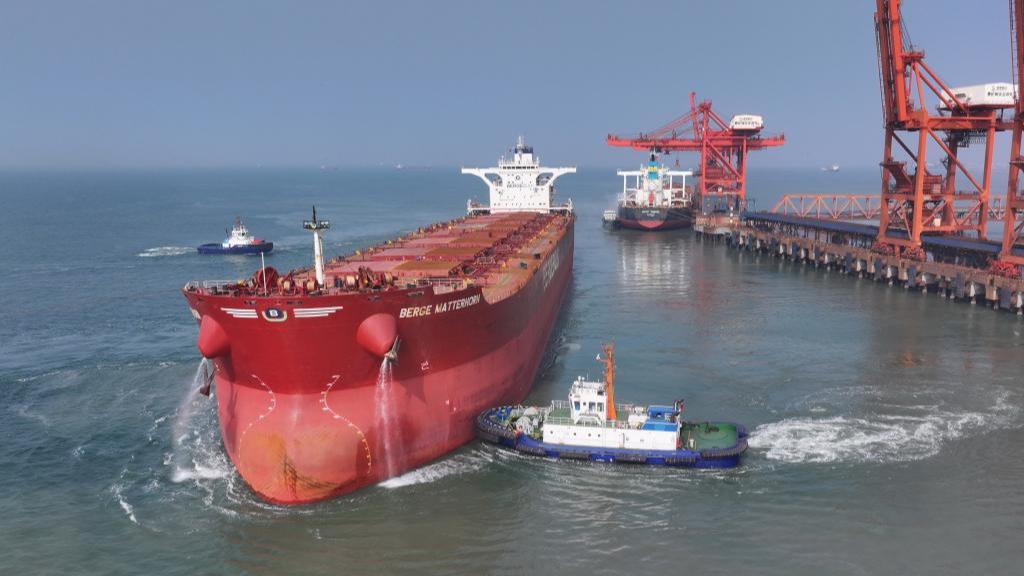
A vessel departing from the ore terminal of Caofeidian Port Area in Tangshan Port in Tangshan, north China's Hebei Province, April 15, 2026. (Photos: Xinhua)
Editor's note: Zhou Jingtong is deputy director of the Bank of China Research Institute. The article reflects the author's opinions and not necessarily the views of CGTN.
Since the beginning of 2026, the international political and economic landscape has evolved rapidly, and the global economy has entered a new period of turbulence and transformation. In particular, the outbreak of the conflict involving the United States, Israel and Iran in late February pushed up commodity prices, triggered sharp volatility in financial markets, dealt another heavy blow to the order of industrial and supply chains and heightened the risk of global stagflation.
Against this complex and volatile external environment, China's GDP grew by 5% year on year in the first quarter. Growth in production and supply accelerated, market demand continued to improve, market prices picked up moderately, and the national economy performed better than expected, achieving a sound start. The stability underlying China's economy is by no means accidental; it fully demonstrates the strong resilience and potential of China's economic development.
First, macroeconomic policies have been deployed with precision, balancing short-term and long-term goals to ensure sustained and healthy economic development.
2026 marks the first year of the 15th Five-Year Plan period. Faced with the intricate domestic and external environment, the Central Economic Work Conference and the Two Sessions have made comprehensive arrangements for economic work. Focusing on prominent problems in current economic operations, growth-stabilizing policies have been clearly oriented and effectively implemented.
A more proactive fiscal policy has been put in place early, ensuring that overall expenditure intensity "only increases rather than decreases" and support for key sectors "only strengthens rather than weakens," driving steady growth in investment in areas such as new infrastructure, livelihood security and new quality productive forces. While maintaining a moderately accommodative stance, monetary policy has provided targeted support to key links of the real economy, avoiding a flood-like stimulus approach.
Short-term growth-stabilizing policies have achieved remarkable results, not only keeping economic operations within a reasonable range but also buying valuable time for deepening reform. In the long run, the outline of the 15th Five-Year Plan (2026-2030) for national economic and social development has charted the course for high-quality economic development in China.
Policies to boost domestic demand, accelerate high-level self-reliance and self-improvement in science and technology, foster new quality productive forces and build a modern industrial system are under implementation in an orderly manner. By balancing reasonable short-term growth and long-term high-quality development, China's economy has not only the confidence for "stability" but also the momentum for "progress."
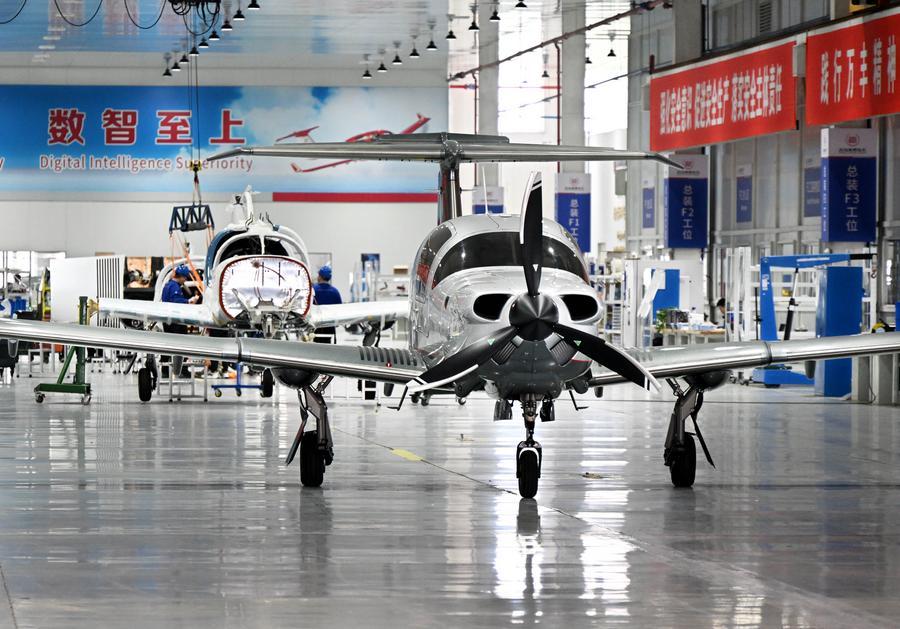
A view inside an aircraft manufacturing workshop of Wanfeng Auto Holding Group in Laixi City, east China's Shandong Province, April 2, 2026.
Second, the orderly transition of old and new growth drivers and the coordinated expansion of domestic and external demand have injected sustained impetus for responding to various risks and challenges.
China has actively promoted the mutual empowerment of traditional and new growth drivers, with domestic and external demand working in coordination, to resolve development dilemmas and expand development space through structural upgrading.
In the consumption sector, new forms of consumption, such as online, digital, green and health, as well as the first-launch economy, have played an increasingly prominent role. In the first quarter, the cumulative retail sales of online goods and services nationwide increased by 8% year on year, 0.1% higher than the same period last year. From bionic robots that can write the Chinese character "Fu" and recite poems to artificial intelligence dolls that speak dialects and provide interactive companionship, and various portable smart wearable devices, the integration of "technology + consumption" has rapidly entered daily life.
In the investment sector, driven by the transformation of traditional industries and the emergence of new ones, manufacturing investment has rebounded significantly. In the first quarter, the cumulative year-on-year growth rate of national fixed asset investment turned positive to 1.7% from -3.8% at the end of last year; among them, investment in equipment and instruments and investment in high-tech industries rose by 13.9% and 7.4% year on year, respectively.
Meanwhile, investment in high-tech industries has laid a foundation for industrial upgrading. The innovation-driven development model will continue, making Chinese products and services more technologically advanced and internationally competitive, and industrial and supply chains more resilient.
In the foreign trade sector, China's export products have improved their position in the global value chain. Mechanical and electrical products and high-tech products have played a stronger role in driving exports, while digital trade and green trade have gradually become new growth points. In the first quarter, China's exports of mechanical and electrical products increased by 18.3% year on year. Since 2018, China's share of global exports has not declined but continued to rise.
Meanwhile, China is willing to act not only as a "world factory" but also as a "world market," translating its opening-up commitments into tangible global benefits through a series of institutional arrangements and landmark platforms.
Third, distinct institutional advantages and a complete industrial system provide a solid foundation for China's economy to withstand risks.
The socialist system with Chinese characteristics has the institutional advantage of pooling resources to accomplish major tasks and effectively respond to risks and challenges. China consistently upholds the organic integration of a promising government and an efficient market. By strictly following the laws of the market economy, it has continuously improved the precision, effectiveness and foresight of macroeconomic regulation through coordinated cross-cycle and counter-cyclical adjustments.
At the same time, China has the world's largest, most comprehensive and most advanced manufacturing system, with a robust industrial support capacity, an efficient supply chain and continuous technological upgrading. These not only support the stable operation of industrial and supply chains, but also serve as important "soil" for fostering new quality productive forces and promoting industrial upgrading, ensuring that China's economy remains stable and resilient in responding to various risks and challenges.
For example, China's forward-looking layout and development of the new energy industry over the years, along with the building of a diversified energy supply system, have ensured an abundant, stable and orderly supply of energy resources amid the spillover effects of current geopolitical conflicts.
In short, China's first quarter performance highlights strong resilience and effective policy support. With ongoing reforms and emerging growth drivers, the economy remains well positioned to navigate global uncertainties and sustain high-quality development.