


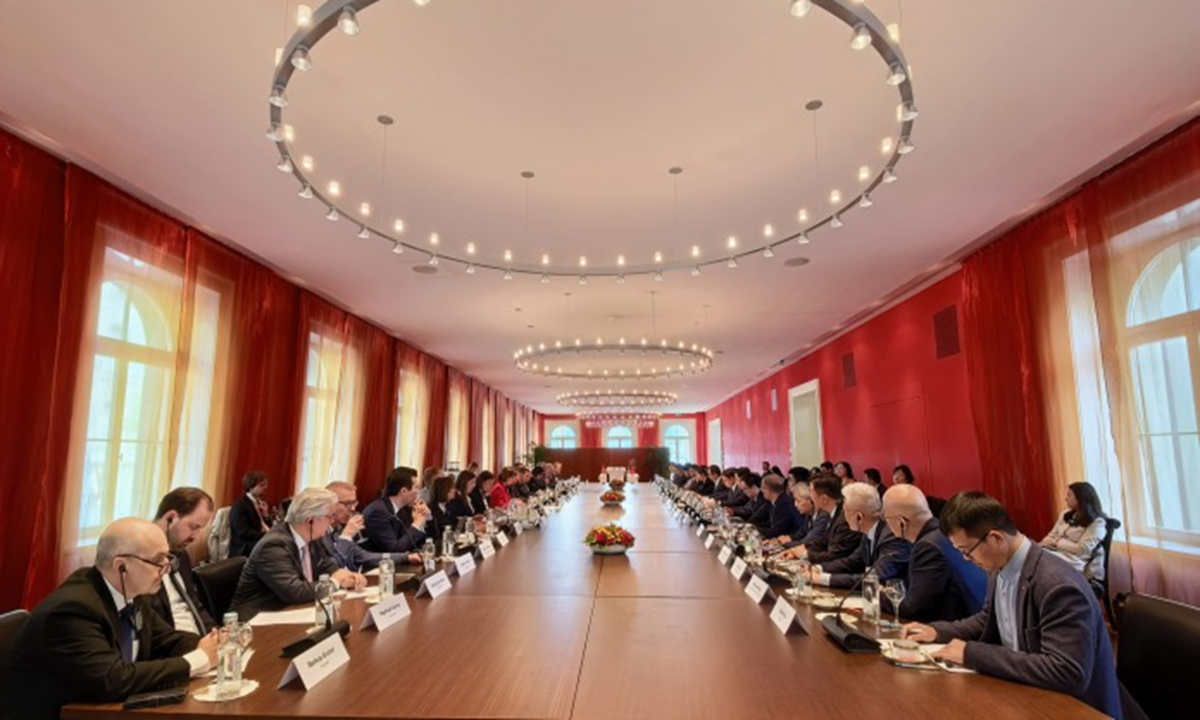
Officials from China and Switzerland hold talks during the 27th China-Switzerland joint economic and trade commission meeting in Bern on April 17. Photo: Website of China's Ministry of Commerce
China is willing to advance negotiations on upgrading the China-Switzerland free trade agreement (FTA), and a high-level FTA will inject new momentum into trade, investment and innovation cooperation between the two countries, Chinese Vice Commerce Minister and deputy China international trade representative Ling Ji said during a bilateral trade meeting in Bern, Switzerland, according to a statement seen on the Ministry of Commerce's website on Saturday.
Amid rising protectionism and uncertainties in the world, the efforts of China and Switzerland to upgrade their FTA not only represent a pragmatic deepening of bilateral economic and trade relations, but also open up new imaginative space for China-Europe cooperation amid an uncertain international environment.
China and Switzerland officially signed the FTA in July 2013, and it came into force in July 2014. During the more than 10 years since its implementation, bilateral trade and investment have grown rapidly.
Between 2014 and 2024, total bilateral trade increased by 44.1 percent, with an average annual growth rate of 4.4 percent. The FTA has facilitated tariff reductions and exemptions for a wide range of products from both sides, while also expanding its coverage from traditional areas such as goods, services and investment promotion to deeper economic and trade issues including intellectual property and competition.
It was against this backdrop that, in September 2024, China and Switzerland officially launched negotiations to upgrade their FTA. In the current climate of sluggish global economic growth, accelerated supply chain restructuring, and green and digital transformations, businesses need a predictable investment environment more than ever before. The signals of expanding opening-up and long-term certainty that China has sent through this round of negotiations are valuable and positive assets which are worth noting.
The economic structures of both countries are optimizing in response to global trends. Switzerland holds world-leading advantages in precision manufacturing, life sciences, fin-tech, and clean technology, while China has developed unique strength in the digital economy, new energy, artificial intelligence application, and developing its vast domestic market.
Their complementarity is becoming increasingly evident. An upgraded China-Switzerland FTA would be well positioned to bring cutting-edge areas such as high-end manufacturing, the digital economy, and green low-carbon development into a tighter institutional framework, fostering deeper collaboration between the two countries in technological research and development as well as two-way investment.
What makes the China-Switzerland FTA upgrade even more noteworthy is its demonstration effect. Despite having different social systems and being at different stages of development, China and Switzerland have consistently put pragmatism first, struck a proper balance between competition and cooperation, and built a long-term, stable, and mutually beneficial partnership. This path offers a valuable model for China's cooperation with other countries, especially European ones.
The practice of mutually beneficial cooperation between China and Switzerland fully shows that European countries can carry out various forms of pragmatic cooperation with China in accordance with their own national conditions and development needs, so as to achieve complementary advantages and share opportunities.
The China-Switzerland FTA upgrade is not an isolated move. Recent breakthroughs in market access between China and Central and Eastern European countries - such as Romania in agricultural products and food -show the potential and opportunities in China-Europe cooperation.
Last week, the General Administration of Customs announced that China has approved imports of dairy products from Romania. Together, these developments signal that China-Europe cooperation is blossoming on multiple fronts and advancing in all directions, moving beyond traditional areas and extending into more diverse and cutting-edge fields.
Despite the complex and volatile international situation and increased geopolitical uncertainties, China-Europe cooperation has a broad foundation of interests and huge development potential and has shown stronger resilience in the face of multiple pressures. Taking the upgrading of the China-Switzerland FTA as an opportunity, it is hoped that more European countries could see the dividends of pragmatic cooperation, promoting new breakthroughs in China-Europe cooperation in a broader range of areas.