


A few months ago, China's Ministry of Industry and Information Technology, together with five other government departments, released the country's first batch of flagship smart factories, with 15 companies selected nationwide.
Construction machinery and agricultural machinery manufacturer Zoomlion made the list with its Excavator Shared Manufacturing Smart Factory project.
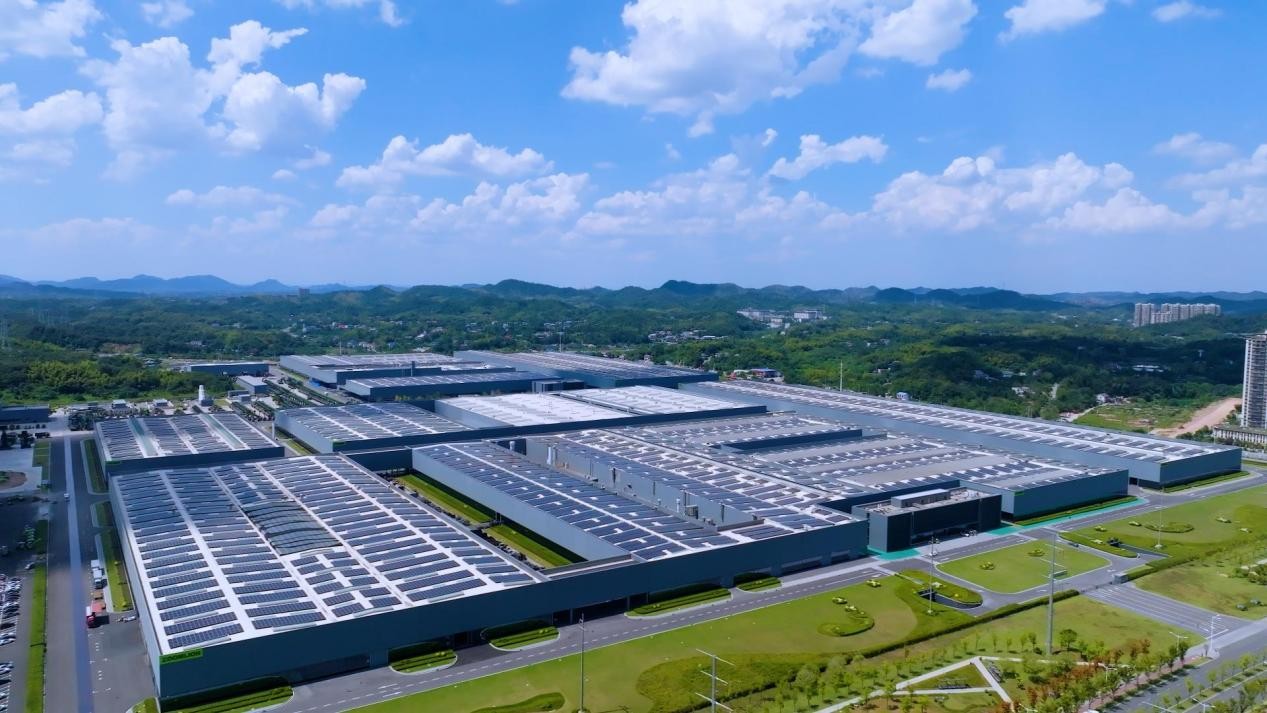
Pictured is Zoomlion's Excavator Shared Manufacturing Smart Factory. (Photos from the official website of Zoomlion)
What truly defines this facility as "smart?"
"At its core, one of the most important things we've done is to give machines a 'brain' and 'eyes'," said Ouyang Shuxun, deputy manager of the process department at Zoomlion's earthmoving machinery division.
Traditional construction machinery workshops are often characterized by noise, crowding and heavy reliance on manual labor for critical tasks such as welding, component flipping and assembly. This approach not only hampers production efficiency but also introduces significant safety risks.
In contrast, at Zoomlion's intelligent factory, the industrial internet is deeply integrated, with over 300 intelligent production lines operating at full capacity. Visitors are immediately impressed by its clean, tidy and high-tech environment, free from loud noise and dust pollution.
The operational contrast is even more pronounced. Hundreds of industrial robots execute tasks with pinpoint precision, working alongside nearly 300 automated guided vehicles (AGVs) to transport multi-ton structural components directly to designated workstations.
Powered by advanced AI, these production lines enable seamless switching between products ranging from 5 to 30 tons without interruption.
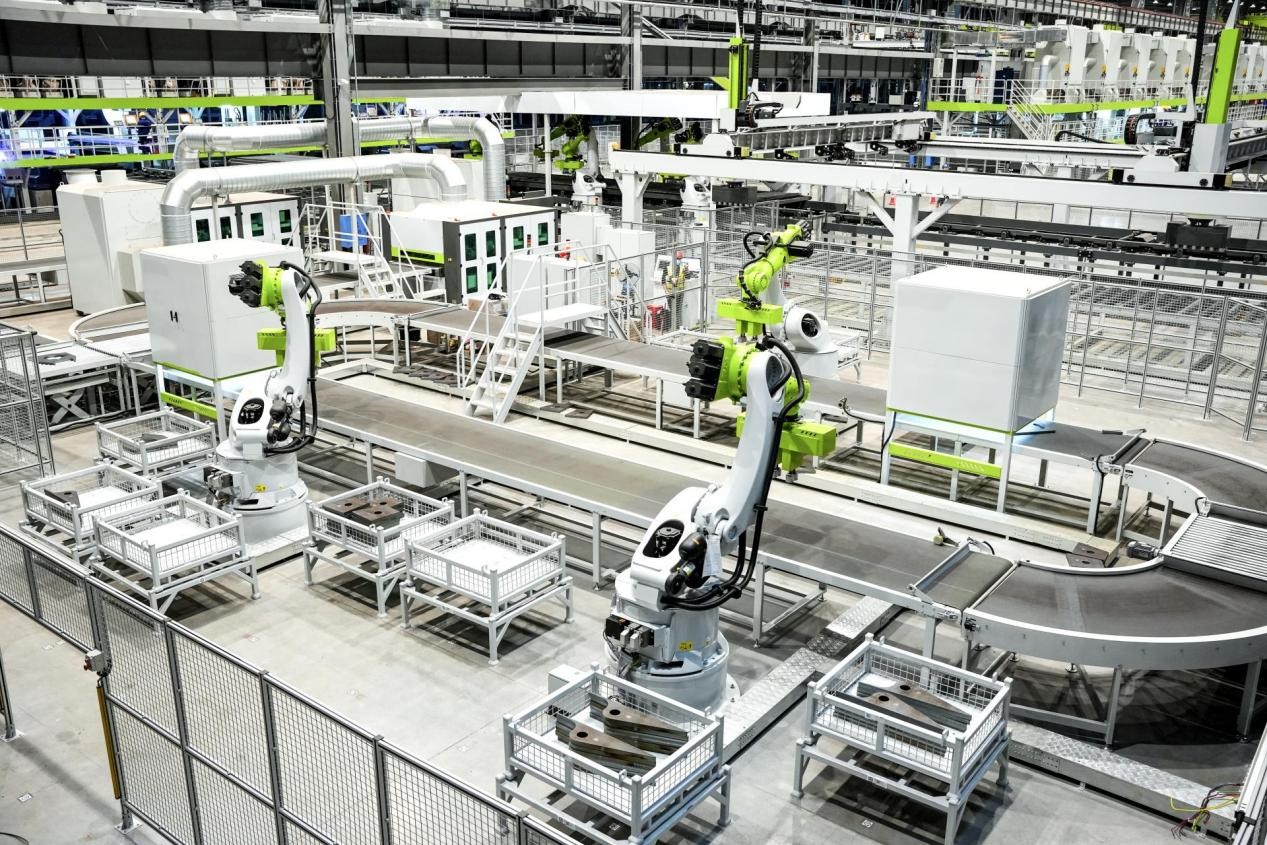
Pictured is the factory floor of Zoomlion's Excavator Shared Manufacturing Smart Factory.
Production efficiency has seen dramatic improvements.
While traditional construction machinery enterprises mostly adopt a build-to-stock model, the digital and intelligent upgrade at Zoomlion has pioneered an innovative build-to-order system.
Upon receiving customers' personalized requirements, the system automatically generates production orders.
The entire process from steel plate cutting to final machine roll-off takes only 6.5 days, and customized products can be delivered to domestic clients in as little as two weeks.
A smart factory is not simply a collection of advanced equipment. It requires seamless coordination among vision systems, laser technologies and robotics.
"We first strengthened core processes, then built cross-disciplinary teams, bringing together welding engineers, robotics engineers, vision specialists and algorithm engineers to tackle challenges collaboratively and bridge knowledge gaps across fields," Ouyang explained.
The smart factory has also built a fully connected information platform covering the entire chain of research and development (R&D), production, supply, sales and service.
It enables real-time data sharing across core systems including R&D and design, manufacturing execution, supply chain management and quality control.
Design modifications are accurately synchronized to the production line, driving a 70 percent improvement in efficiency.
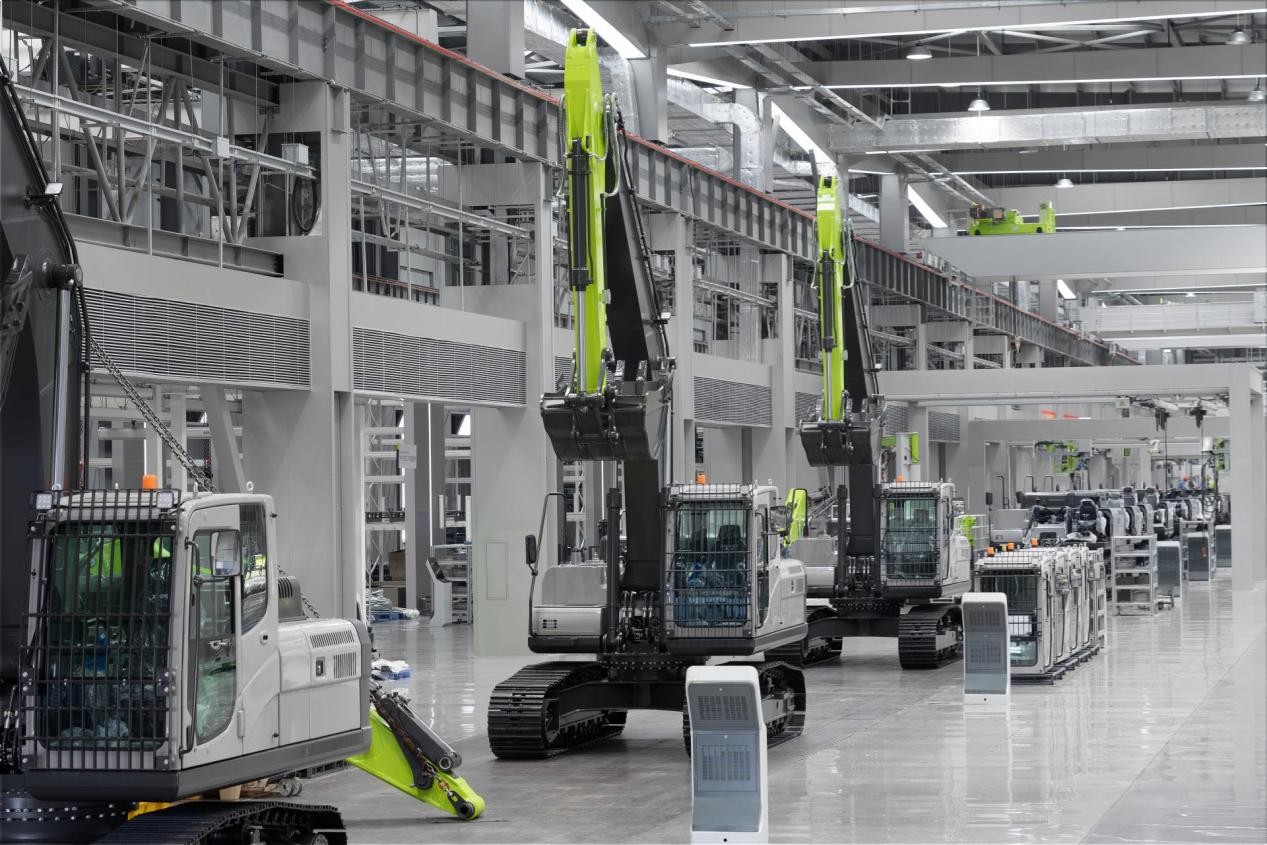
Excavators roll off the production line at Zoomlion's Excavator Shared Manufacturing Smart Factory.
Today, the smart factory has achieved full-process automation and intelligence. From steel plate cutting, bending and beveling to welding, machining, automotive-grade coating and finally intelligent assembly and testing, the facility rolls out one finished product every six minutes on average.
AI is also deeply embedded throughout production: It recommends optimal process plans for new products, while robot programming follows a "best solution plus fine-tuning" model, increasing the yield rate by 15 percent.
Beyond these impressive figures, a new model of "shared manufacturing" is also drawing attention.
The construction machinery industry has long grappled with the challenge of high product variety and small batch sizes.
Take excavators for instance. They involve 4,000 to over 6,000 different components and production must handle mixed models of various tonnages. To address this, Zoomlion has adopted a sharing-based model.
Within its industrial park, the excavator factory's three shared core manufacturing facilities, a medium- and heavy-plate blanking center, a high-strength steel blanking center and a stamping center, serve not only its own production but are also open to neighboring facilities for cranes, concrete pump trucks and aerial work platforms, enabling cross-product collaboration.
The benefits are substantial: Steel utilization exceeds 90 percent, while the construction cost of the smart factory cluster has been reduced by 15 percent.
Powering this entire ecosystem is an AI-driven "industrial brain" that oversees more than 6,000 process routes for over 100 excavator models, enabling seamless product changeovers with zero downtime.
This shared manufacturing solution has been successfully replicated and deployed across more than 20 smart factories worldwide, driving new momentum for the entire industry.
By thoroughly optimizing key processes and enabling seamless data flow across equipment, intelligent shared manufacturing is set to advance the sector with even greater strength and confidence.