


(Illustration: GT)
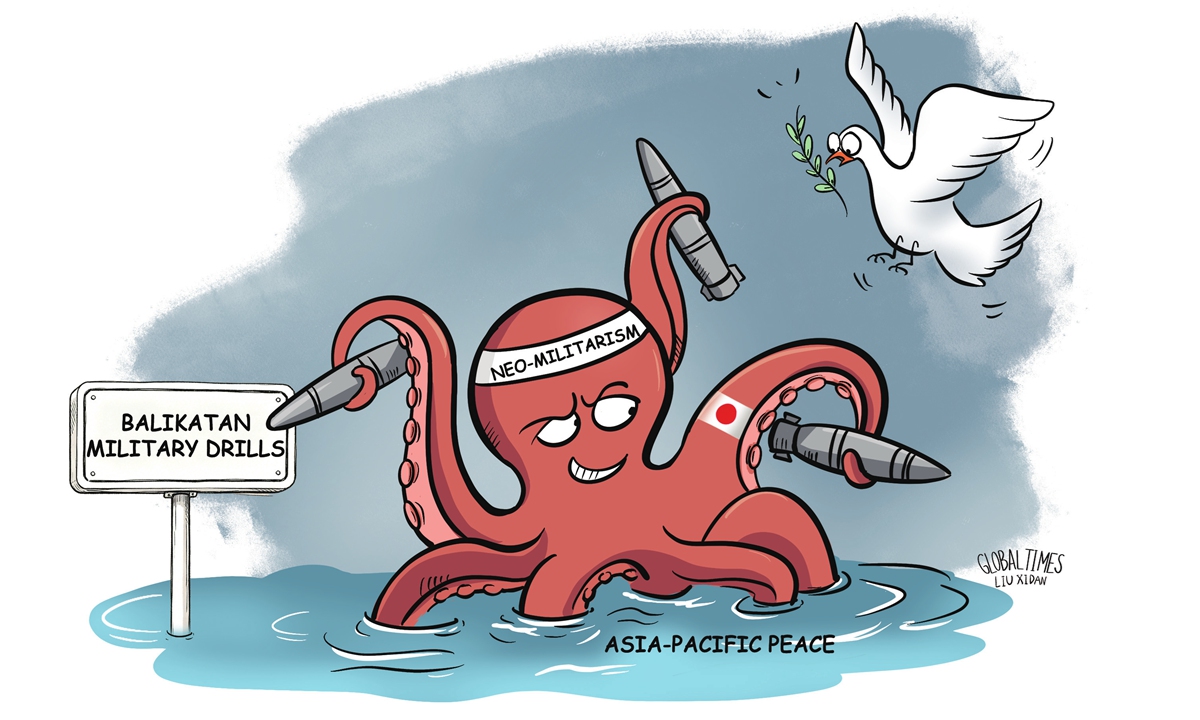
Japan is taking part in the annual Balikatan military drills led by the Philippines and the US starting Monday. This marks Japan's full and high-profile participation in the military exercises for the first time, rather than participating as observers or in noncombat roles.
This is a calculated step in Japan's strategy of breaking through its "exclusively defense-oriented policy," hollowing out the pacifist constitution, and pursuing "national normalization" and military expansion. The danger this poses warrants the vigilance of the entire Asia-Pacific region.
As a country defeated in World War II, Japan's pacifist constitution clearly renounces the right to war and restricts overseas military deployment. In the past, Japan mainly participated in military drills under the banner of humanitarian assistance and disaster response. This time, however, Japan has become the third-largest troop contributor, with personnel drawn from a broad cross-section of the Ground, Maritime and Air Self-Defense Forces joining multinational maritime missions, amphibious warfare, counter-landing live-fires, maritime strikes, and integrated air and missile defense, among others. It is reported that Japan will even deploy and test the offensive weapons, including the Type 88 ground-based anti-ship missile system.
Zhang Junshe, a Chinese military affairs expert, told the Global Times on Monday that "Japan has long been chipping away at its pacifist constitution in a 'salami-slicing' manner. It aims to use the drills to project military force abroad, enhance its combat capabilities, and pave the way for larger-scale overseas military operations in the future."
In recent years, Japan has been advancing its "military normalization.'' From lifting the ban on collective self-defense in 2015 to signing the Reciprocal Access Agreement with the Philippines in 2024 and accelerating the deployment of offensive long-range missiles in March this year, these moves have gradually equipped the Self-Defense Forces with overseas operational capabilities, laying the institutional and operational groundwork for deeper involvement in the drills.
What, then, will a Japan increasingly unshackled from its postwar constraints bring to the Asia-Pacific? Lü Chao, a professor at the Liaoning Academy of Social Sciences, told the Global Times that Japan's participation in such drills itself constitutes strategic signals. It is showing the world that it is gradually breaking away from the postwar security framework and moving toward transforming the Self-Defense Forces into a "regular military," while also signaling its intention to expand its military presence and assume a greater security role in the Asia-Pacific. The question is: what kind of "security" can Japan actually bring to the region?
Japanese officials claimed that the purpose of the drills is to deepen cooperation with other "like-minded" participants and reinforce commitments to the security of the South China Sea, thereby "contributing to the creation of a security environment that does not tolerate unilateral changes to the status quo by force." However, through military expansion and deeper involvement in regional strategic competition, Japan itself is increasingly becoming a challenger to the very "status quo" it claims to uphold.
Japan's right-wing forces have long hyped the so-called geopolitical threats in the Asia-Pacific to justify military buildup and expansion. "Through participation in these exercises, Japan is attempting to turn the Philippines into a forward foothold in the South China Sea, paving the way for future involvement in contingencies in the Taiwan Straits or the South China Sea," Lü added. This not only exacerbates regional bloc confrontation but also exposes the Asia-Pacific to new security risks.
From signing defense deals with the Philippines and Australia to its deep involvement in these drills, Japan is leveraging Washington's Indo-Pacific strategy agenda to build its own military "small circles" in the Asia-Pacific region, binding other countries to its bandwagon of military expansion.
When a country that has failed to deeply reflect on its militarist past once again sets foot on lands it once invaded, who can guarantee that history will not repeat itself? The Philippines, instead of remaining vigilant, has chosen to deepen its ties with Japan's neo-militarism. This is nothing short of "making a pact with the tiger for its skin." China's Ministry of Foreign Affairs has warned: "For countries that tie their own security to others, it is important to bear in mind that this may very well backfire."
The peace of the Asia-Pacific must be safeguarded collectively by regional countries. The international community must remain highly vigilant against Japan's military expansion, resolutely oppose any actions that undermine regional peace, uphold the victory of World War II, and ensure that the peaceful foundation of the Asia-Pacific is not easily erased.