


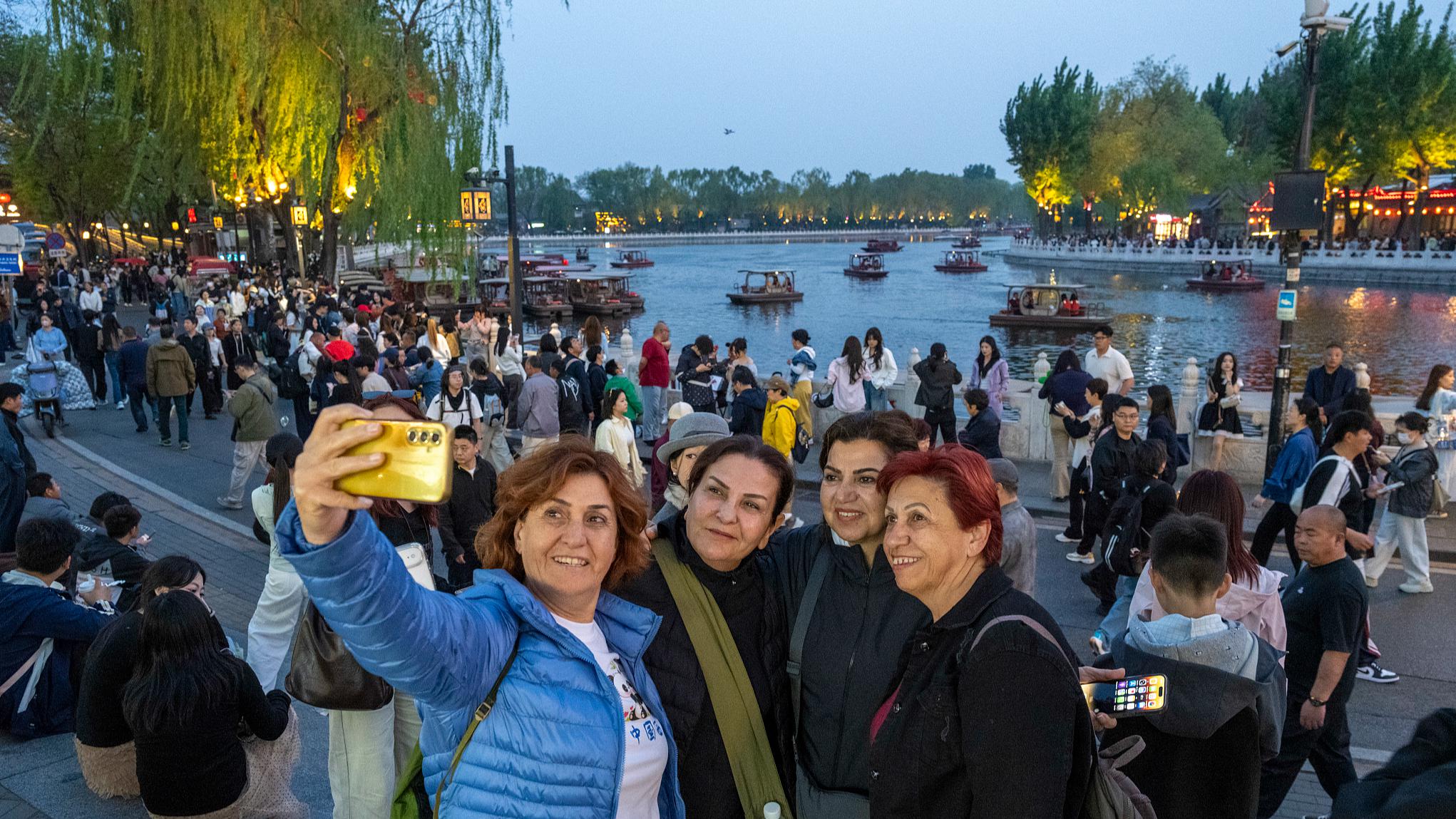
Foreign tourists visit the Shichahai Scenic Area at night in Beijing, China, April 22, 2026. (Photos: CFP)
To the buzzwords arising from China and becoming part of the global parlance – such as win-win, can-do and China speed – there's now a new addition: the Chinese sense of security or China safety.
Several things have contributed to this. First and foremost is the remarkable surge in tourism following various relaxations in visa policies, from visa-free admissions for certain countries to a 240-hour visa-free transit for some tourist groups, to visa-free travel to select cities for groups coming via Hong Kong or Macao.
The Chinese Culture and Tourism Ministry recorded over 150 million inbound tourist trips last year, 17% more than in 2024. This included 30 million who availed of the visa-free policies. Among them were vloggers, bloggers and professional tourists who highlighted how stress-free it was to travel in China. Apps make hotel and flight bookings, payments and translation easy, and the cherry on this seamless travel cake is the sense of safety visitors experience: You can walk at night freely without untoward incidents, parcels and belongings stay intact where you leave them, and online payments are secure.
The sense of a safe China has also been boosted by the Gallup Global Safety Report 2025 that surveyed over 145,000 adults in 144 countries and territories, and found China to be one of the safest places on earth, scoring 93 out of 100 on the Law and Order Index.
This is further borne out by domestic statistics that show a significant decline in crime in 2025. Data from the Ministry of Public Security indicates a 12.8% reduction in the number of criminal cases filed in 2025, compared to 2024. Traditional crimes such as human trafficking dropped by 40.7%, theft, robbery and fraud by 21.2%, and violent crimes by 4.7%.
To someone like me, who lived in China for over a decade, these are not mere figures. They are lived-in experiences that go beyond official data. When I started living in Beijing, my front door was always kept unlocked at night so that my dog walker could come in in the morning without my having to get up after a late-night shift.
I often worked night shifts that ended after midnight. When I waited for the bus, there was no sense of fear but kinship as I watched dozens of women going home on their bicycles after having finished their work in the neighborhood hotels and restaurants. Sometimes I walked home and the only people who accosted me were newcomers to the area, asking for directions.
When I took the last metro at night, the sense of security on the empty train was no surprise. What was surprising was the people manning the station. They were mostly youngsters and women and I marveled at the overall system that produced this secure environment without a single gun or even a truncheon visible anywhere.
A colleague, who was from Russia, told me she loved the subway in China. Besides being ubiquitous, efficient and cheap, it was absolutely safe. "We had terror attacks in Russia and my mother would call me to say, I hope you are not taking the subway. There's a bomb alert," she told us.
Another colleague, a young woman from France, told us how she had been followed to her apartment gate in Paris by a stranger. "When I ran inside and closed the security screen door, he spat and made threatening gestures before leaving," she said. "I have never felt as safe in Paris as in Beijing."
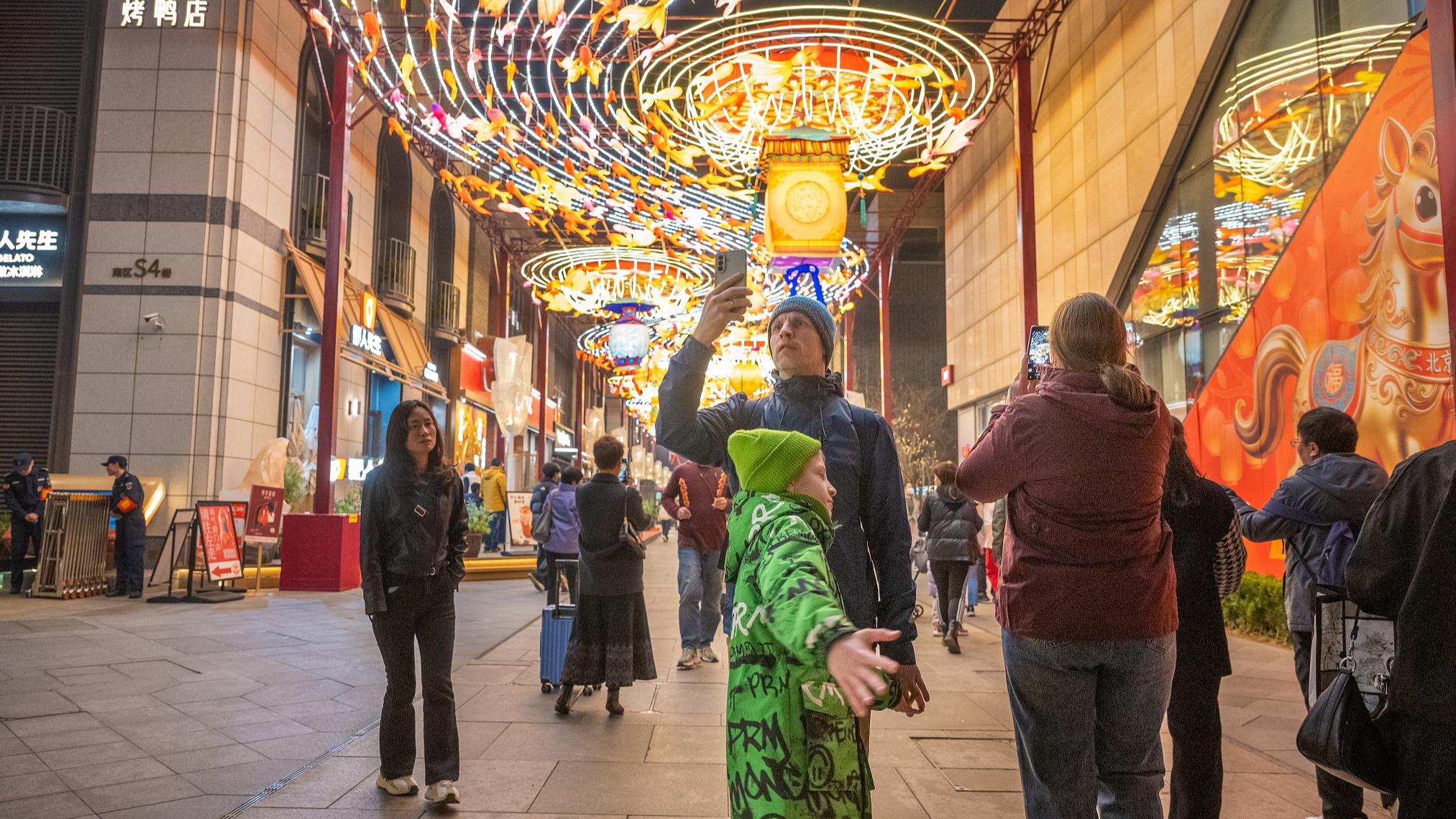
Foreign tourists walk along Qianmen Street, Beijing, China, March 21, 2026.
As we, long-term residents in China, see it, "China safety" is not a recent phenomenon. It has been there for a long time. It is only that people have started talking about it now. The work to ensure a safe country started decades ago, painstakingly and consistently.
While the Confucian ideology has inculcated in the Chinese DNA a sense of humanity and respect for law and order, the authorities have also been working in various ways to nudge residents toward civilized behavior. In which other country do you get messages from your telecom provider when you are traveling to a different province or even country, reminding you to follow the law of that place?
For those talking about CCTVs and "surveillance," as a long-timer in China, I would like to point out that it is not irrational. The security cameras, criticized by some as infringing on people's freedom, play an important role in addressing crime. In 2024, over 99% of homicides were solved, the highest level not only in China's history but among the highest in the world.
From my personal experience, I regard the "surveillance" as more of a security system keeping track of non-locals' arrivals and legitimate stay to ensure there is no overstay or crime, something that is a global problem today.
During my first year in Beijing, about a month before my visa was to expire, I experienced the proverbial "midnight knock" on my door.
"Who is it?" I asked on the intercom. "Open the door," came the answer. "It's the police."
There were three people outside, two men and a woman. They declined to come in and asked to see my passport. When I told them I had submitted it to the Public Security Bureau to get the visa renewed, they asked for the receipt, took a photo of it and left without ado, telling me to get the new visa registered at the local police station.
It opened my eyes to how serious they were in China about security.
After that meeting, I learned what I was expected to do. So, every time I applied to renew my visa after that, I would go to the police station on my own and show them the receipt.
Others may call it "surveillance." I regard it as mutual give and take. As an expat living in a foreign country, I respect the local laws and regulations; and the police respect my legal rights and ensure my safety.
My "China safety" story would not be complete without mentioning my visit to Lhasa, capital of Xizang Autonomous Region. There are still stories circulating on the Internet about how some foreign visitors said they were followed everywhere they went and even people being "deported."
But when I visited Lhasa to attend a forum, I went out in the night to look around and eat local food. I did not think of informing anyone and no one stopped or followed me. At the 7th-century Jokhang Temple, I saw believers prostrating themselves and circumambulating. No one stopped them either. At the local stall where I ate, I met two young Tibetan women, one of whom had just cleared the exam to join local administrative services and was eagerly waiting for her posting.
The winds of change are blowing through everywhere. While some changes may be good and some may be bad, you need to see these changes for yourself and judge for yourself.