


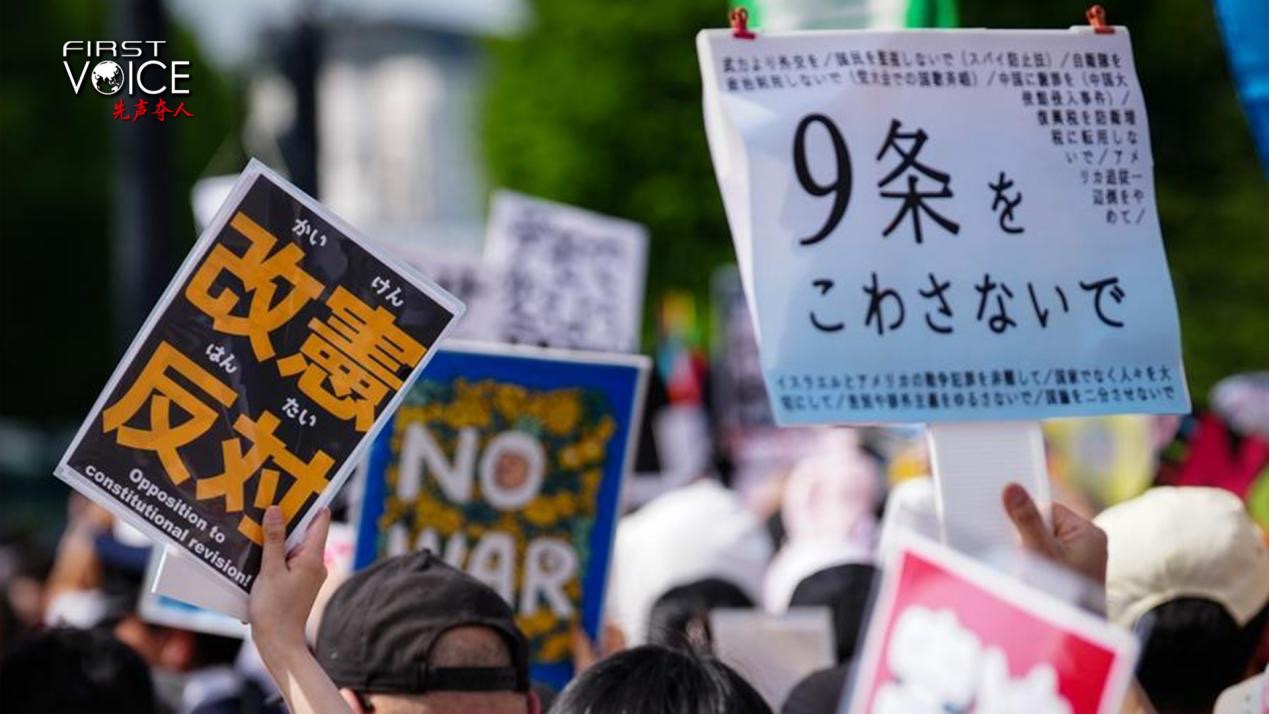
People gather around the parliament building to protest attempts of the government of Japanese Prime Minister Sanae Takaichi to revise the country's pacifist constitution and to call for the protection of Article 9 in Tokyo, Japan, April 19, 2026. (Photos: Xinhua)
Japan is becoming increasingly aggressive in its pursuit of nuclear power. The Japanese government convened its first expert panel meeting on Monday to consider revisions to the three security documents, with its Prime Minister Sanae Takaichi repeatedly attempting to revise the long-standing Three Non-Nuclear Principles.
In response to Japan's nuclear ambitions, China's Foreign Ministry released a working paper outlining its position on the issue on Thursday.
As the paper noted, Japan has, in recent years, pushed ahead with revisions to its National Security Strategy and other key security documents, as well as to the Three Principles on Transfer of Defense Equipment and Technology. Its defense budget has risen for 14 consecutive years, with the 2026 defense budget surpassing 9 trillion yen.
At the same time, Tokyo has begun opening the door to the export of offensive weapons. These developments together point to a clear trend: the revival of a new militarism.
Tokyo's latest "security" moves have further revealed a troubling pattern: Instead of reflecting on history and preserving the hard-won postwar order, the country is edging toward a more dangerous and revisionist course.
The panel meeting on revising the three security documents indicates that Japanese senior officials are accelerating a strategic shift with potentially profound consequences for East Asia. This is troubling not only because of Japan's war history, but because it sends the wrong signal at a time when the international community is already facing deep uncertainty over arms control and non-proliferation.
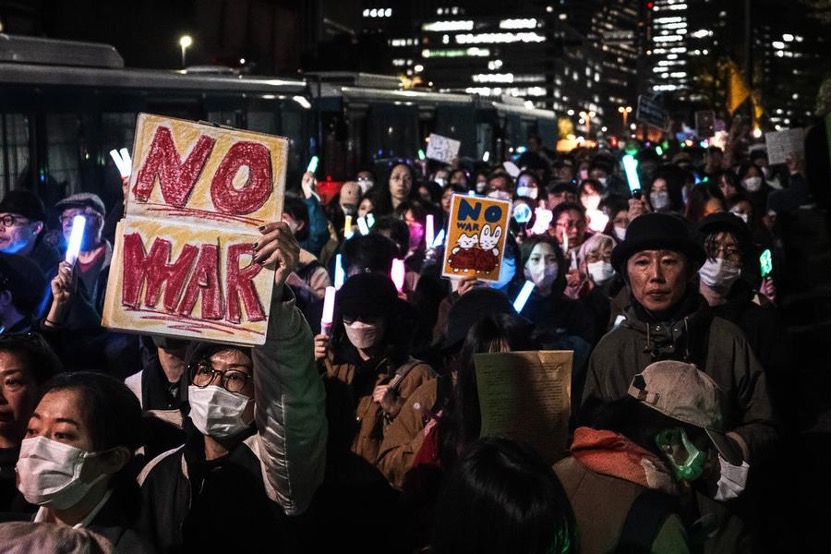
People participate in a protest outside the parliament building in Tokyo, Japan, April 8, 2026.
Japan has often proclaimed itself a peace-loving country that draws lessons from the tragedy of the Second World War and the atomic bombings of Hiroshima and Nagasaki. Yet its current rhetoric and policy trajectory suggest a growing willingness to test the limits of that identity.
This exposes Japan's hypocrisy in its so-called commitment to nuclear arms control. On the one hand, Japanese leaders continue to speak in the language of peace, restraint, and responsible state behavior. On the other hand, they appear willing to weaken the very principles that have kept Japan formally outside the nuclear weapons club for decades.
This is a direct challenge to the international nuclear non-proliferation mechanism built around the Treaty on the Non-Proliferation of Nuclear Weapons. The treaty is one of the pillars of global strategic stability. Its credibility depends on the willingness of states to respect both its legal framework and its underlying spirit.
Japan, as a country rebuilt under a pacifist constitution, has long benefited from that framework. But if it now moves closer to nuclear normalization, it is undermining the historical foundation of the postwar order itself.
Japan's nuclear ambition also weakens the common efforts of all countries to uphold the international nuclear non-proliferation system and endangers the hard-won peace and prosperity that emerged after the Second World War.
There is also a domestic political danger. Allowing right-wing forces to drive the development of stronger offensive capabilities, while treating nuclear possession as a subject for open debate, risks dragging Japan further down a path of remilitarization. That would not make the region safer. It would fuel mistrust, trigger greater vigilance among neighboring countries, and increase the likelihood of an arms race that no one can truly control.
As the paper noted, Japan must learn from history and decisively sever itself from new militarism. It should faithfully uphold its Peace Constitution and the Treaty on the Non-Proliferation of Nuclear Weapons, stop the trend of remilitarization, and abandon any nuclear ambitions. Anything less would damage the international order that has helped secure peace and prosperity since 1945.
The international community must take Japan's nuclear ambition seriously. When a country with Japan's history begins to loosen its nuclear red lines while expanding its military reach, that is not an internal matter alone. It is a warning sign with implications far beyond Japan's borders.