


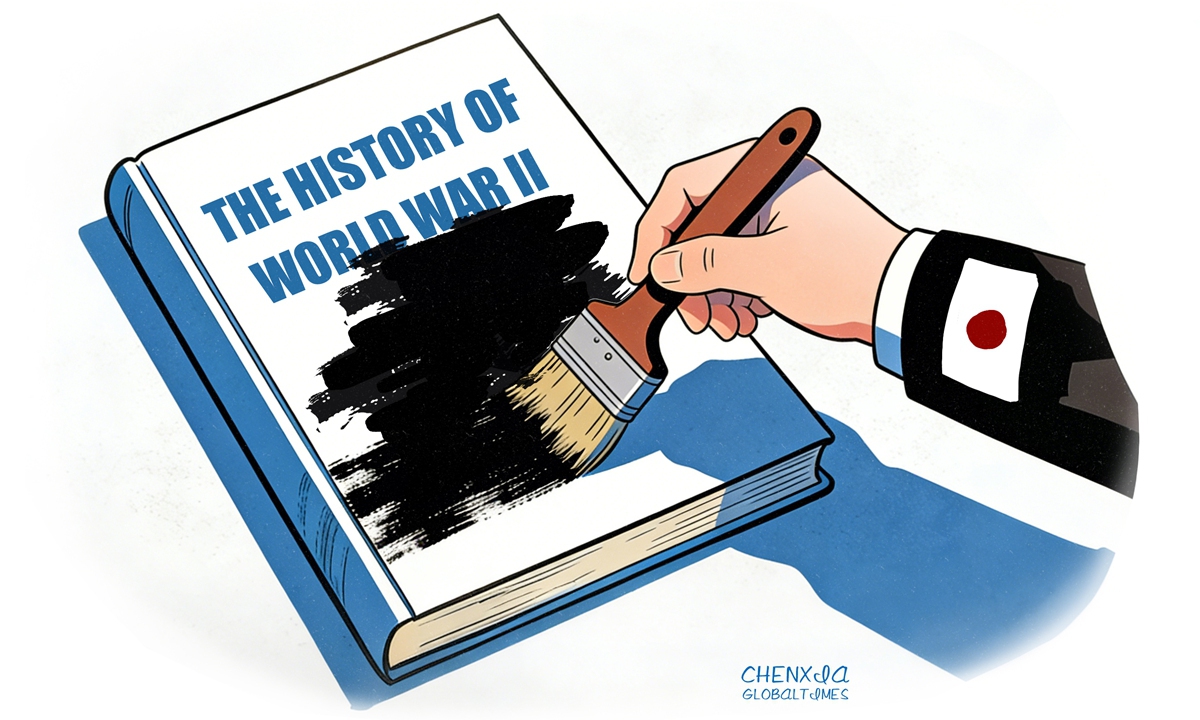
Illustration: Chen Xia/GT
May 3 marks the 80th anniversary of the opening of the Tokyo Trial. From May 1946 to November 1948, the International Military Tribunal for the Far East, composed of representatives from 11 countries including China, the US, the UK and the Soviet Union, conducted legal proceedings against Japanese militarist aggression. This unprecedented international trial not only punished Class-A war criminals such as Hideki Tojo, Koki Hirota, and Iwane Matsui in accordance with the law, but also laid an important foundation for the postwar international order and global peace.
The Tokyo Trial characterized Japan's expansion from 1928 to 1945 as an act of aggression and defined the planning, preparation, initiation or waging of a war of aggression as "crimes against peace" under international law. It thereby affirmed the illegality of Japan's colonial aggression during World War II. The Cairo Declaration signed by China, the US, and the UK explicitly stated: "The Three Great Allies are fighting this war to restrain and punish the aggression of Japan. They covet no gain for themselves and have no thought of territorial expansion." Article 10 of the Potsdam Proclamation also declared: "We do not intend that the Japanese shall be enslaved as a race or destroyed as [a] nation, but stern justice shall be meted out to all war criminals, including those who have visited cruelties upon our prisoners." It was on the basis of these provisions that the Tokyo Trial determined that Japan's war of aggression constituted "crimes against peace" and "crimes against humanity" - acts that violated human conscience and reason. Regardless of whether they were explicitly codified in Japan's domestic law or international treaties at the time, the criminal nature of these acts had long been established.
During the Tokyo Trial, many war victims and witnesses traveled to Tokyo to testify and expose the atrocities and acts of aggression committed by the Japanese military. For example, Qin Dechun, a witness to the July 7th Incident, testified about the Japanese army's role in provoking the incident and occupying North China; Puyi, the last emperor of China, testified regarding Japan's establishment of the puppet state of "Manchukuo" in Northeast China and its colonial rule. Meanwhile, survivors of the Nanjing Massacre such as Wu Changde and Shang Deyi, along with several foreign witnesses including John Rabe, George Fitch and Robert Wilson, revealed through their firsthand experiences the atrocities committed by the Japanese invaders. Together with extensive documentary evidence from Japan, this testimony played a crucial role in the tribunal's decision to sentence Iwane Matsui, the principal perpetrator of the Nanjing Massacre, to death.
Today, reaffirming the Tokyo Trial's historical value and profound implications,, while upholding the legal characterization of Japan's crimes of aggression, holds great contemporary relevance. It is essential to maintaining the postwar international order and defending justice for humanity. The concepts of "crimes against peace" and "crimes against humanity" were formally established through the Nuremberg Trial and the Tokyo Trial. These two landmark international judicial practices clarified the boundaries of sovereignty and state responsibility, transforming the protection of human rights from abstract moral declarations into binding norms of international law, and laying the legal foundation for "crimes of aggression" and "crimes against humanity" in modern international criminal law. In 1974, the UN General Assembly adopted the Definition of Aggression, which further clarified that, under international law, "aggression is the use of armed force by a State against the sovereignty, territorial integrity or political independence of another State, or in any other manner inconsistent with the Charter of the United Nations, as set out in this Definition."
For Japan, the Tokyo Trial contributed, to some extent, to the emergence of Article 9 of its "pacifist constitution." The legal consensus that "a war of aggression is a crime" constitutes an insurmountable legal boundary that curbs the attempts of Japanese right-wing forces to overturn historical verdicts. It is important to note that since the 1980s, amid recurring trends such as frequent visits by Japanese political figures to the Yasukuni Shrine, the revisions of history textbooks by Japan's Ministry of Education, Culture, Sports, Science and Technology, and the denial of Japan's wartime aggression and atrocities, and voices challenging the legal conclusions of the Tokyo Trial have continued to spread in Japan. This is an extremely dangerous development. The international community should remain highly vigilant against the dangerous attempts by Japanese hardline right-wing figures, including Prime Minister Sanae Takaichi, who seeks to deny the legal conclusions of the Tokyo Trial and undermine the postwar international order, and resolutely refute and resist such efforts.
The authors are, respectively the director of the Red Culture Research Institute of Changzhou University, former curator of the Memorial Hall of the Victims in Nanjing Massacre by Japanese Invaders; and a researcher at the Red Culture Research Institute of Changzhou University.