


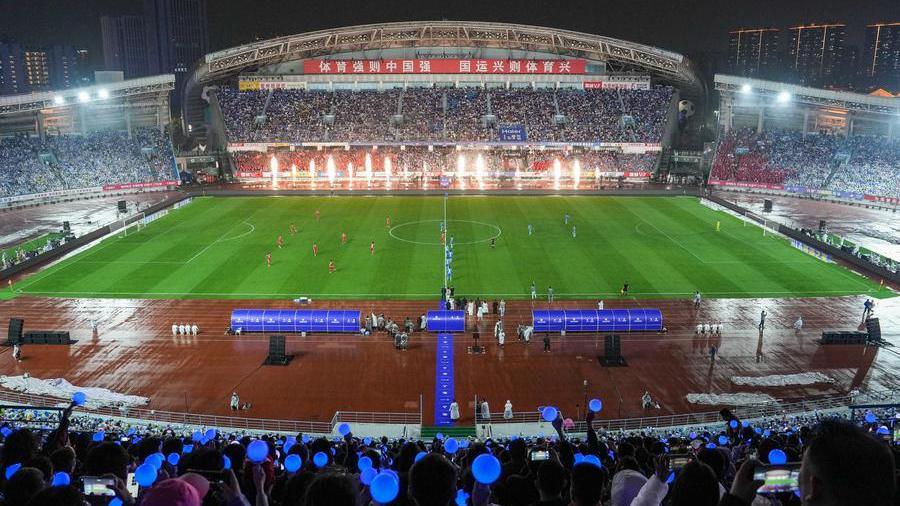
Players of Changzhou and Nantong wait for the kick-off of their opening match of the 2026 Jiangsu Football City League in Changzhou, east China's Jiangsu Province, April 11, 2026. /Xinhua
Editor's note: Deng Liuchun, a special commentator for CGTN, is an associate professor of economics at Duke Kunshan University. The article reflects the author's opinions and not necessarily those of either CGTN or Duke Kunshan University.
On the evening of May 1, I joined a sea of blue at Shanghai Stadium to watch Shanghai Shenhua's football match against Chengdu Rongcheng. For home supporters, the ending was painful: Chengdu scored twice in stoppage time to secure a 3-2 victory. But as an economist, I left the stadium thinking less about the scoreline than about the economy unfolding around it.
The match was economically significant. Official and third-party figures put attendance at 61,815, including roughly 8,000 visiting Chengdu supporters. It was estimated that spending directly associated with the event reached 135 million yuan (roughly $19.77 million), while the broader economic pull was estimated at 375 million yuan, supporting an estimated 1,533 jobs. These figures should be read as estimates rather than precise causal measurements, but they indicate how a major sporting event can extend demand well beyond ticket sales.
This is not merely a story about football. It illustrates a broader shift in China's holiday economy: People are increasingly traveling not only to visit places, but to participate in events. A football match, concert, music festival, marathon, night market or immersive exhibition can now become the anchor around which households organize transport, hotels, restaurants, shopping and leisure. In this sense, the ticket is no longer merely an entry pass. It is the starting point of a wider consumption chain.
The broader May Day holiday data point in the same direction. China's Ministry of Transport estimated over 1.52 billion cross-regional trips during the holiday, a record high for the period. The railway system reached a particularly visible peak: China State Railway Group Co., Ltd. reported 24.8 million railway passengers on May 1, a new single-day record. These figures are important because mobility is the bedrock of service consumption. When people move across cities and regions, demand is transmitted to local businesses.
A notable feature of this year's holiday economy was the expansion of "new consumption scenarios." Datas from Meituan, a ticketing and services platform, show that searches for music festivals had quadrupled since April, suggesting that performances and live events are becoming important anchors for holiday travel. Other experiential activities – from handicraft workshops and travel photography, to hot-air-balloon rides – are also gaining traction. Taken together, these examples suggest that holiday consumption is becoming less centered on sightseeing alone and more about participation, experience and social sharing.
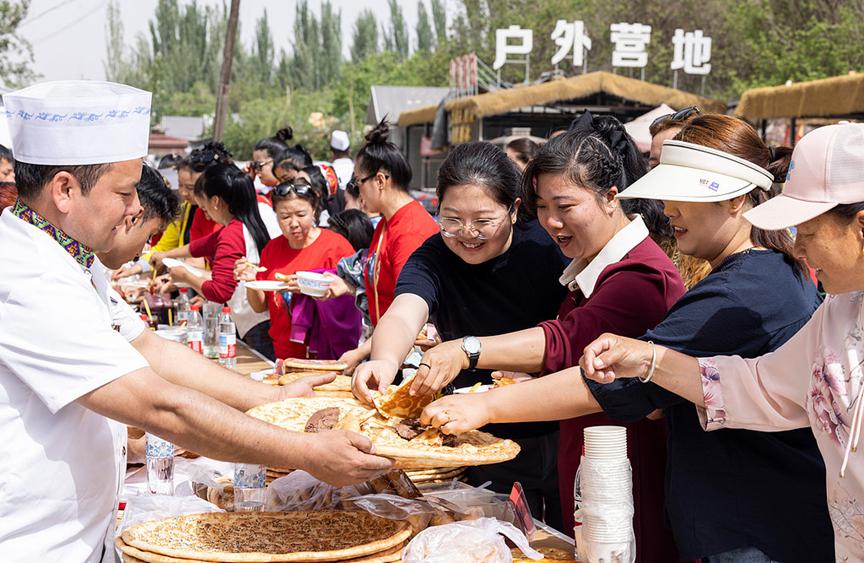
Visitors sample local delicacies such as the signature Naan, a baked flatbread, in Kuqa City, northwest China's Xinjiang Uygur Autonomous Region. May 1, 2026. /CFP
Digital technology is central to this transformation. Platforms reduce search costs, connect visitors with local services and help smaller providers reach consumers beyond their immediate markets. A typical holiday trip may begin with a short video, continue through online ticketing and hotel booking, rely on digital navigation and mobile payment, and end with social-media sharing that generates further demand. In this sense, the digital economy does not simply record consumption after it occurs. It increasingly shapes where people go, what they buy and how local businesses organize supply.
Artificial intelligence (AI) is beginning to add another layer to this process. Recent reports describe scenic areas and tourism platforms experimenting with AI-assisted itinerary design, smart guiding systems, translation devices and immersive visual technologies. The economic value of these tools should not be judged by novelty alone. Their promise lies in reducing information frictions, improving accessibility for different groups of visitors and enabling richer forms of engagement.
The employment implications deserve particular attention. Holiday consumption is often viewed as a short-term boost for restaurants, hotels and scenic spots, but event-based and digitally mediated consumption can support a broader range of occupations: stadium operations, logistics, crowd management, digital marketing, platform services, data analytics, AI design, smart retail, cultural-content production and urban safety management. These activities are not peripheral to the service economy. They are increasingly part of the strategic service sectors in which consumption, technology and employment interact.
The policy lesson is to turn temporary traffic into durable capability. Cities should improve event planning, transport coordination, digital infrastructure, platform governance and professional training for modern service occupations. They should also measure the full employment potential generated by major events, rather than focusing only on visitor numbers or ticket revenue.
China's vast domestic market remains a major source of economic resilience. Its potential will be strongest when mobility, experience, digital technology and employment creation reinforce one another.