


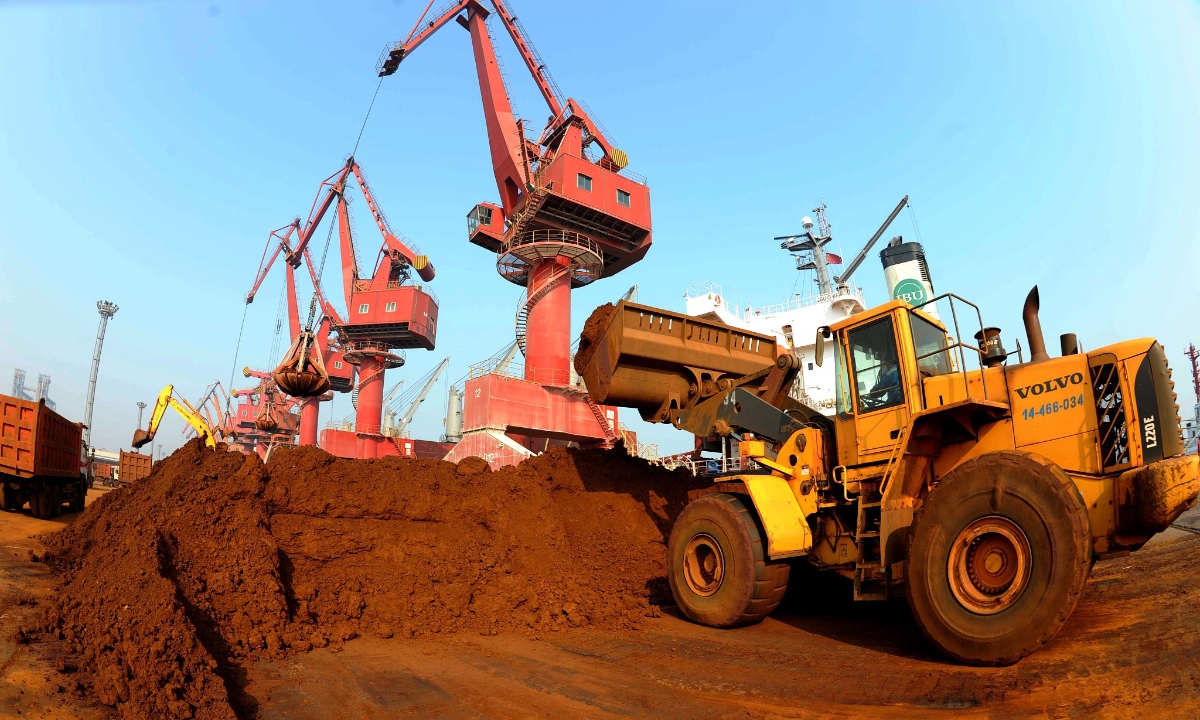
rare earth Photo:VCG
As G7 countries reportedly stepping up coordination on critical minerals and discuss ways to reduce reliance on China, Chinese experts warned that repeatedly framing China as the problem could leave Western supply chain initiatives trapped in a deadlock, arguing that “de-risking” should not come at the expense of free trade principles.
The Group of Seven (G7) countries are in talks to create a permanent secretariat to ensure initiatives to increase critical mineral supplies survive beyond the bloc's rotating presidencies, five sources familiar with the discussions said, according to Reuters.
Notably, France, which holds the G7's rotating presidency, called an online G7 meeting for Thursday [this week] to discuss how to break China's stranglehold on critical materials. The meeting is intended to prepare for a mid-June summit of the G7 leaders in the French town of Evian, Finance Minister Roland Lescure told reporters.
The move once again places China in opposition to Western rare earth supply chain strategies. While a Chinese expert noted the repeated push for the misguided approach of excluding China is precisely why some countries remain stuck in a deadlock, unable to find a viable solution. Expert also stressed that building independent supply chains does not conflict with upholding free trade.
The Reuters said developed countries around the world are seeking to cut their reliance on China, which dominates production of the minerals needed for defense, the energy transition and manufacturing.
According to Reuters’ another report on Tuesday, French Finance Minister Roland Lescure said that France has called an online meeting of G7 countries for Thursday to discuss how to break China's stranglehold on critical materials.
Lescure said one of the projects under consideration within the G7 is to ensure that alternatives are developed through international cooperation, per Reuters.
France's strategy, which intends to underpin the country's position in those talks, aims to rebuild a domestic rare earths and permanent magnets supply chain, curbing dependence on China for materials critical to electric vehicles, wind turbines, electronics and defense, the report said.
Efforts to build “independent” rare earth supply chains are, in themselves, understandable, as countries seek greater self-reliance and supply chain security, Jian Junbo, director of the Center for China-Europe Relations at Fudan University’s Institute of International Studies, told the Global Times. However, he criticized some Western countries for attacking China’s rare earth policies while using “de-risking” as a pretext to push supply chain restructuring that excludes China, saying such moves are driven more by political and security considerations than by genuine free trade principles.
Jian also noted it would be extremely difficult for Western countries to build an independent rare earth supply chain without China, as the industry involves not only mining, but also refining, processing and a complete downstream manufacturing system. “Even if Western countries step up domestic development or seek resource cooperation in third-party regions such as Africa, they would still face challenges including resource competition and limited reserves, making it far from certain that such efforts could fully meet their needs.”
Amid a growing number of Western initiatives on critical materials driven by “de-risking” from China, experts said it remains uncertain whether Western countries can truly forge a unified road map, as differences in economic interests, industrial needs and priorities over whose interests should come first could further complicate internal coordination.
The US and the EU last month agreed to deepen their coordination on critical minerals, such as lithium, cobalt and rare earths, per Reuters.
While two of the sources reached by Reuters familiar with the discussions said Europe had rejected the idea of single shared stockpile in favour of each country controlling its own reserves. European governments also do not want the US to lead the project because they are worried access to critical minerals could be restricted in a crisis, the sources said.
The International Energy Agency IEA declined to comment on the G7 talks. The OECD did not immediately respond to a request for comment, said the report.
China’s position in the rare earth supply chain is underpinned by both industrial capabilities and resource endowments, said Jian. “While China remains committed to maintaining the stability of global rare earth supply chains, the dual-use nature of rare earths also requires the country to strengthen oversight from a national security perspective, a practice that is consistent with international norms and WTO rules.”
China's Ministry of Natural Resources has recently revealed that, by the end of the 14th Five-Year Plan period (2021-25), 14 minerals, such as rare earths, tungsten, tin, and molybdenum, rank the first globally in reserves, and at the end of 2025, China led the world in the production of 17 minerals.
In April last year, China announced export controls on seven categories of medium- and heavy rare-earth-related items, citing the need to better safeguard national security and interests and fulfill non-proliferation and other international obligations. Since then, Chinese authorities have repeatedly stressed the use of facilitation measures, including general licenses, to promote compliant trade in dual-use items and safeguard the stability of global supply and industrial chains.
On December 18, China's Ministry of Commerce spokesperson He Yadong said that some Chinese exporters had preliminarily met the basic requirements for applying for general licenses, adding that a number of applications submitted by Chinese exporters had already been approved.
China has also repeatedly stressed that it is always committed to maintaining the security and stability of global industrial and supply chains.