


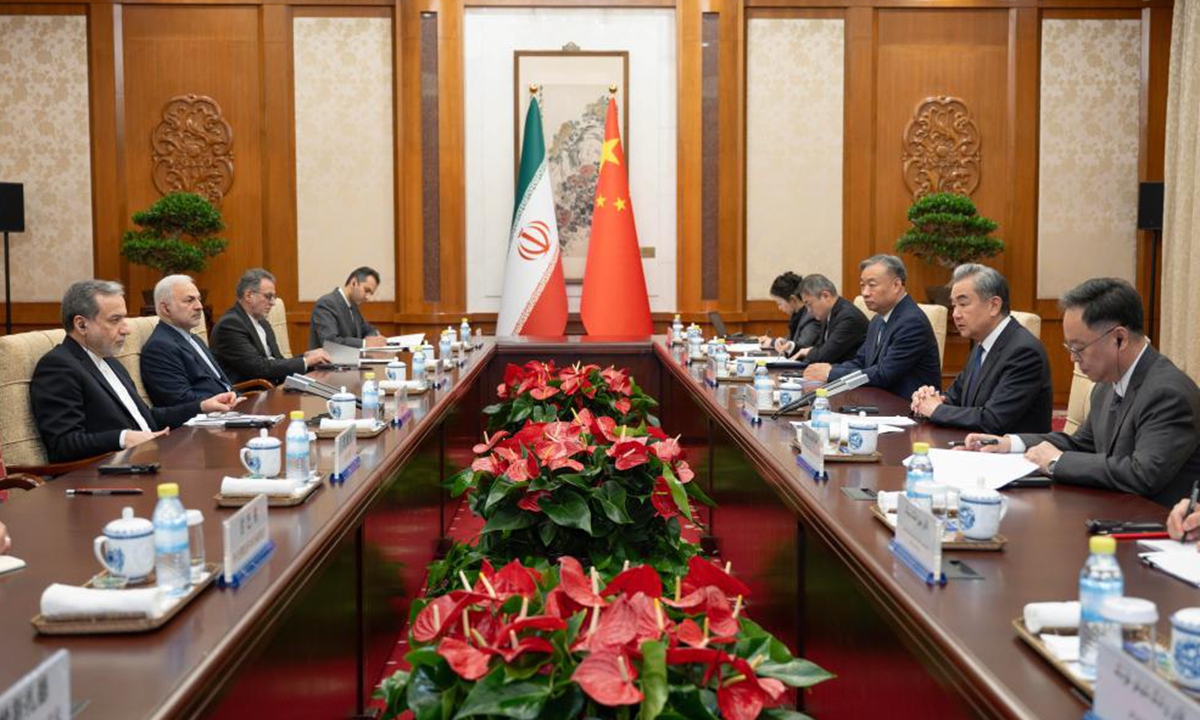
Chinese Foreign Minister Wang Yi, also a member of the Political Bureau of the Communist Party of China Central Committee, holds talks with Iranian Foreign Minister Seyyed Abbas Araghchi in Beijing, capital of China, May 6, 2026. (Photo: Xinhua)
Iranian Foreign Minister Seyyed Abbas Araghchi arrived in Beijing on Wednesday to begin his visit to China. This marks the first trip to China by Iran's top diplomat since the outbreak of the US-Israel military operation against Iran in late February this year. At present, the situation in the Middle East remains fragile and highly uncertain. This round of dialogue between China and Iran has sent a positive signal of seeking peace amid heightened regional tensions.
Public opinion from all sides has noted that "trust" is a key word in this dialogue. Araghchi emphasized that Iran highly appreciates and endorses the four-point proposal put forward by Chinese President Xi Jinping on promoting regional peace and stability in the Middle East, stating that "Iran places its trust in China." This trust also reflects the international community's broad recognition of and response to China's four-point proposal and its positive role.
At its core, the problems in the Middle East stem from the long-standing neglect of the principle of indivisible security. China's proposal cuts to the heart of the issue: sovereignty should be respected, the rule of law must be upheld, and development is the ultimate guarantee of security. These propositions do not favor any party, yet they have gained wide recognition from all sides because they express the most fundamental aspiration of people across countries - to live without the shadow of war.
Since the outbreak of the US-Israel military operation against Iran on February 28, China has consistently taken concrete actions to inject stabilizing forces into easing the Middle East situation. In mid-April, President Xi, while meeting with Sheikh Khaled bin Mohamed bin Zayed Al Nahyan, Crown Prince of Abu Dhabi, the United Arab Emirates, who was on a visit to China, put forward the four-point proposal on promoting peace and stability in the Middle East: adherence to the principle of peaceful coexistence, the principle of national sovereignty, the principle of international rule of law, and the coordination of development and security.
In late March, China held discussions with Mohammad Ishaq Dar, Deputy Prime Minister and Foreign Minister of the Islamic Republic of Pakistan, who made a special visit to China as a mediator in the conflict, on how to ease Middle East tensions, and jointly proposed the Five-Point Initiative.
Since the war began, China has also continued to engage in shuttle diplomacy and other efforts to mediate among various parties to help de-escalate the situation.
Whether through telephone calls or face-to-face meetings, China has sent a clear signal: at a time when regional security faces a severe test, China is regarded as a trustworthy strategic partner. This trust stems from China's consistent approach: upholding objectivity and fairness, not drawing lines based on ideology, and not changing its stance due to any single event or moment. The more turbulent the situation, the more precious this mutual trust becomes.
China is not a party to conflicts in the Middle East, nor does it seek any geopolitical self-interest. From facilitating the historic reconciliation between Saudi Arabia and Iran to helping bring about the signing of the Beijing Declaration on Ending Division and Strengthening Palestinian National Unity by 14 Palestinian factions, China has consistently worked to build platforms for dialogue, create conditions for talks, and convey rational voices among all parties.
The current regional situation is at a critical turning point between war and peace. China has repeatedly emphasized that the door to negotiations must remain open, and that talking is always better than continuing to fight. This is a sincere appeal to all parties in the conflict and echoes the shared aspiration of the international community for peace.
In the current Middle East situation, the most heart-wrenching issue is the navigation of the Strait of Hormuz. This waterway carries about one-fifth of the world's oil transportation and should not be used as a bargaining chip in geopolitical competition.
China's position is clear and consistent: the international community shares a common concern for restoring safe and normal passage through the strait and hopes that the parties involved will respond promptly to the strong calls from the international community.
If the strait remains blocked, the ultimate harm will fall on the fragile recovery of the global economy and the everyday livelihoods of ordinary people. Promoting de-escalation and restoring normal navigation in the strait is both a humanitarian imperative and the responsibility of major powers.
China-Iran relations have stood the test of time and reflect a partnership forged through adversity. Since the outbreak of the conflict, China has provided Iran with emergency humanitarian assistance and has consistently advocated for peace and dialogue. China understands that there is no winner in a war; each additional day of fighting brings more casualties and destruction.
China supports Iran in safeguarding its sovereignty and national dignity, while also encouraging the resolution of issues through peaceful negotiations. This reflects both the moral responsibility of a friend and the duty of a major country.
The world can no longer afford another prolonged war in the Middle East. A recent report by the United Nations Development Programme noted that the spillover effects of regional conflicts impact economies and households worldwide. Fluctuating energy prices, disrupted shipping routes, and a shadow cast over economic recovery all mean that the cost of war ultimately falls on ordinary people.
For this reason, the international community has such strong expectations for a peaceful and stable Middle East and warmly welcomes all efforts aimed at promoting peace and ending conflict. The Iranian Foreign Minister's visit to China is a response to this expectation and also a demonstration of China's continued constructive role.
Peace never arrives on its own; it requires sincerity and dialogue. At this critical juncture between war and peace, China stands ready to uphold the spirit of four propositions, support countries in the Middle East to work for building a common home of good-neighborliness, development, security and cooperation, stay committed to deescalation and ending the conflict, assist the resumption of peace talks and play a bigger role in restoring peace and tranquility to the Middle East.
This reflects a commitment to the traditional friendship between China and Iran and also a concrete practice of the vision of a community with a shared future for humanity.