


Egyptian expert says Chinese governance model draws rising interest in Arab world
CAIRO, May 11 (Xinhua) -- China's governance model is fueling growing interest across the Arab world in understanding the country's development experience, an Egyptian expert on Chinese affairs said.
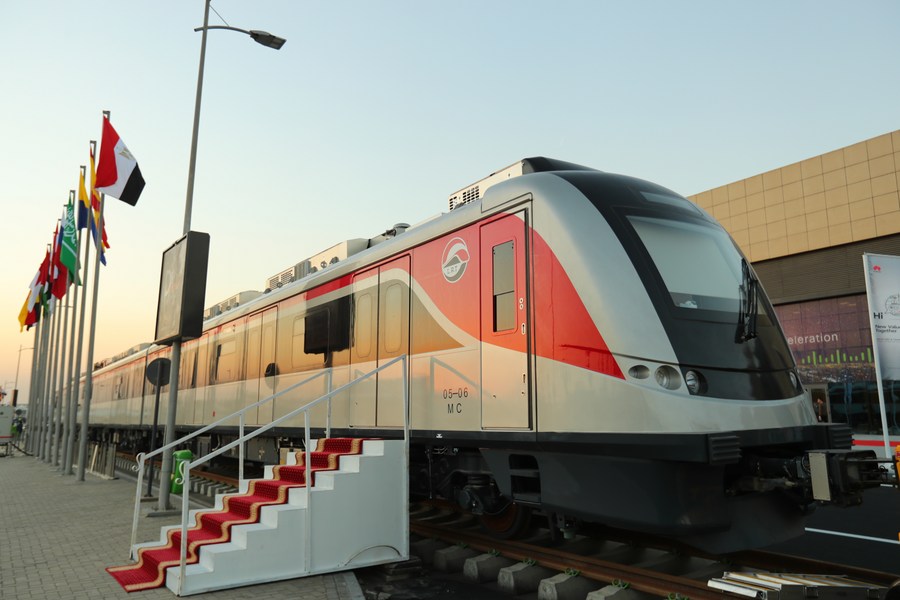
A real four-coach train is displayed by the China Railway Rolling Stock Corporation (CRRC) during the fourth Smart Transportation and Logistics Fair and Forum for the Middle East and Africa (TransMEA 2021) in Cairo, Egypt, Nov. 7, 2021. (Photo: Xinhua)
"Arab societies increasingly see the Chinese model as an example of development rooted in national experience rather than the imitation or export of foreign systems," Ahmed al-Saeed, chairman of Egypt's Bayt Al-Hekma Cultural Group, told Xinhua.
"The Chinese governance model shows that every country can find its own development path based on its experience, ideological background and cultural conditions," he said.
China did not copy the West, al-Saeed said, adding that its governance system evolved gradually in response to the country's own realities and accumulated experience.
He cited the popularity of Chinese political science books in the Arab world as evidence of growing interest in China's governance philosophy, recalling that Arab intellectuals and officials rushed to purchase Chinese titles during a book fair in Riyadh.
"It was surprising to see nearly everyone entering the fair buying a copy," he said, adding that the demand reflected a genuine desire among Arabs to understand how China achieved development while preserving its identity.
According to al-Saeed, many Arab countries are increasingly drawn to China's approach because it emphasizes mutual respect, noninterference, and shared interests rather than ideological pressure.
"The Arab world has become tired of powers trying to impose their ideas and culture on others," he said, stressing the importance of cooperation based on mutual benefit.
He said historical similarities between Chinese and Arab civilizations have also helped deepen cultural understanding.
"One reason China-Arab interaction has been smooth is that both sides come from ancient civilizations with deep cultural heritage," he said.
Al-Saeed said China's development initiatives -- particularly the Belt and Road Initiative -- have strengthened trust across the Arab world and the broader Global South because they focus on development rather than political interference.
The initiatives support countries in the Global South that have long suffered from Western dominance, he said, adding that China's growing partnerships with developing countries are helping promote a more multipolar world order.
"When countries in the Global South see China succeeding through cooperation rather than domination, they gain confidence in the Chinese model, which can help shift the global balance toward a multipolar world instead of a unilateral one," he said.
Al-Saeed also stressed that stronger people-to-people ties remain essential to the long-term future of China-Arab relations.
The League of Arab States and China's official Xinhua News Agency will jointly host the Global South Media and Think Tank Forum Chinese-Arab Partnership Conference from May 12 to 13.
Al-Saeed said he expected the event to generate ideas for the development and revitalization of Global South countries and explore paths to modernization, citing similar forums held in China, Brazil, and South Africa.
He added that media cooperation would play an increasingly important role in strengthening mutual understanding and promoting more balanced international narratives.
Media cooperation between China and Arab countries is essential to ensuring a fair voice, especially on Arab affairs, he said.