



Paulo Nogueira Batista Jr. (Photo: Shi Yuanhao/People's Daily)
The harmonious coexistence between humanity and nature is crucial to improving people's quality of life and ensuring humanity's perpetual survival on Earth. The practices and experiences of China's path to modernization, balancing economic and social development with ecological and environmental protection, offer valuable lessons for many countries.
From 2015 to 2017, I worked at the New Development Bank (NDB), headquartered in Shanghai. I could clearly feel the continuous improvement in Shanghai's air quality, with blue skies increasingly becoming the norm. When I returned to China in late autumn last year, I gazed from the NDB headquarters building at the vast, clear and expansive sky. The achievements in air governance in China are truly remarkable; this is a microcosm of China's promotion of harmony between humanity and nature.
The important concept originating in China, "lucid waters and lush mountains are invaluable assets," contains profound philosophy: for a country, maintaining a good ecological environment is the most fundamental aspect of people's well-being, no less important than increasing material wealth.
Last year, I witnessed a harmonious coexistence between humanity and nature in Ping'an village, Longsheng county, Guilin. Nestled among mountains, opening a window reveals beautiful terraced fields. The development of ecotourism there has both increased local people's income and effectively protected the ecological environment. The green transformation of Chinese cities is equally impressive. On the streets and alleys, new energy vehicles flow back and forth, emitting zero emissions and low noise.
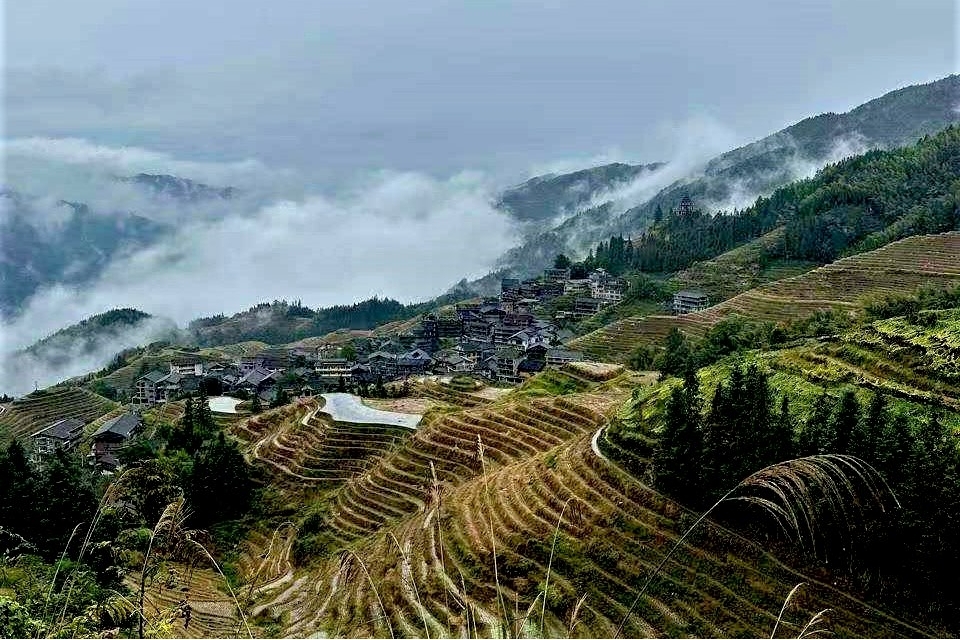
Ping'an village in Longsheng county, Guilin, Guangxi Zhuang Autonomous Region. (Photo: Paulo Nogueira Batista Jr.)
These achievements did not materialize out of thin air; they benefit from China's consistent green development philosophy and its successive long-term strategic plans. From the top-level design of ecological civilization, to the special provisions in the "15th Five-Year Plan" for comprehensively promoting green transformation of economic and social development and building a Beautiful China, and to the enactment of the Ecological and Environmental Code of China, China has systematically incorporated ecological civilization construction into its national development strategy. Relying on this institutional advantage, China has forged a modernization path characterized by harmonious coexistence between humanity and nature, thereby marking a clear distinction from other development models.
During my tenure as Vice President of the NDB, my first project was financing an initiative supporting sustainable development in Brazil. The NDB embeds sustainable development into its core provisions. Since its inception, it has embraced a green mission, continuously providing green financing for offshore wind, photovoltaic projects and other projects across multiple countries. In these fields, China stands at the forefront of technological development. China supports the NDB in its green operations and provides practical support, making positive contributions to global green development through diverse platforms and mechanisms, such as the Belt and Road Initiative, the Asian Infrastructure Investment Bank, and the Export-Import Bank of China.
Government departments in Global South countries could send representatives to conduct field research in China's urban and rural areas to learn from China's successful experiences in promoting green development. Currently, several countries, including Brazil, have already engaged in similar exchanges. I hope this mutual learning can continue to deepen.
(The author is a former Vice President of the New Development Bank and a Brazilian economist)