


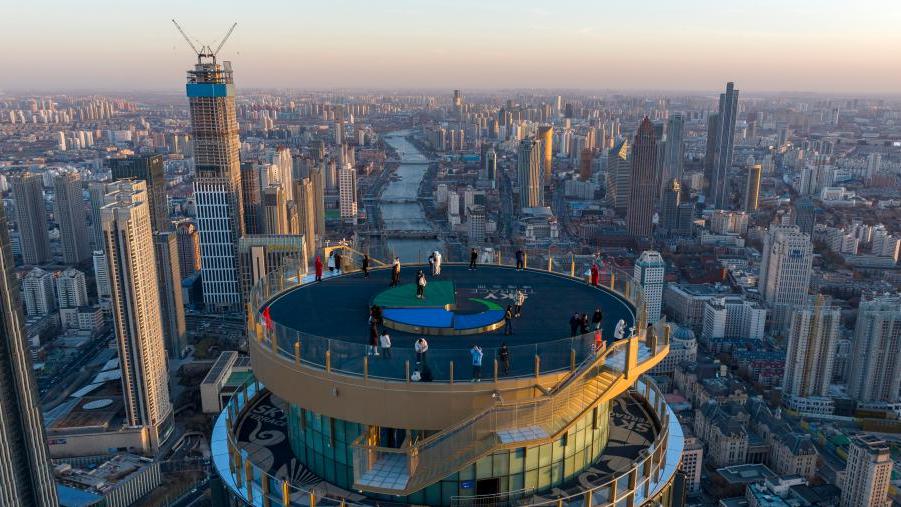
Visitors enjoy the city view from the Jinwan Yunding sightseeing deck in Tianjin, north China, December 20, 2025. (Photo: Xinhua)
These days all the world is closely following the high-level international meetings in China. US President Donald Trump just completed his first state visit to China since his trip in November 2017. On May 19, another top foreign guest will arrive on a two-day state visit: Russia's President Vladimir Putin.
Unlike his American colleague, Putin has always regarded Beijing as one of his preferred international travel destinations; the last time he was here was less than a year ago, in September 2025. The two sequential trips symbolize the growing importance of China as a global player; Beijing has become an indispensable actor in critical dimensions of world politics and economy.
More than 'business as usual'
The two summits are not a sudden and unexpected outburst of diplomatic activities. Since the beginning of the year, China has seen many top foreign statesmen, including South Korea's President Lee Jae Myung, British Prime Minister Keir Starmer, his Canadian counterpart Mark Carney and Spanish Prime Minister Pedro Sanchez, not to mention a long string of foreign ministers, defense ministers and other high-ranking officials.
While the sheer number of foreign leaders going to China is impressive, what is even more so is the diversity: Major powers and mid-size states, close neighbors and remote overseas lands, and Global North and Global South nations.
The flood of high-level guests demonstrates the fast-growing breadth of China's international connections and its principles of equal and open major-country diplomacy, featuring non-alignment, non-confrontation and non-targeting of third parties. It also reflects China's clear stance: Managing differences through dialogue, pursuing stability through cooperation and promoting win-win outcomes through practical actions.
It sends a strong message to the world that China has been consistently acting as a builder of peace, contributor to development and defender of international order, fulfilling its responsibilities as a major country. China's principles are reflected in the four strategic visions outlined by President Xi Jinping: The Global Development Initiative, Global Security Initiative, Global Civilization Initiative and the Global Governance Initiative.
Both Trump and Putin are very special visitors for China. The US remains the main superpower in the world with a profound impact on the global international system. Americans are leading in many hi-tech areas, from semiconductor design to quantum computing. Russia is a long-time close strategic partner of China and the largest foreign supplier of oil and gas.
Overall China-US trade experienced a visible decline in 2025, but nonetheless accounted for $414.69 billion with a lot of potential for further growth. The China-Russia trade was more modest, but still impressive – $228.1 billion in 2025. From January to April in 2026, it demonstrated a nearly 20% increase and continues to grow. No wonder then that the May state visits of US and Russia's presidents go beyond diplomatic "business as usual."
If we take a closer look at the current state of China-Russia-US relations, is a Beijing-Moscow partnership by definition hostile to US national interests? Does China have to choose between Russia and the US? Is late American diplomat Henry Kissinger's approach to the global geopolitical triangle – maintaining good relations with China taking advantage of its then distance from the Soviet Union – still valid or should it be dismissed as archaic and misplaced?
No 'zero-sum game' anymore
Some claim that there is a natural affinity between China and Russia, nations opposed to US or other Western hegemony. Trump probably does not share this rather primitive world outlook personally, but it is nonetheless very typical for the US political mainstream, especially the segment closely associated with the Democratic Party. This rigid view of the world clearly does not hold water and contradicts the real-world picture.
The political and economic systems in China and in Russia are very different. China is a socialist country, while Russia has moved to capitalism since early 1990s. Russia's political institutions have been created in the image and likeness of Western examples, not Chinese ones. Besides, social and political similarities have never guaranteed foreign policy unity.
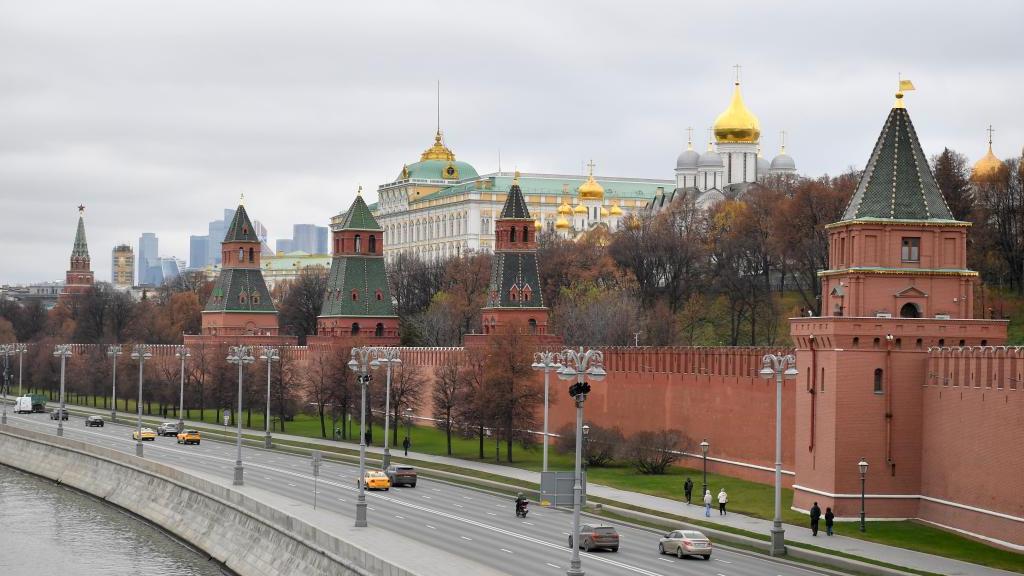
A view of the Kremlin in Moscow, Russia, November 10, 2025. (Photo: Xinhua)
Maybe, the real legitimate concern in the US should be about the deepening economic interdependence between China and Russia. But as mentioned, the China-US trade is almost twice the China-Russia trade; it is also much more diverse involving large numbers of small and mid-size enterprises on both sides. Beijing holds almost $700 billion of US Treasury bonds and is looking for a substantial increase in direct investment in America. Trump's visit will undoubtedly be a major boost to bilateral cooperation between the two most powerful economies of the modern world. However, the political and business leaders in Russia expect that at some point, the China-Russia economic cooperation may fully match the current level of China-US interaction.
To compare the present social interaction between China, Russia and the US, there are over 277,000 Chinese students in the United States today – five times more than that in Russia, despite the new student visa restrictions enforced by the Trump administration and energetic attempts by Russian universities to get more enrollments from China.
Around 1.5 million tourists from China visited the US in 2025, while about 834,500 chose to go to Russia. And one should not underestimate the powerful attraction of the US movie industry, pop music and the English language.
Are the US concerns grounded in the geopolitical proximity of Beijing and Moscow? The latter two nations often hold the same position in international institutions like the UN Security Council, they actively promote multilateral groupings like BRICS and the Shanghai Cooperation Organization, and jointly call for a multipolar international system.
Still, this meeting of minds is not anything close to the monolithic Soviet-Chinese cooperation of 1950s. Beijing and Moscow have distinctly different nuclear doctrines and different attitudes to strategic arms control.
It would be wrong to conclude that the relations within the China-Russia-US triangle can be described as a "zero-sum game." A degree of competition between Moscow and Washington for attention from Beijing is unavoidable and natural, but it does not mean that the Kissinger approach would work out half a century later in a completely different environment.
For instance, if China buys less from America, it does not necessarily mean that it will automatically buy more from Russia. If Moscow is successful in reaching out to Washington, it does not imply that it will lose its appetite for upgrading its ties to Beijing.
None of the three would be interested in global economic or financial instability. An economic tide is likely to raise all the three boats, while an economic storm might wreck all three. Even on the most sensitive and potentially divisive matters like the conflict in the Middle East, there is considerable overlap in China, Russia and US positions: None of them would like to see Israel wiped off the map, or the Strait of Hormuz staying closed indefinitely.
It is said that China, Russia and the US have very different views on the future world order. Beijing and Moscow stand for a truly multipolar world, while in Washington, they still dream about the lost unipolarity. However, in many cases this polemic becomes purely scholastic.
International affairs these days fit less and less into any of these theoretical frameworks; they represent a complex mix of unipolarity, bipolarity, multipolarity and no polarity. Academics might fight for the best theoretical frameworks explaining the contemporary international system and forecasting its future evolution, but politicians should focus on working together where there are even minimal opportunities for joint efforts.
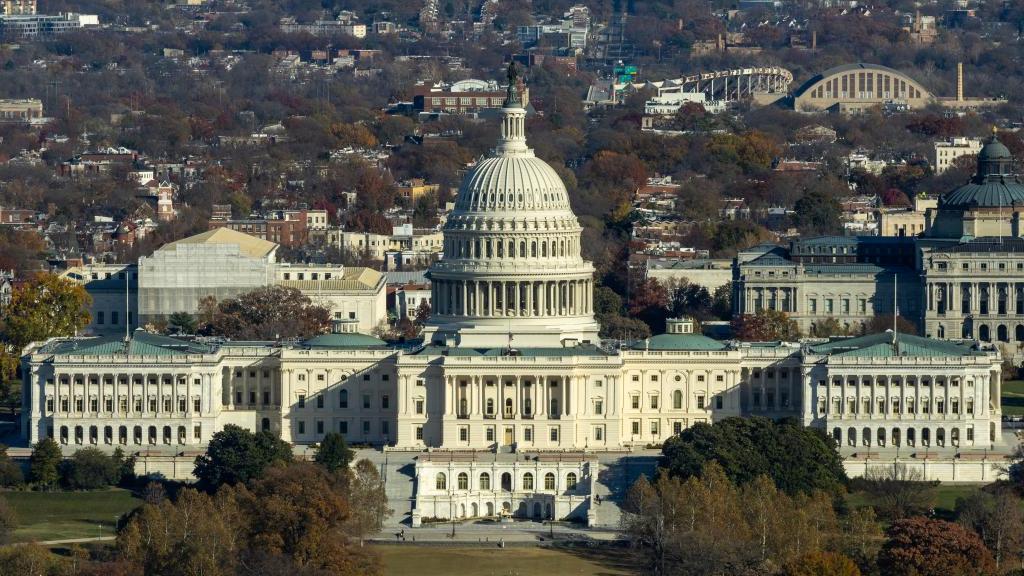
The US Capitol building in Washington, DC, the United States, November 17, 2025. (Photo: Xinhua)
It is all about trust
So, what is the most important difference between China-Russia and the China-US relations? In my view, what really matters is whether China, Russia and the US can trust one another. At the end of the day, it is trust that defines what is possible and what is not in relations between the three major powers.
Does trust exist in the China-US-Russia geopolitical triangle?
The answer is definitely positive in the case of China-Russia relations. The predominant public views of each other are essentially positive, especially among the younger generation. According to the most recent survey conducted in May by the Global Opinion Research Center at Renmin University of China, within the Russian and Chinese age group between 18 and 35, the overwhelming majority view bilateral relations as friendly (85.5% in China and 87.5% in Russia), have positive views of the other nation (76.4% and 78%) and are optimistic about future cooperation (73.7% and 77.7%). The strong personal relations between their top leaders also add to the stability and predictability of bilateral relations.
Regretfully, in the case of China-US relations, the answer is less encouraging. Although the recent survey by Pew Research Center shows that 27% of Americans now hold a favorable view of China, the figure suggests that considerable room for improvement still exists. There are many reasons why the two nations cannot fully trust each other. The trust, if it ever existed between Beijing and Washington, was badly damaged over the last couple of years by inconsistent and unpredictable US policies.
This is not only about the personality of Trump though his personal style, undoubtedly, brings more uncertainty into US foreign policy. However, the core problem is about the current state of American society and politics. As long as this society remains deeply divided, it is very hard to expect a predictable, consistent and trustworthy foreign policy to come out of the US.
The odds are that due to these deep social and political divisions, the US will remain a difficult foreign policy partner in years to come. Still, it will remain an indispensable player in many areas of international life, which means that both Beijing and Moscow should keep trying to engage Washington wherever possible, short of yielding to excessive US demands or accepting inappropriate US ultimatums.
It will be a long and bumpy road for both China and Russia. However, as Confucius put it, "It doesn't matter how slow you go as long as you don't stop."