


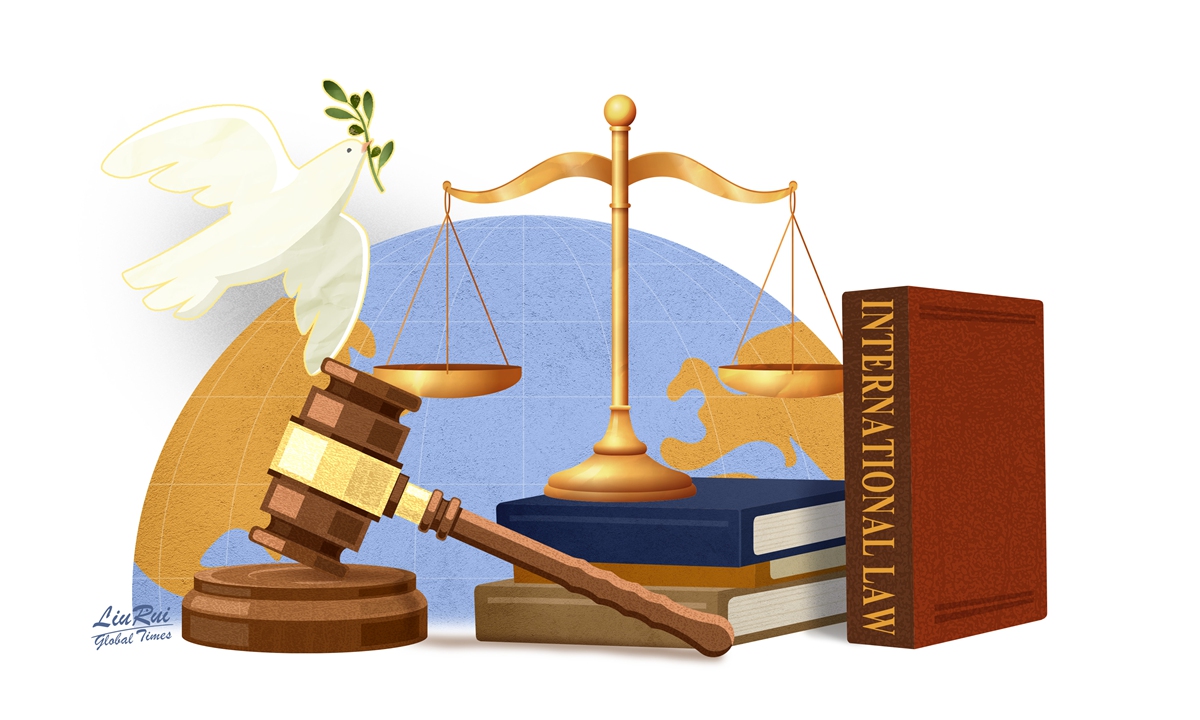
(Illustration: GT)
2026 marks the 80th anniversary of the start of the Tokyo Trial. As a landmark judicial event in the aftermath of World War II (WWII), the trial has exerted a profound influence on modern international criminal law and the evolution of international order, especially the regional order in Asia. What role did the Tokyo Trial play in shaping the world's understanding of WWII? Pascal Lottaz ( Lottaz), a Swiss scholar and an associate professor at Kyoto University's Graduate School of Law and Hakubi Center (Japan), shared his views with Global Times ( GT) reporter Wang Wenwen.
GT: To what extent do you think the Tokyo Trial shaped the world's understanding of WWII?
Lottaz: The Tokyo Trial was very important as a way to bring an end to WWII, bring some justice for the victims of WWII, and hold some of the perpetrators to account.
At the time, it marked a huge shift in Japan's attitude. The whole war was fought about what kind of vision for Asia would prevail. Japan pushed for its own vision of a Japan-led regional order with other nations subjugated. Having been defeated, Japan decided to surrender and politically let the Tokyo Trial happen and just live with that fate.
The Tokyo Trial puts a final end to the question of whose interpretation of WWII would win. And it is the Allied vision and narrative of WWII that won. We have a resolution of the narrative battle of what WWII was about.
GT: Since the Tokyo Trial laid the foundation for peace, why are there still factions in Japanese society that have failed to complete a "historical reckoning"?Lottaz: After WWII ended, Japan was under seven years of occupation and then struck a bargain with the Americans. And the bargain was security for bases. That meant Japan went from "we will fight the enemy to the death" to "we are allies with the enemy." A lot of Japanese would think that what happened in WWII was a tragedy because they also "suffered" in Hiroshima and Nagasaki, and that war was "evil." That's where Japan's pacifism in the past and even today came from. They repeated that like a mantra and institutionalized it.
However, what it did was to eradicate the awareness of guilt. The Japanese shifted the focus away from who was guilty. One of the casualties of this form of pacifism is the awareness of the crimes committed against others by Japan. Japan doesn't have an understanding anymore of how the other side of the war - the Chinese, the Southeast Asians and the Koreans - remember WWII and what happened before, not just Japanese militarism, but also Japanese colonialism.
GT: You have been living in Japan for more than a decade. Based on your observation, how can a sense of empathy be cultivated in Japanese society?Lottaz: We can try to install an acknowledgment and a proper sense for the pain that the others felt - in the sense of Japan, not just Hiroshima, Nagasaki, not just the Japanese women and children who were mutilated and literally evaporated in those events, but the mother, the father and the children in Nanjing that were slaughtered - then connect that with the idea of "together we need to prevent that hurt to occur." This would connect with the Japanese understanding of pacifism.
GT: Some contend that undermining the legitimacy of the Tokyo Trial is essentially undermining the post-WWII international order. Why was the Tokyo Trial not merely a trial of Japanese war criminals, but also of international justice and human conscience?
Lottaz: The Tokyo Trial was very important for justice. Together with the Nuremberg Trial, it set the precedent that political leadership could be liable for war crimes and set the stage for very important developments within international law. Before WWII, international law was mainly the law among nations. The Tokyo Trial and the Nuremberg Trial changed that, and there's individual responsibility, and international law pertains to them as well. And then the international human rights law developed in parallel with the international humanitarian law, and that gave rise to the International Criminal Court.
Undermining the legitimacy of the Tokyo Trial is not a good thing to do, but it doesn't change 80 years of development of international law.