


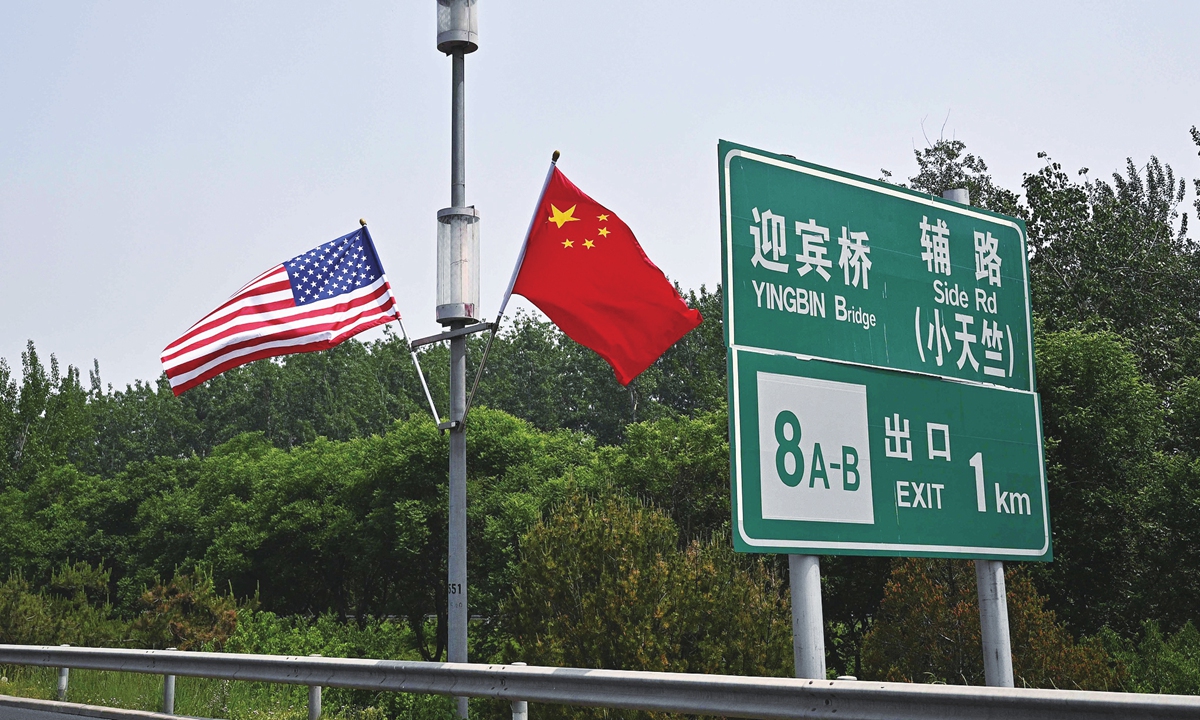
Chinese and US national flags line Beijing's Airport Expressway ahead of President Donald Trump's arrival for his state visit to China on May 13, 2026. (Photo: VCG)
US President Donald Trump left Beijing last Friday afternoon after having concluded his state visit to China. The visit, which captured the world's attention, was "very successful and unforgettable," as the US president had put it. Why did the visit capture so much attention? What signals did it send regarding the future trajectory of one of the most important bilateral relationships in the world today? In an interview with Global Times (GT) reporter Wang Wenwen, Sarwar Kashmeri (Kashmeri), founder and host of Polaris-Live.com "America and China in the world" and a senior fellow at the US-based Foreign Policy Association, said that despite differences in their core national interests, the leaders of the two strongest powers in the world have demonstrated that they can still sit across from each other to try and resolve their differences.
GT: Having observed President Trump's visit to China, what is your biggest takeaway?
Kashmeri: The leaders of China and the US meeting again after years of antagonism between the two countries is a big accomplishment in itself. Both presidents should be congratulated for that alone, because they've been able to put their differences aside and meet.
They are sending the world a big signal that the two countries have differences, but they can still sit down and talk.
We have to admit that on both sides there are differences which both peoples and both countries feel very strongly about. So meeting and talking about the differences is really important. China feels very strongly about the US sending arms to Taiwan. That's a very strong red line for China. On the other hand, some Americans believe that China exports a large portion of its production - sometimes below manufacturing cost - which hurts American jobs. I'm not saying it's right or wrong. I'm saying there are these kinds of differences. So even if we can make a little bit of improvement in that, it will be very helpful.
GT: During their meeting, the two presidents agreed to "build a constructive China-US relationship of strategic stability." What is your understanding of this new vision?
Kashmeri: I suppose the exact meaning of this important phrase will become clear as the two countries engage in commercial deals and geopolitical cooperation in the future. My early assumption is that strategic guidance for bilateral relations means the two countries will take their red lines far more seriously and construct future foreign policy around them. For example, the US will modulate the supply of offensive weapons to China's Taiwan region.
GT: In a previous discussion, you said that it is China that has to play the role of "adult" in bilateral relations with the US. Can you further elaborate?
Kashmeri: First of all, I am an admirer of China and Chinese history which goes back thousands of years. China and the US have, and will have, disagreements as both countries pursue their national interests. But China, over thousands of years, has seen many challenges within its country and with other countries, and has learned to successfully deal with them.
China is a big country, and governing a country like China is very different from governing a country like the US. What I meant by saying China can act as an "adult" is that China can do better than the US when things are getting to a boiling point. This is meant as a very positive comment about China.
GT: Looking back over the past few years, from trade wars to technology wars, from the Taiwan Straits to the South China Sea, China-US relations have experienced considerable turbulence. This time, the two leaders sat at the same table and talked about a wide range of issues. What do you think this period of turbulence has taught both sides?
Kashmeri: My main takeaway is: Don't try to change the other country, don't try to control the other's progress. It cannot be done, and it only fuels serious disagreements.
Most importantly, the two sides must keep talking. They met during Trump's first presidency. After that, China doubled down on its efforts to grow its economy and make it more independent in all the leading technologies - chips, robotics and electric vehicles. So China now is a very different country than it was. It can resist US pressures much more.
Trump realizes how much China has changed and how it has strengthened itself. But he also knows that China has serious work to do with its domestic economy, as it seeks greater global integration.
I think both China and the US now have a better understanding of each other. The last thing we want is to get into a war. If China and the US ever get into a war, the whole civilization might end. Kudos to President Trump's comments on Taiwan island as he flew back to Washington by saying, "The last thing we need right now is a war that's 9,500 miles away."
GT: Which areas do you see with the most promising prospects for bilateral cooperation?
Kashmeri: Last month, when I checked into my hotel in Beijing, there were four robots that were doing room service. I had never seen anything like this. Then, I was there when the robot half-marathon took place. China is so advanced in technologies that the US should have and is trying to have. Meanwhile, American automobile companies are trying to catch up with China by working with Chinese EV companies. There were reports that the US and China are pursuing guardrails to stop AI rivalry from spiraling into a crisis. These are the very strong areas for the two countries to work together.
GT: The China-US summit has caught global attention. What signal does the summit send to the world?
Kashmeri: I think it will give the world more comfort that both China and the US know that, as the old saying goes, jaw-jaw is better than war-war; that they are, again, starting to believe that there is a big world out there and we cannot close borders, and that we need to include everybody in the world's trading business family. If the two strongest powers in the world begin cooperating in just two or three key areas, it will give the world even greater confidence that both countries fully understand the importance of international trade and global cooperation.