



Attendees visit the 10th China-Russia Expo in Harbin, northeast China's Heilongjiang Province, May 17, 2026. The 10th China-Russia Expo opened to the public on Sunday. (Xinhua/Zhang Tao)
BEIJING, May 19 (Xinhua) -- Russian President Vladimir Putin's upcoming visit to China is widely expected to elevate bilateral relations further and inject much-needed stability and positive momentum into a turbulent world.
This year marks the 30th anniversary of the establishment of the China-Russia strategic partnership of coordination and the 25th anniversary of the signing of the China-Russia Treaty of Good-Neighborliness and Friendly Cooperation.
These milestones underscore the maturity and resilience of a relationship defined by mutual respect for each other's core interests and major concerns as well as mutually beneficial cooperation, while both sides pursue development paths suited to their own national conditions.
Guided by the strategic visions of the two heads of state, China-Russia relations have been continuously advancing to higher levels and expanding to broader dimensions, serving as a model for major-country relations in the new era. Since 2013, the two leaders have met more than 40 times on bilateral and multilateral occasions.
The China-Russia comprehensive strategic partnership of coordination for a new era has grown steadily stronger and more substantive, underpinned by deepening political mutual trust, enduring good-neighborly friendship and practical cooperation across multiple fields.
Institutionalized dialogue mechanisms among ministries and agencies at all levels have continued to deliver fruitful outcomes, supported by mutual backing for each other's development interests. Energy cooperation remains a cornerstone of China-Russia ties, anchored by solid foundations and the steady progress of major infrastructure projects.
According to China's Ministry of Commerce, bilateral trade reached approximately 228 billion U.S. dollars in 2025, exceeding the 200-billion-dollar threshold for the third consecutive year. China has remained Russia's largest trading partner for 16 consecutive years.
Strategic coordination has also galvanized vibrant cultural exchanges, further strengthening mutual understanding and friendship between the two peoples. The China-Russia Years of Education, starting this year, are set to feature hundreds of exchange events, building on the success of previous theme years dedicated to culture, sports and sci-tech innovation.
Mutual visa-free policies have significantly facilitated people-to-people exchanges between the two countries. According to the Association of Tour Operators of Russia, over 150,000 Chinese tourists visited Russia in the first quarter of 2026, up 44.4 percent year on year, while Russian trips to China rose 33.6 percent in 2025.
Beyond bilateral cooperation, China and Russia also play an important role in amplifying the voice of the Global South and promoting a multipolar international order.
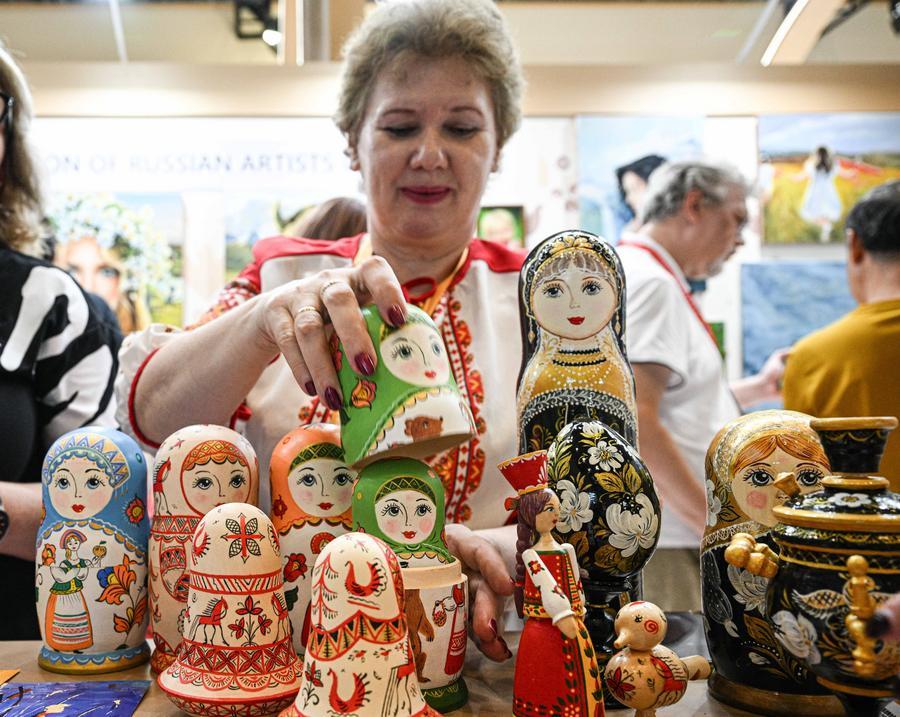
An exhibitor displays handicrafts from Russia during the sixth China International Consumer Products Expo (CICPE) in Haikou, south China's Hainan Province, April 16, 2026. (Xinhua/Pu Xiaoxu)
The world today is witnessing profound transformation and mounting turbulence, as the post-war international order comes under strain, established norms governing international relations are increasingly challenged, geopolitical conflicts intensify, and the risk of a return to the law of the jungle grows.
The strategic coordination between China and Russia is of great significance for maintaining global strategic stability, and upholding multilateralism and the international order.
China and Russia have been pooling global efforts to firmly uphold fairness and justice, defend the victorious outcomes of the World War II, and safeguard the UN-centered international system and the basic norms of international law.
In response to a more uncertain and unstable international landscape, Beijing and Moscow should strengthen multilateral coordination, uphold and practice multilateralism, and work together to revitalize the authority and vitality of the United Nations.
They should also maintain close coordination and cooperation within frameworks such as the Shanghai Cooperation Organization and BRICS, and promote the development of the international order toward a more just and equitable direction.
As the world is undergoing profound changes, the continued resilience of China-Russia relations carry significance far beyond the bilateral level.
Their cooperation demonstrates that major-country relations can move beyond bloc confrontation and zero-sum rivalry, and instead contribute to multipolarity, the democratization of international relations, and greater stability and certainty in a changing world.