


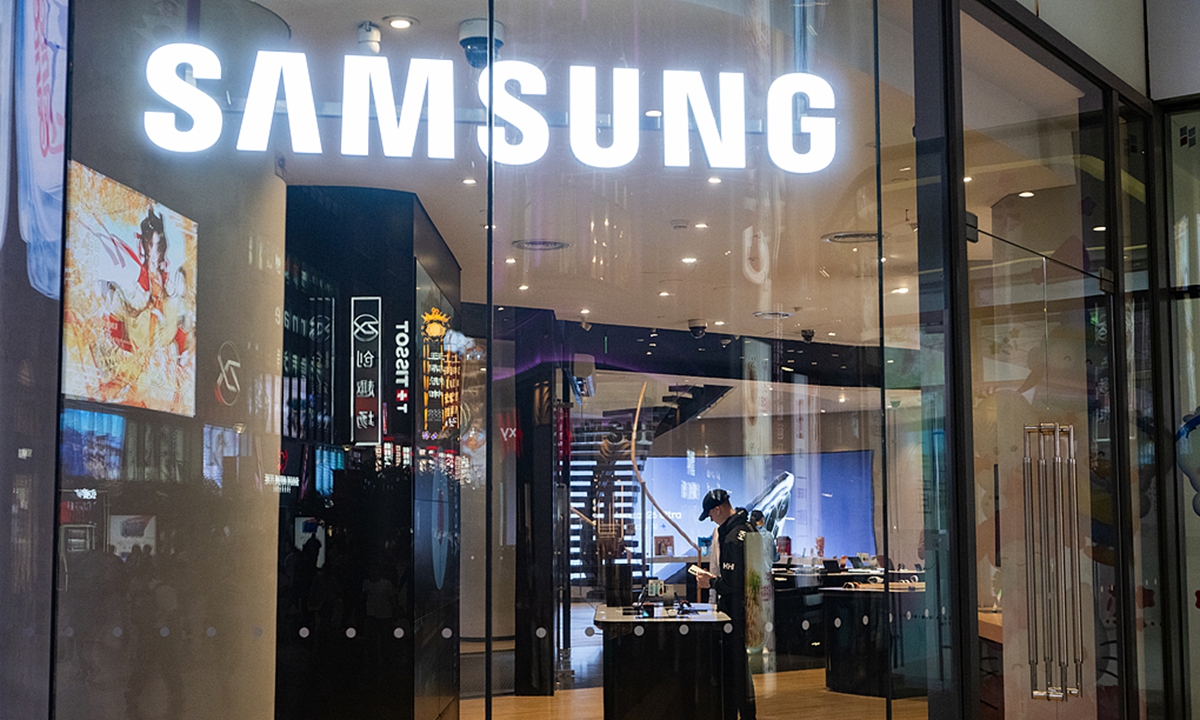
A Samsung store in Shanghai Photo: VCG
Currently, China's economy is steadily advancing along the path of high-quality development, even as domestic and international circumstances become increasingly complex. Some Western media, due to misunderstanding or bias, have repeatedly questioned or even distorted China's economic development. Accordingly, the Global Times launches the "Q&A on China's Economy" column to publish opinion pieces to present facts and clarify perceptions.
South Korea's Samsung Electronics recently announced that it will discontinue sales of all home appliance products in the Chinese mainland market, including televisions, refrigerators and washing machines. In some Western media reports, narratives such as "foreign capital withdrawal from China" and "Samsung's retreat from the market" have frequently appeared. But has Samsung, which began investing in China soon after the establishment of China-South Korea diplomatic relations in 1992, really "withdrawn" from China?
Whether foreign capital is "withdrawing" cannot be judged by isolating a single business adjustment. The key is whether companies are actually pulling out capital, relocating personnel and abandoning the Chinese market. In Samsung's case, the adjustment is the opposite. It's merely exiting low-margin retail sales to shift capital and resources toward more profitable and forward-looking areas. This is a typical case of "changing lanes without leaving the field."
This adjustment is due to the profound restructuring of China's home appliance market. In recent years, Chinese domestic brands, leveraging full industrial chain advantages, scale effects, and rapid technological iteration, have significantly enhanced their price competitiveness in televisions, refrigerators, and washing machines. Product quality and smart features have rapidly caught up with or even surpassed foreign competitors, while consumer preferences have increasingly shifted toward more cost-effective domestic options. Samsung's home appliance business has come under sustained profitability pressure globally, with reports indicating losses in relevant divisions in 2025. Against this backdrop, the company's decision to exit the retail sales segment aligns with its global "selective focus" strategy.
In fact, many multinational corporations have undertaken similar restructuring under similar pressures. Around 2018, Ford Motor Company faced intense competition from Japanese and South Korean brands, leading the company to discontinue mainstream sedan models in the North American market. It reallocated resources, production capacity and R&D toward higher-margin product lines such as the truck and SUV. Following this adjustment, Ford's North American profitability improved significantly. Another example is Panasonic. As a Japanese electronics giant, it has long faced fierce competition in consumer electronics and pressures from global supply chain shifts. In recent years, it announced to exit or scale down segments such as LCD panels, certain semiconductor businesses and household appliances, while concentrating resources on high-growth core areas such as automotive batteries, energy solutions and B2B operations.
Samsung said it would continue to maintain its home appliance manufacturing bases in China. These facilities are being transformed into global export hubs of the company. As a multinational corporation with cumulative investment of $56.7 billion in China, operating 16 manufacturing enterprises and 13 R&D centers, Samsung is carrying out a strategic reallocation of "less in some areas, more in others" - reducing exposure in highly competitive, margin-pressured consumer-end markets, while strengthening positions in higher-tech, more embedded, and globally strategic segments.
The numbers are telling. Samsung continues to increase investment in its Xi'an plant, with 2025 investment reaching 465.4 billion won ($308.2 million), up 67.5 percent year-on-year. The facility accounts for roughly 40 percent of Samsung's global NAND flash production capacity, making it an irreplaceable manufacturing hub in its global memory chip strategy. In the electronic components sector, Samsung's Tianjin MLCC plant operates at full capacity to supply core components to a number of global clients. Samsung's Suzhou home appliance factory, after adjustments in its sales channels, continues to serve as a global supply chain hub, supplying high-quality products to overseas markets such as North America and Southeast Asia. Reports indicate that the current production efficiency reaches approximately one refrigerator every 16 seconds and one washing machine in under 10 seconds. In truth, this is just shifting from "selling in China" to "manufacturing in China for the world."
Therefore, labeling Samsung's adjustment in China's home appliance market as "foreign capital withdrawal" is clearly a misreading of its global strategic restructuring. It overlooks the dynamic nature of global industrial division of labor. As China's market matures and domestic firms rise, multinational corporations naturally reallocate resources according to comparative advantages. This is not a loss of confidence in China, but rather recognition of China's manufacturing capabilities: China has become an efficient and reliable global production base.
This shift in foreign investment patterns also reflects the continued optimization of China's investment structure. According to the Ministry of Commerce, in the first quarter of this year, the actual use of foreign direct investment in China's high-tech industries went up 30.7 percent year on year to 102.73 billion yuan ($15.1 billion), accounting for 41.2 percent of the total - an increase of 12 percentage points from the same period last year. Among them, actual investment in R&D and design services, computer and office equipment manufacturing, and electronic and communication equipment manufacturing increased by 127.8 percent, 88.1 percent and 23.8 percent, respectively. This indicates that foreign investment in China is shifting from general manufacturing toward high-tech manufacturing, R&D and innovation services. The Zhanjiang Verbund site of BASF's globally largest single investment project has officially commenced operations; Volkswagen has inaugurated its first full-process R&D and testing center outside Germany in Hefei, East China's Anhui Province; and Schneider Electric has built two new factories in Xiamen, East China's Fujian Province, and Wuxi, East China's Jiangsu Province, while upgrading its Beijing R&D center. These are all vivid examples.
For multinational corporations that truly understand the Chinese market, "withdrawal or not" is a false question. In intense competition, companies are instead asking how to embed themselves more deeply. China's newly revised Catalogue of Encouraged Industries for Foreign Investment places greater emphasis on technological innovation and the development of new quality productive forces, increasing support for advanced manufacturing and high-tech sectors, while guiding foreign capital toward specialized consumption and business services. The combination of policy signals and market opportunities makes "investing in China" not only a practical choice, but also a strategic one for the future of global enterprises.