


The movie Dear You—whose Chinese title can literally be translated as "A Love Letter to Grandma"—has unexpectedly topped the 2026 box office. To date, the film has grossed over 1 billion yuan ($147 million), captivating audiences not only in China but also across different countries, regions, and generations.
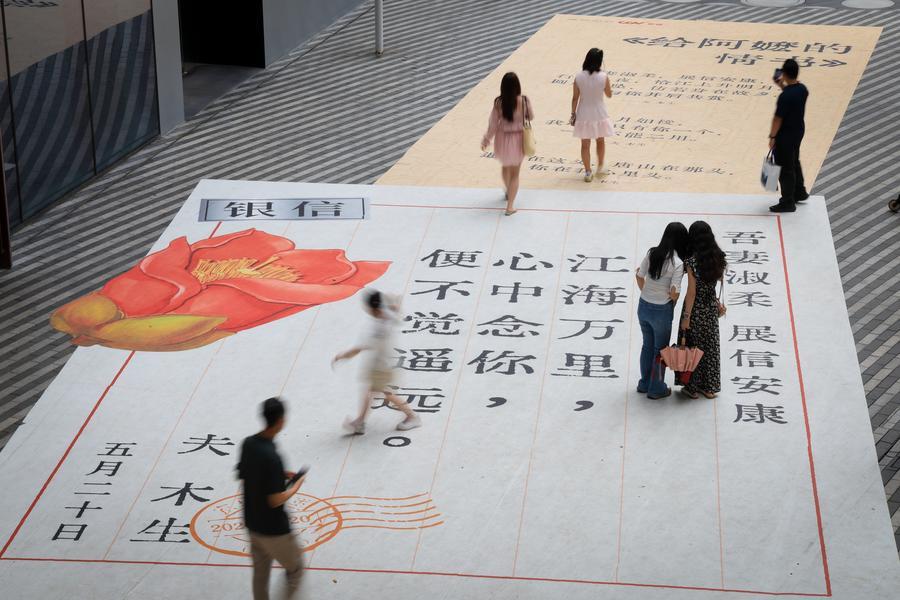
People visit a community themed on qiaopi of Chinese film "Dear You" in Shenzhen, South China's Guangdong Province, May 20, 2026. (Photo: Xinhua)
The film tells a simple story, yet one distilled from the real-life experiences of many people from Chaoshan, a coastal region in southern China with deep historical ties to Southeast Asia. In the 1940s, Musheng flees the war and travels to Malaysia and Thailand to make a living, leaving behind his wife and three young children. He supports his family by sending "qiaopi"—letters with remittances. After his accidental death, Nanzhi, the daughter of his landlord, continues to send letters and remittances as Musheng to his wife Shurou out of appreciation for their friendship, and also in reciprocity for his help saving his landlord from a fire. This goes on for 18 years, until the Musheng's grandson uncovers the secret.
Nearly everyone has left the theater in tears, as the story has struck a profound emotional chord and awakened a powerful sense of belonging and cultural identity in the hearts of countless Chinese.
What, then, is that chord?
The answer is "love." The film is a romance. Beginning with a storyline quite similar to many romances around the world—Mucheng, a poor young man, and Shurou, a beautiful young woman from a wealthy family, fall in love and elope. The film then diverges. To fulfill his promise to Shurou, Musheng works hard and saves every penny he earns to send back to his wife and children. Yet unlike many Western romance films that emphasize open expressions of love, the emotions here are different: quiet endurance hidden in patience, responsibility, sacrifice, and a restrained yet deep affection. This is illustrated in a dried kapok flower from his wife that Musheng risks his life to save, in the descriptions of his well-being in letters to his wife despite the hardships he endures abroad, and in his boldness in starting a business to earn more money for his family's betterment.
On Shurou's side, it is in her perseverance in raising their three children alone, in her quiet yet decisive relocation of the family without complaint after receiving a group photo of Musheng with Nanzhi and several children (leading her to mistakenly think that he had remarried), and in her safeguarding the letters from Musheng by keeping them inside a weathered wooden box as her most precious belongings.
Another answer is "home." When Nanzhi sends letters and remittances to Shurou in Musheng's name, she embodies the bond between them and, almost imperceptibly, becomes a family member. Behind their friendship and appreciation of their love lies their connection to their hometown, Chaoshan—where they share the same ancestors, the same language, and a longing for a place called home, with everything they can rely on as a last resort and for a better future. What sustains this concept of "home" is care for one another and the devotion to it. "Home is wherever you are; with home in the heart, no distance or drifting can ever leave you adrift," Musheng tells his wife in the film.
From 1864 to 1911, nearly 2.94 million people from Chaoshan crossed the sea to make a living in Southeast Asia. Like Musheng, they bore the harshest burdens themselves yet sent home every last coin they could save. What kept them going was an unyielding determination to build a better life for their families back home. Their motherland remained an enduring spiritual beacon—a light that reached across rivers and mountains. The bond with home is carved into the bones of the Chaoshan people and forms the bedrock of Chinese cultural identity.
Then there is qingyi, the theme of the film highlighted at both its beginning and end. There are many English words close to qingyi, but none fully commensurate with it. For qing, it can mean love, affection, care, bonds, sincerity, and honor; for yi, it can mean integrity, loyalty, duty, and devotion. Underpinning Nanzhi's silent rescue is the bond forged by their mutual support in hard times; likewise, underpinning Musheng's bravery is a sense of duty to step forward and protect his hometown folks in the face of injustice. That sense of duty wins him Nanzhi's friendship, costs him his life, and yet makes him a true hero—one to whom people later pay tribute in various ways. Their perseverance, kindness, and sense of responsibility speak to the core values of every Chinese heart. "One must be compassionate and righteous," stresses Grandma (Shurou), reflecting the enduring cultural and ethnic spirit that unites Chinese people. And when countless such acts of kindness come together, they forge an unbreakable sense of identity and cohesion—the very strength that has carried the Chinese nation through hardships and propelled it forward for thousands of years.
Finally, we have education and learning. At the heart of the story lies qiaopi. More than financial lifelines, they were emotional arteries, carrying news, love, and hope across the sea. Yet both Musheng and Shurou are illiterate and must rely on others to write and read those letters. Their longing for knowledge leads them to create a small learning space and invite an instructor to teach the children of Chinese expatriates how to read and write. In essence, Musheng and his friends start a school—or more accurately, a teaching station. It is at this school that Nanzhi learns to read and write Chinese, which later enables her to continue writing to Shurou after Musheng's death. That small teaching station changes the lives of the children, some of whom go on to help establish a Chinese language school in Thailand. A shared language is key to national identity—and the film proves that education that cultivates language skills can change the trajectory of a life.
Ultimately, Dear You is a film about the soul of the Chinese people. The tears audiences shed are not only for the joys and sorrows of the characters, but also for a shared current of emotion that carries within it the deepest spiritual code of the Chinese nation.
In an increasingly globalized world—marked by greater population mobility, more people crossing borders, working abroad, and living in different cultures—the meaning of home has also changed. It is no longer just a physical place, but rather an emotional bond and a cultural identity. That is what holds Chinese people together: while not necessarily through handwritten letters anymore, but still, through the language and culture passed down through education and learning, the spiritual code of the Chinese people endures. What truly defines "home" in a world on the move is a deep love for one's homeland, a sense of responsibility to family, and an unyielding commitment to a promise. It is through these enduring bonds that the Chinese people, even across mountains and seas and across centuries, continue to prosper and shape a better place for themselves and for the world.
(Wang Yan, associate research fellow, Beijing Foreign Studies University)