


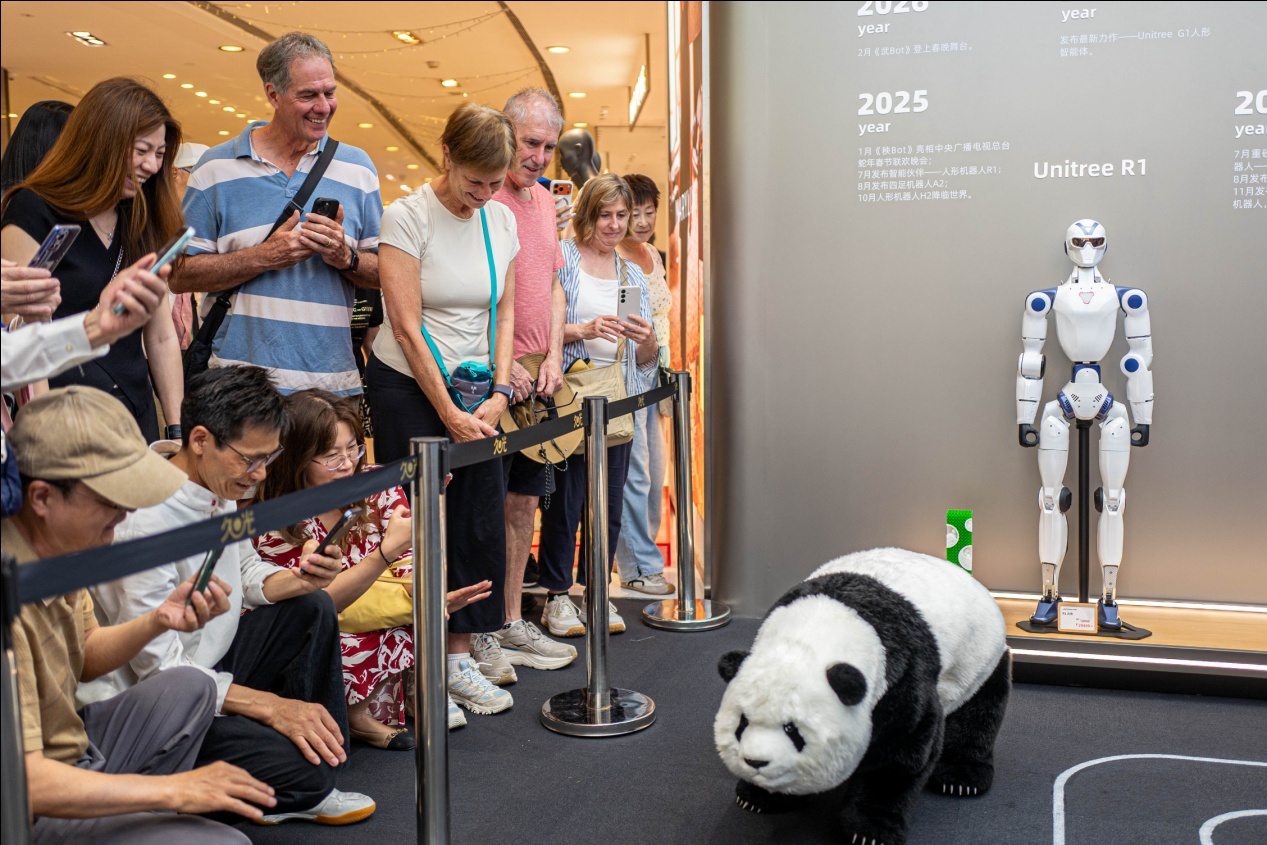
Chinese and foreign tourists watch a robot dog dressed in a panda costume at Unitree's first experience center in Asia in Shanghai. (Photo/Wang Chu)
A string of eye-catching breakthroughs has put China's AI industry in the global spotlight. A humanoid robot developed by Chinese tech firm Unitree featured as a guest on a Polish TV show, while V4, the latest open-source large model of Chinese AI company DeepSeek, has made headlines across major international news outlets.
Riding the worldwide AI boom, China has followed a distinctive homegrown roadmap for open-source development to upgrade its domestic AI sector. As it builds up indigenous innovation capabilities, the country also fuels sustained growth for the global digital and intelligent industry.
The vitality of an innovation ecosystem is often reflected in the data. According to a report released by a leading international open-source platform, Chinese-developed models accounted for 41 percent of all large-model downloads on the platform over the past year, making China one of the world's most active and fastest-growing sources of open-source AI models.
Another report, jointly released by the Massachusetts Institute of Technology and the same platform found that Chinese-developed open-source models surpassed those from the United States in global downloads for the first time last year, ranking first worldwide.
The growing influence of Chinese open-source models is expanding beyond developer communities and into real-world applications. More companies around the world are adopting Chinese AI models for commercial deployment.
Bill Ready, chief executive officer of the U.S. company Pinterest, noted that Chinese AI companies' decision to embrace open-source development has helped fuel the explosive growth of global open-source models.
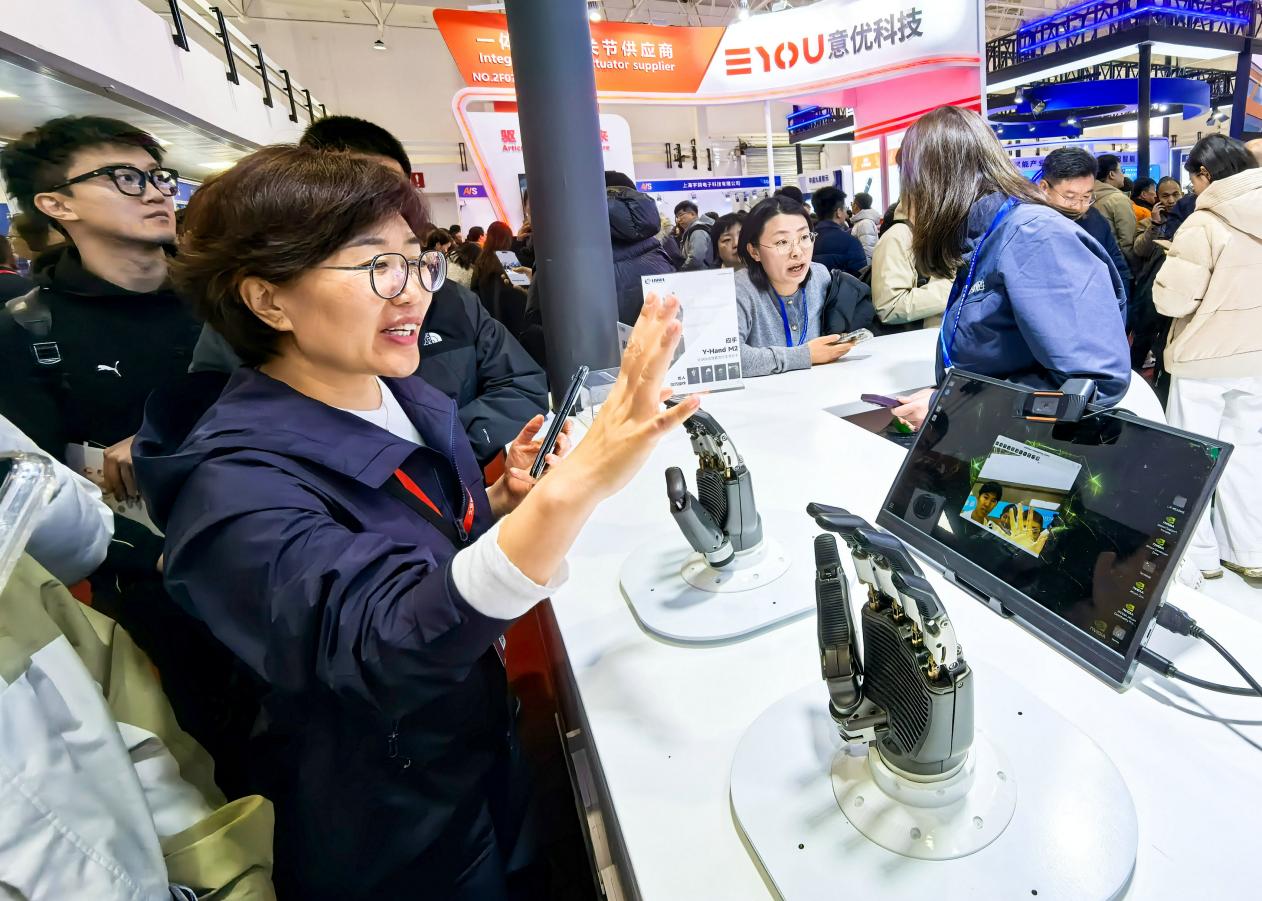
A woman interacts with a robotic hand at the AI Show 2026 in Beijing, March 18, 2026. (Photo/Luo Wei)
Chinese open-source models have earned the support of developers around the world because of both their technological strength and their commitment to openness and inclusiveness.
DeepSeek's V4 model, for example, combines advanced features such as ultra-long context windows with open access to model weights and source code, allowing developers worldwide to build and innovate on top of the technology.
Following years of development, China has now established a complete AI industrial system. The country is home to more than 6,000 AI companies, with industrial chains covering every key link from intelligent chips and computing clusters to model development and application scenarios.
An article published by Malaysia's The Star argued that Chinese AI products place strong emphasis on practical implementation and have already achieved world-leading capabilities in resource integration. Its open-source, shared developer ecosystem has effectively accelerated technology adoption both domestically and internationally, while expanding applications in sectors such as energy, transportation, and health care.
The open-source and shared development model not only makes intelligent technologies more accessible worldwide, but is also unlocking new drivers of economic growth within China.
Multiple Chinese open-source models, including Qwen, Moonshot AI's Kimi, and DeepSeek, have broken down technological and industry barriers, enabling creators and developers around the world to rapidly deploy AI models and develop applications.
Within China, the rapid expansion of the open-source ecosystem is increasingly translating into new engines of growth.
Daily token usage exceeding 140 trillion and a domestic user base of more than 600 million for generative AI have given rise to a rich variety of intelligent application scenarios.
Collaborative innovation among businesses, universities, and research institutions is transforming AI into a shared technological resource that benefits multiple stakeholders.
Open source is not merely a technological development model; it reflects a broader philosophy of collaboration and shared progress.
AI is profoundly reshaping human production and everyday life. Yet it should not become "a game for rich countries and rich people," nor should it slide into the logic of zero-sum competition.
When certain countries build technological barriers, fragment industrial chains, and artificially obstruct the cross-border flow of innovation resources, the result is a widening technology gap and growing developmental imbalance, ultimately harming the global innovation ecosystem itself.
China has already become an important contributor to global open-source software and open models, and has written "advancing the development of open-source systems" into its 15th Five-Year Plan.
The development of China's AI industry demonstrates that the more cutting-edge the technology, the greater the need for openness and cooperation; and the bigger the global challenges, the greater the need to share innovation achievements.
Only by remaining committed to innovation and openness, deepening international cooperation, and jointly creating an open, equal, fair, and non-discriminatory environment for AI development can the technology move toward inclusive and beneficial development and truly become an international public good that serves humanity.
The path of open source leads to innovation and shared success. As global attention increasingly turns toward China's AI industry, the world is seeing not only rapid technological progress and a thriving industrial ecosystem, but also a Digital China committed to openness, open-source development, and ensuring that intelligent technologies serve the common good.
China will continue leveraging its strengths and working with all parties to help narrow the global divide of intelligent technology and jointly write a new chapter in global technological development.