


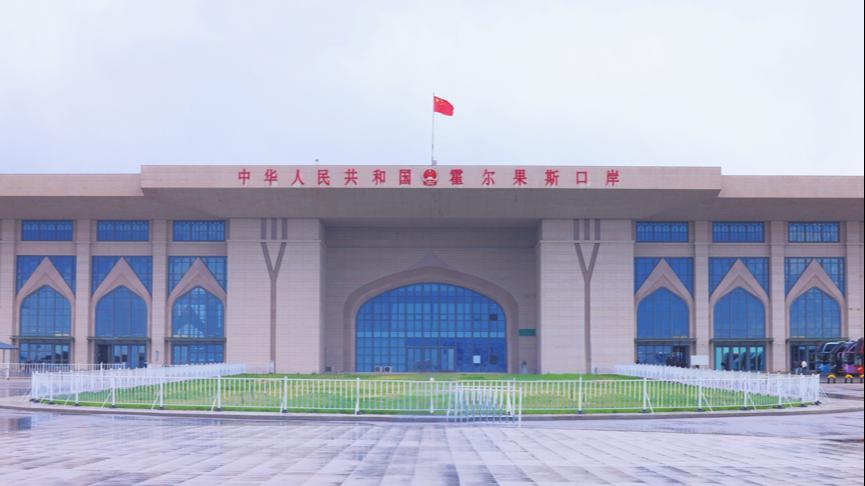
An undated photo shows the Horgos Port in Xinjiang Uygur Autonomous Region in northwest China, a hub of bustling cross-border trade and cultural exchange along the Silk Road. (Photo: CGTN)
For much of modern history, China's economic miracle has been a story of the eastern seaboard. But look at the map of global trade in 2026, and the center of gravity is shifting inland. The Horgos Port in Xinjiang Uygur Autonomous Region in northwest China, straddling the China-Kazakhstan border and at the intersection of the ancient Silk Road and the modern "Belt and Road," is no longer just a port; it is the engine of a new economic reality.
To understand China's "westward opening up," one must first stand in the shadow of the towering gantries at Horgos. In the first five months of 2026, this border outpost has transformed into a barometer of Eurasian integration, clearing over 4,000 China-Europe and China-Central Asia freight trains. This is not merely a statistical milestone; it represents a fundamental shift in logistics, where time zones are compressed and distance is measured in the rhythm of steel wheels on rail.
However, to view Horgos solely as a railway hub is to miss the larger picture. This is the heart of Xinjiang's emergent "port economy." While heavy machinery and electronics remain staples, the port has become a "golden corridor" for fresh produce.
In the first quarter of this year, the export of fruits and vegetables reached 230,000 tons, surging by 31.5%. Delicate produce like dragon fruit and cherry tomatoes now survive the journey to Central Asian markets thanks to green channels and smart refrigeration. By the end of May, passenger traffic at the road port rose 19.8% to over 646,000 trips, as economic integration deepens beyond goods to human mobility.
Just a few hundred kilometers north, Alashankou, also known as Alataw Pass, is quietly breaking records. In the first four months of 2026, it handled over 10 million tons of cargo, an 11% year-on-year increase, showcasing the immense capacity of Xinjiang's dual-rail corridors.
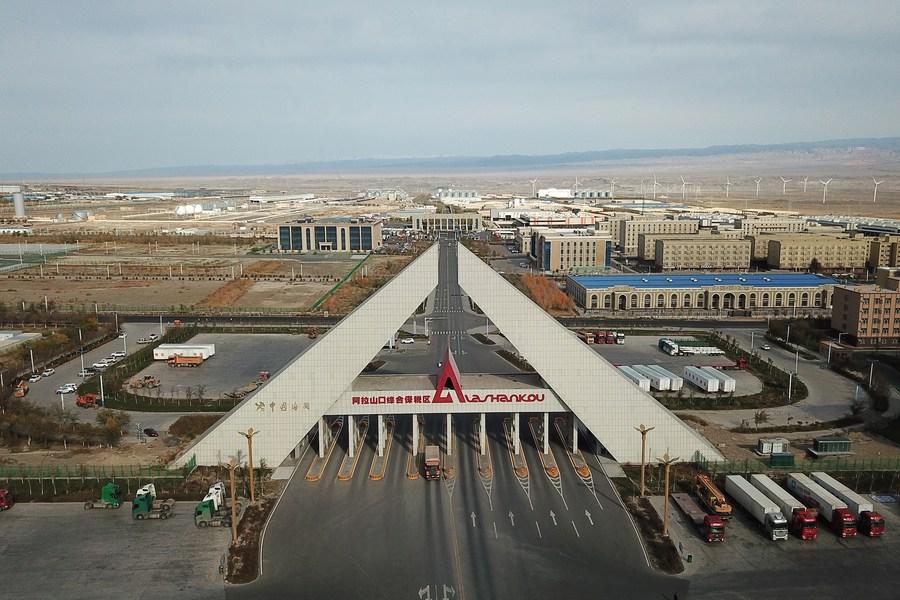
The Alashankou comprehensive bonded area in Xinjiang Uygur Autonomous Region, northwest China, November 5, 2023. (Photo: Xinhua)
But perhaps the most symbolic shift is happening in the air. The international air route between Yining in Xinjiang and Almaty in Kazakhstan marked its second anniversary in April. What began as a modest cross-border connection has steadily grown into a vital artery for trade and travel, with passenger numbers exceeding expectations and border crossings becoming routine rather than remarkable.
Then an even bolder milestone followed. On June 1, China Southern Airlines launched the first direct passenger link from Xinjiang to Frankfurt, Germany. This promises to be a gamechanger. For decades, travelers from western China had to backtrack eastward through Beijing or Shanghai to reach Europe. Today, the flight from Urumqi to Frankfurt takes just eight hours.
This air bridge is the final piece of the puzzle, transforming Urumqi from a remote regional capital into a genuine intercontinental transit hub capable of moving businesspeople, tourists and high-value goods between the Pearl River Delta and the Rhine in a single calendar day.
China's westward opening up is not happening in a vacuum. The responsiveness of its neighbors validates the strategy. Kazakhstan, acutely aware of the opportunity presented by Horgos, is currently laying second tracks in the Altynkol-Zhetygen section, a key part of the Trans-Caspian International Transport Route.
Despite the intense trade and passenger volume, the Horgos Port is implementing stringent environmental measures to protect the Ili River Valley, where it is located. This is not a unilateral export of Chinese goods; it is a bilateral dance of infrastructure and environmental responsibility.
Geopolitically, Xinjiang's port economy is China's hedge against maritime volatility. The overland route via Horgos offers strategic depth. It allows China to trade with the European Union and the Global South through Central Asia without a single warship escort.
Economically, this is the maturation of the "dual-circulation" development pattern. The 4.2% growth in Xinjiang's foreign trade, reaching 172.7 billion yuan ($254.6 billion) in the first four months of 2026, reflects domestic resilience. When global demand in the West stalled due to inflationary pressures, the markets of Central Asia, hungry for electronics, automobiles and machinery, remained open.
Horgos in 2026 tells the story of a land power reasserting its connectivity. From the swift export of pomegranates to Kazakhstan to the arrival of German tourists in Urumqi, the "port economy" is building a new type of globalization – one that is overland, multi-directional and runs directly through the heart of Xinjiang.
Shang Jianglong is a special commentator on current affairs for CGTN.