


BEIJING, June 26 (Xinhua) -- As high-tech harvesters sweep across China's golden wheat fields this summer, the latest tallies signal steady progress in the country's drive to become an agricultural powerhouse, a success that adds a measure of certainty to a volatile global food market.
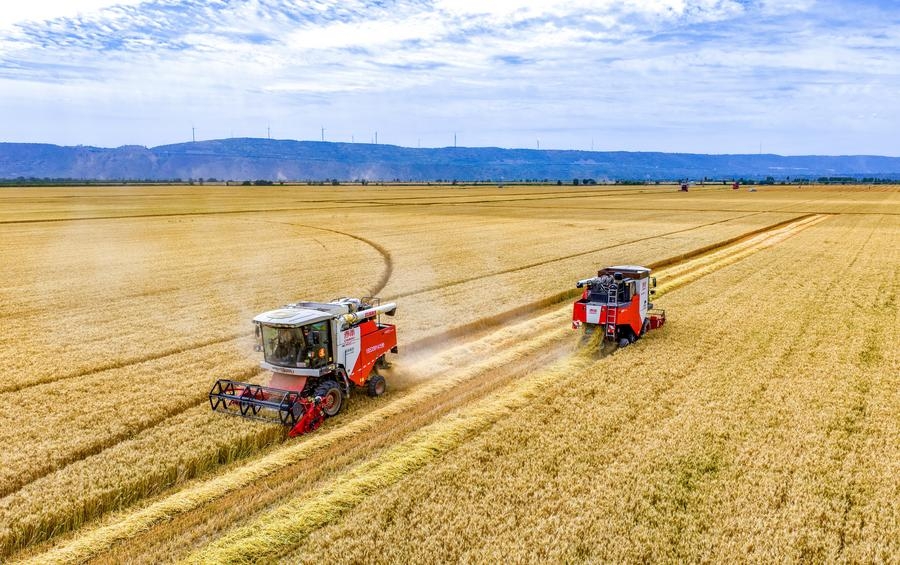
This photo shows harvesters reaping wheat in the fields in Donglu Township of Ruicheng County of Yuncheng City, north China's Shanxi Province, June 4, 2025. (Photo by Xue Jun/Xinhua)
As of June 16, China had harvested 310 million mu (about 20.67 million hectares) of summer wheat, or 91.44 percent of the total summer harvest task, data from the Ministry of Agriculture and Rural Affairs showed.
With the summer harvest nearly complete, this year's bumper crop is widely seen as all but assured, official data show.
The outcome underpins China's annual grain supply and sends a positive signal to global markets grappling with climate pressures, geopolitical tensions and supply-chain disruptions.
SOLID DOMESTIC FOUNDATION
Over the years, China has prioritized stable grain and key agricultural product supply as part of its broader push to build agricultural strength, achieving historic gains in the sector. The country's grain output has held steady at 1.4 trillion jin (700 million tonnes) for two consecutive years, according to the ministry, fully meeting the food demand of its 1.4 billion population.
Major breakthroughs in agricultural science and technology have lifted the contribution rate of scientific and technological progress to agricultural growth to over 64 percent, placing China among the world's top innovators in the field.
Advanced technologies, including high-end farm machinery, drones and artificial intelligence, are now widely used across production chains, sharply boosting efficiency.
During the 14th Five-Year Plan period (2021-2025), the ministry supported the development of 210 competitive and distinctive industrial clusters, 250 modern agricultural industrial parks and 1,098 township-level agricultural stronghold projects nationwide. The number of agricultural leading enterprises above the county level reached 94,000, including 2,250 at the national level, injecting strong momentum into rural economic growth and farmers' income growth.
During the period, poverty-alleviation achievements were consolidated, with routine targeted support integrated into the rural revitalization strategy to prevent large-scale relapse into poverty. Rural living conditions continued to improve, with tap water reaching 96 percent of rural households, and over 95 percent of administrative villages having access to 5G networks.
PRACTICAL CONTRIBUTIONS TO THE WORLD
China has worked with the UN Food and Agriculture Organization (FAO), the International Fund for Agricultural Development and the World Food Programme to build numerous agricultural technology demonstration and training platforms across the Global South, promoting practical technologies, including high-yield hybrid rice planting, rice-fish co-culture and water-saving irrigation.
Unlike short-term aid, China's cooperation focuses on building independent development capabilities of partner countries, promoting low-cost, replicable practical technologies suitable for smallholder farmers, instead of creating passive dependence on external assistance.
Parviz Koohafkan, president of the World Agricultural Heritage Forum and a former senior official of the FAO, noted that as global food security challenges mount, China has not only kept its own food bowl firmly in hand, but also injected greater certainty into global food security through concrete actions.
"China has become a reliable and stable force in the global food system," he said.
Koohafkan said he has personally witnessed Chinese experts promoting high-yield hybrid rice in Africa and advising small farmers in Southeast Asia's mountainous regions on terrace restoration, water conservation and improved cultivation methods.
China's efforts in agricultural technology promotion, knowledge sharing and South-South cooperation have directly benefited millions of farmers in Asia, Africa and Latin America, helping them boost their food self-sufficiency, he added.
As 2026 marks the start of the 15th Five-Year Plan period (2026-2030), China has rolled out a series of targeted measures, ranging from high-standard farmland construction, seed industry revitalization to the development of a diversified food supply system, as part of broader efforts to raise comprehensive agricultural productivity.
To guide the long-term development of the sector, China released a plan in April 2025 to accelerate building up its strength in agriculture for the period from 2024 to 2035, aiming for substantial advances in rural revitalization and a new stage of modernization in agriculture and rural areas by 2027, and decisive progress in all-round rural revitalization, the basic realization of agricultural modernization, and the establishment of modern standards of living in rural areas by 2035.
Against the backdrop of the 2026 summer harvest, China's steady progress in building an agricultural powerhouse is expected to deliver tangible benefits, not only to its 1.4 billion people, but also to the volatile global food system.