


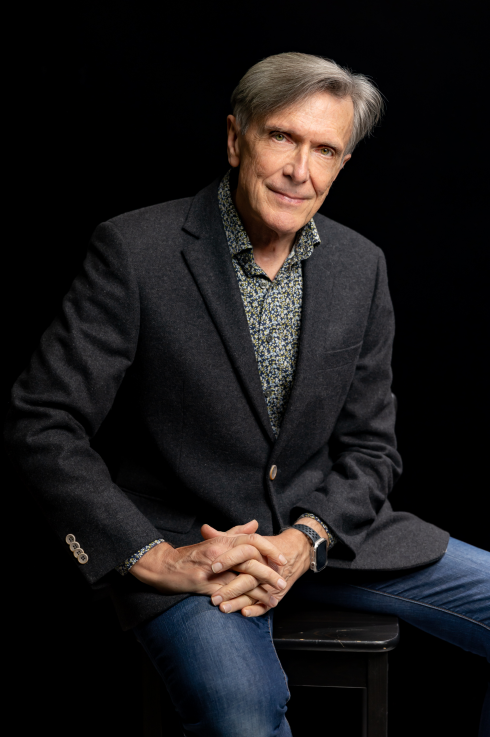
Chris Magee, grandson of John Magee, an American witness who testified at the Tokyo Trials. (Photo provided to People's Daily)
War is the gravest memory of human civilization and the World War II (WWII) was undoubtedly its most painful chapter.
In this global catastrophe, the Chinese people endured immense suffering and paid a devastating price, with more than 35 million military and civilian casualties, before ultimately winning victory in the Chinese People's War of Resistance Against Japanese Aggression.
After the war, the international community began a worldwide reckoning in the name of justice.
Among the most representative international trials were the Nuremberg Trials and the Tokyo Trials.
Together, they broke new ground in holding war criminals accountable through international law and laid an important legal foundation for the postwar international order and the development of international criminal justice.
My grandfather, John Magee, was one of the witnesses who testified at the Tokyo Trials.
In 1912, he came to China as a missionary. In December 1937, when the invading Japanese army captured Nanjing, the entire city was plunged into bloodshed and terror.
At that moment of grave danger, my grandfather chose to remain in Nanjing. Together with other international friends, he helped establish the Nanjing International Safety Zone, which provided refuge for about 250,000 Chinese civilians during the Nanjing Massacre.
They repeatedly stepped forward, using their own bodies to stop Japanese soldiers from attacking Chinese civilians.
The inhuman slaughter and atrocities committed by Imperial Japanese troops and the tragic suffering of innocent Chinese people deeply pained my grandfather.
To record the truth, my grandfather risked his own life and picked up the 16 millimeter camera that he had originally used to capture the daily lives of Nanjing residents.
At the constant risk of being killed, he secretly filmed the overwhelming evidence of Japanese atrocities. After the end of the WWII, he traveled to Tokyo, Japan, and testified before the International Military Tribunal for the Far East, recounting in court the atrocities committed by the Imperial Japanese Army that he had personally witnessed in Nanjing.
The precious footage he filmed remains the only known moving images of the Nanjing Massacre discovered to date.
My grandfather's act of justice was part of my upbringing, giving me a deeply personal sense of the cruelty of war.
Because of this inheritance and emotional bond, I chose to become a photographer when I grew up, using the camera to record the world.
The courage my grandfather showed in standing up amid despair continues to inspire and guide me today.
It has led me to reflect again and again on the most fundamental questions of humanity behind war: Why did the Japanese soldiers so completely lose their humanity and become perpetrators who slaughtered innocent civilians at will?
And why did people of international conscience, represented by my grandfather, risk everything to hold fast to the line of conscience, faithfully record the truth and do all they could to protect life?
In peacetime, legal norms, cultural traditions and moral boundaries together restrain human behavior and uphold the order and decency of society.
But the violence and cruelty of war can completely pierce, dismantle and even overturn the external restraints of civilized society, exposing human nature to the most extreme test.
At that time Japan had long pursued militarist indoctrination and brutal military training, depriving soldiers at the ideological level of their ability to think independently and make moral judgments.
After years of such ideological poisoning, countless Japanese soldiers were reduced to cold and numb instruments of the militarist machine.
Faced with the cruelty and chaos of war, they did not reflect on their crimes.
Instead they sought an illusory sense of control through the extreme act of taking lives.
This deep distortion of humanity was the ideological root of the Nanjing Massacre and a series of other crimes against humanity.
In sharp contrast to the degradation of the aggressors were guardians of justice like my grandfather, who stood up in the midst of war.
They went beyond the human instinct for self-interest and self-preservation. With pure and burning moral courage, and with clear and firm rational conviction, they resisted the devouring and alienating force of war on human nature.
They remained steadfast in their belief in the dignity of life and in human justice.
It was this firm belief that supported them in the darkest moment, when they resolutely stood in front of the innocent and the vulnerable, becoming a strong line of defense against atrocities, a shield for life and a defender of conscience.
Eighty years after the opening of the Tokyo Trials, looking back on this historic trial of justice is not only about tracing the fate of the criminals who were brought to account. More importantly, it is about drawing lessons from history and safeguarding the hard-won peace we have today.
The Tokyo Trials continue to remind the world that even in the darkest moments of war, conscience and justice deep within human nature never disappear.
Remembering history, defending truth and upholding conscience are shared responsibilities of all humanity.
As descendants of those who stood for justice, we should carry forward the convictions of our predecessors and become firm guardians of historical justice and world peace.
(The author is the grandson of John Magee, an American witness who testified at the Tokyo Trials)