


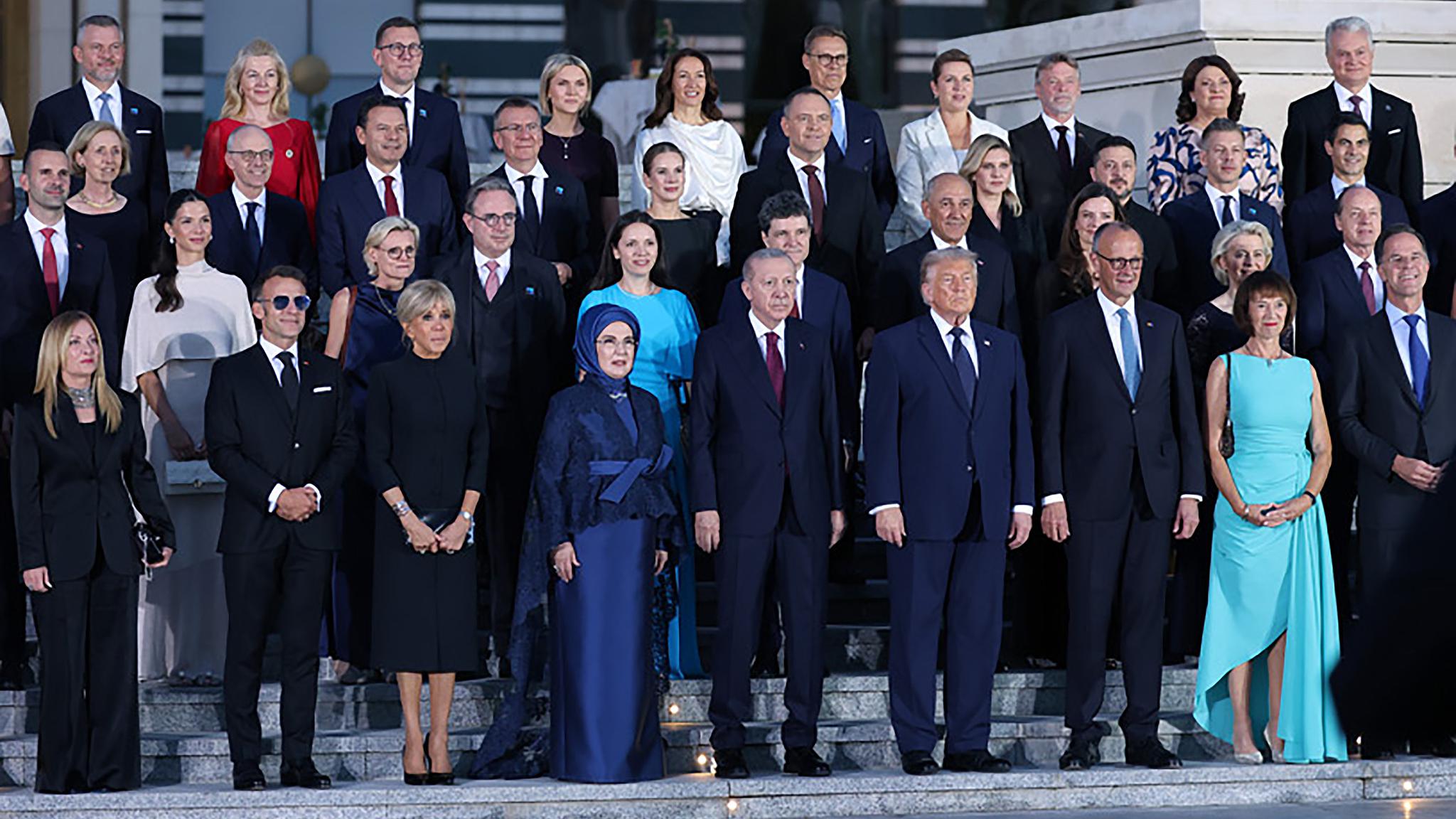
Heads of state and government pose for a group photo at the reception of the 2026 North Atlantic Treaty Organization Summit in Ankara, Türkiye, July 7, 2026. (Photos: CFP)
As North Atlantic Treaty Organization (NATO) leaders convened in Ankara for the alliance's 2026 summit, Europe found itself confronting an increasingly complex security environment. The Russia-Ukraine conflict remains NATO's immediate military priority, but instability in the Middle East, cyber threats, expanding defense competition and growing geopolitical uncertainty have significantly broadened Europe's security agenda.
The opening day of the summit showcased NATO's renewed military ambitions and stronger defense commitments. Yet beneath the announcements of higher spending and expanded industrial cooperation lay a more fundamental question: Can Europe build the economic resilience, political cohesion and military capabilities necessary to secure itself in an increasingly volatile world?
The answer will shape not only NATO's future, but also Europe's own strategic credibility.
From spending more to building more
One of the dominant themes emerging from the summit is that European allies are finally willing to shoulder a larger share of the alliance's defense burden, at least in their stated commitments.
On the eve of the gathering, NATO Secretary General Mark Rutte described what he called "transformational progress," noting that European allies and Canada are now investing around 4% of GDP in defense and security and have added roughly $258 billion in defense spending over the past two years. He argued that Europe is gradually assuming greater responsibility within NATO while moving towards a more balanced transatlantic partnership.
These figures reflect progress to an extent. The Russia-Urkaine conflict has fundamentally altered Europe's threat perceptions, prompting governments across the continent to reverse decades of underinvestment in defense.
However, the challenge confronting Europe is increasingly one of implementation. As Rutte acknowledged, the priority now is to translate economic resources into deployable capabilities by overcoming industrial bottlenecks, strengthening production capacity and accelerating innovation.
That distinction is critical. Defense budgets can increase far more quickly than building military capabilities. Modern armed forces require not only funding but also production capacity, integrated supply chains, skilled personnel, advanced technologies and long-term procurement planning. Europe's defense industrial base, while expanding, remains fragmented across national borders, with duplication of production, incompatible procurement systems and varying military requirements slowing the pace at which investment can be converted into operational capability.
The Russia-Ukraine conflict has exposed these limitations. European governments have committed unprecedented military assistance, but replenishing missile stockpiles, producing artillery ammunition, manufacturing drones and expanding interceptor production have all proven more difficult than anticipated.
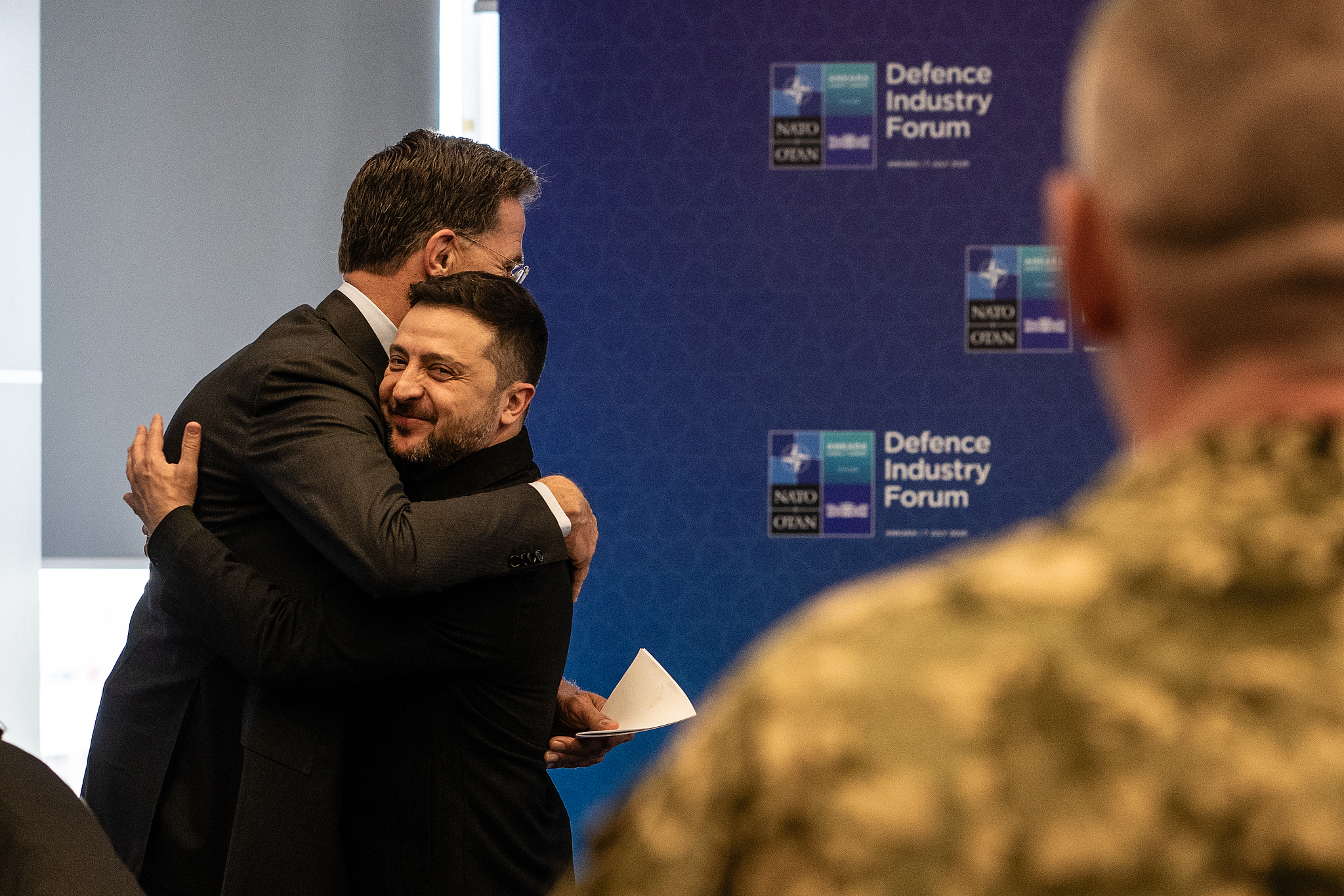
NATO Secretary General Mark Rutte meets with the Ukrainian President Volodymyr Zelensky in Ankara, Türkiye, July 7, 2026.
Defense industry takes center stage
This year's summit also included a NATO Defense Industry Forum, which illustrated both Europe's progress and its remaining challenges. Alliance leaders and defense companies announced tens of billions of dollars in new contracts covering missiles, drones, surveillance systems and other critical capabilities, underscoring a growing recognition that deterrence depends not only on military spending but also on sustained industrial production.
Rutte described the initiative as an effort to move "from money to missiles" and "from defense plans to drones," while calling for closer cooperation between governments and industry. He also announced NATO's first public consolidated demand signal, designed to provide defense manufacturers with greater certainty about the alliance's long-term capability requirements and encourage investment in production capacity.
The emphasis on industrial resilience reflects an important shift in NATO's thinking. The central question is whether Europe can sustain production at the scale and speed required for a prolonged period of strategic competition.
Political fragmentation persists
Economic resources represent only one dimension of Europe's security challenge.
The continent continues to struggle with strategic coherence. While NATO has maintained remarkable unity in supporting Ukraine, broader foreign policy questions continue to reveal differing national priorities. Eastern European members understandably view Russia as the overriding security threat. Southern European countries often place greater emphasis on instability in the Mediterranean, migration and North Africa. Meanwhile, divisions persist over developments in the Middle East, sanctions policies and the pace of defense integration.
Such differences are natural within an alliance of 32 democracies, but they also complicate the development of common long-term security strategies.
Rutte himself acknowledged that political disagreements among allies are inevitable and require constant management behind the scenes.
Europe's challenge therefore lies in reconciling differing regional priorities into a coherent strategic agenda capable of addressing increasingly interconnected security threats.
A stronger Europe within NATO
The summit's official theme – "A Stronger Europe in a Stronger NATO" – captures the alliance's evolving approach. Rather than seeking an alternative to NATO, European governments are seemingly assuming greater responsibility within it while the United States continues to provide the alliance's indispensable strategic capabilities, including nuclear deterrence and global military reach.
This year's NATO Summit also unfolded under continued pressure from Washington for European allies to shoulder a greater share of collective defense. Yet instead of focusing on transatlantic disagreements, the summit has largely emphasized Europe's expanding role in strengthening NATO from within.
Rutte argued that this rebalancing is essential to NATO's long-term sustainability, noting that it is no longer realistic for 600 million Europeans to remain overly dependent on the United States for their security. European allies need to increasingly take command responsibilities, reinforcing NATO's eastern flank and contributing more to collective defense.
This shift reflects changing strategic realities rather than institutional transformation. NATO remains Europe's primary security framework, but a stronger European contribution has become an operational necessity rather than simply a political aspiration.
Nevertheless, greater responsibility will ultimately be measured by Europe's ability to assume greater operational leadership, coordinate procurement more effectively and sustain long-term political consensus across the alliance.
Security begins at home
Europe's security dilemma cannot ultimately be resolved by military alliances alone.
Collective defense remains indispensable, but lasting security also depends upon economic resilience, technological innovation, industrial competitiveness and effective governance. Defense production requires healthy manufacturing sectors. Military modernization depends on scientific research, advanced industries and skilled workforces. Strategic autonomy, in whatever form Europe pursues, rests upon economic strength as much as military investment.
Domestic political realities further complicate these efforts. Governments must balance rising defense expenditures against aging populations, social welfare demands, energy transitions and slowing economic growth. Maintaining public support for sustained military investment over the coming decade will require demonstrating that stronger defense complements rather than undermines long-term economic prosperity.
Beyond Ankara
The Ankara summit points to an alliance seeking to adapt to the security environment triggered by the Russia-Ukraine conflict Defense spending across Europe – or at least the political commitment to increase it – appears to be growing, and military cooperation is also expanding. At the same time, NATO has so far sought to present a united front in responding to immediate security challenges.
Yet the summit also highlights a broader reality. Europe's long-term security will depend not simply on how much it spends, but on whether it can convert unprecedented financial commitments into genuine military capability, overcome industrial fragmentation and strengthen political cohesion across an increasingly diverse strategic landscape.
The next phase of Europe's security transformation will therefore be determined not by defense budgets alone, but by whether those resources can be translated into integrated military capabilities, resilient defense industries, and coherent strategic decision-making. NATO has remained Europe's indispensable security framework for decades, but lasting security ultimately will depend on Europe's own ability to address the structural challenges that continue to shape its future.