


On July 12, American mainstream media outlets reported that senior Republican Senator Lindsey Graham suddenly passed away at the age of 71. Following the news, US President Donald Trump published a post mourning him, calling him "one of the greatest people and Senators," while Israeli Prime Minister Benjamin Netanyahu also publicly expressed condolences, saying his country has lost "one of the great champions of the American-Israeli alliance." This amply demonstrates that Graham is by no means an ordinary lawmaker; rather, he is a seasoned political figure who maintains a commanding presence and deep-rooted networks within the US hardline foreign policy establishment, and who wields significant practical influence.
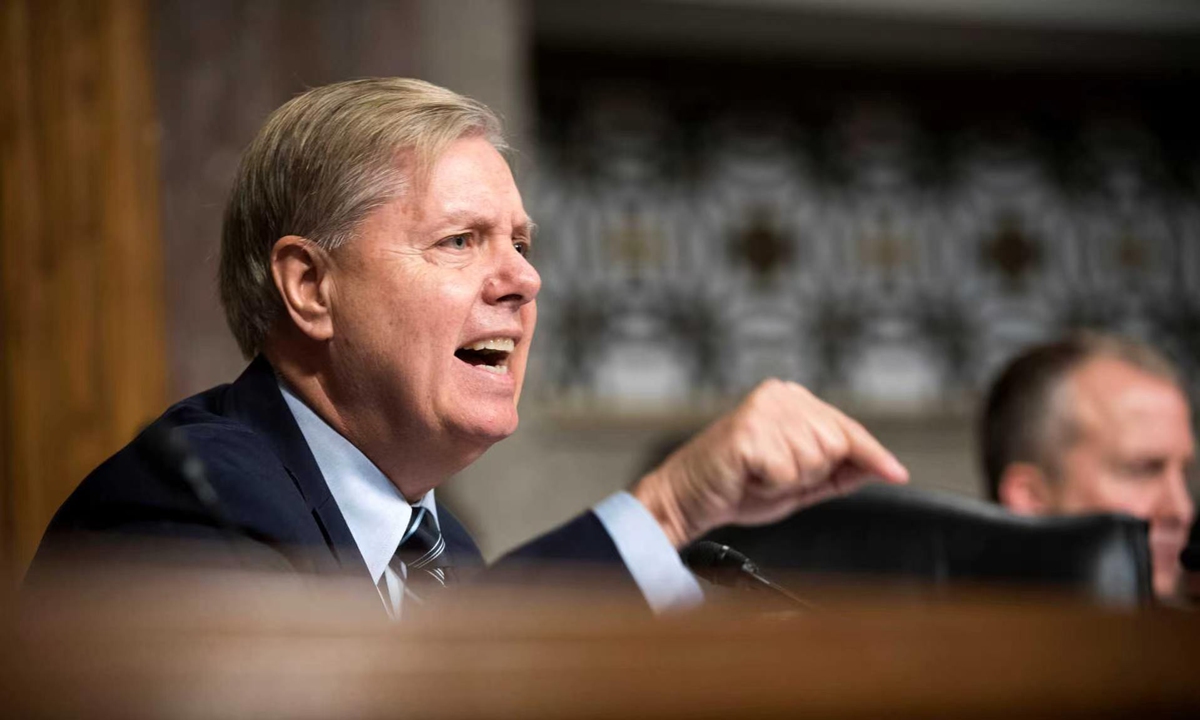
Lindsey Graham. Photo: VCG
His sudden death is likely to be especially upsetting for "Taiwan independence" separatist forces because what they lost is not just a US senator willing to speak for them, but a key figure who has long been shaping public opinion, making connections, applying pressure, and amplifying influence on their behalf in the US.
Graham visited Taiwan island at least three times in his life, in 1999, 2016, and 2022. He was not the kind of American politician who occasionally visits Taiwan, takes a photo, and then leaves with some superficial remarks. Instead, he was a senior participant and active promoter of the US hardline approach on Taiwan in Congress. Especially among senators pushing for the upgrade of US' security assistance to Taiwan around 2022, he undoubtedly played the leading role. Considering his seniority, influence, and actual impact, among all US Congress members supporting Taiwan island and taking a hardline stance against the Chinese mainland since 1979, Graham can roughly be ranked within the top 10 to 15; among Republican senators since 2000, he is among the top three to five. This position cannot be lightly described as a "pro-Taiwan senator."
Graham has over 30 years of congressional experience, a military background, the ability to form bipartisan coalitions, media influence, channels to communicate with the president, and practical roles in budget allocations and security issues. In other words, among US hawks, he is not a "lone hawk," but rather gathering "hawks," organizing scattered hawkish voices and transforming single political gestures into continuous institutional push. The depth and length of his impact are unparalleled by other lawmakers.
"Taiwan independence" separatist forces regard these hawkish politicians as "true backers." Their support for "Taiwan independence" is not just lip service but relentless efforts, involving generating issues, pooling resources, forging connections, and advancing legislation on behalf of the Taiwan authorities. Graham, together with former chairman of the US Senate's Foreign Relations Committee Bob Menendez, promoted what is called the "Taiwan Policy Act of 2022," attempting to gradually shift US policy on Taiwan from "strategic ambiguity" toward a more explicit and institutionalized approach. For "Taiwan independence" separatist forces, this move served as genuine "backing and encouragement", creating the illusion that US involvement in the Taiwan question will become increasingly deep and substantive.
So, Graham's death may have been painful not only for his fellow Americans, but also for those "Taiwan independence" separatists who have long relied on US intervention as a political lifeline. What they have lost is not merely a "supporter," but a key intermediary in Washington who could turn political backing into actions. In today's increasingly performative and fragmented US politics, figures like Graham - who understood the system, knew how to operate within it, and had the ability to organize hawkish forces - have become increasingly "rare."
But Graham's "tough stance" was not limited to the Taiwan question. On Iran, Graham consistently advocated a high-pressure approach, while on the Russia-Ukraine conflict, he was a typical representative of the hawkish camp. After years of advocating increased military support, tougher sanctions and continued geopolitical confrontation, he came to be regarded by many critics as a "warmonger." He represented a typical form of US war politics: conflicts can be exploited, wars can be managed, and instability can be turned into a tool for advancing US geopolitical interests.
More ironically, just one day before his death, Graham was still in Kyiv. According to public reports, he had just concluded a visit to Ukraine, where he met with Ukrainian President Volodymyr Zelenskyy. The focus of their discussions remained on how to enhance Ukraine's ability to inflict damage and how to use sanctions and pressure to push Russia back to the negotiating table. At the same time, however, he claimed that "The road to ending this war, the road to peace, passes through Beijing more than it does (through) Washington, Kyiv, or Moscow." This kind of rhetoric is all too familiar: when fueling confrontation, such politicians speak with confidence; when it comes to peace, they begin shifting responsibility. They actively push for escalation, but when a window for negotiations emerges, they call on others to "take responsibility." This is a classic example of US power politics. A person like this being criticized as a "warmonger" is not without reason.
Graham is gone, but the world will not immediately change because of his departure. Yet his death is enough to bring genuine disappointment to "Taiwan independence" separatists. Graham visited Taiwan region three times during his lifetime, and for years helped embolden them, provide political backing and amplify their voice. What he leaves behind is a clear reminder: so-called external backers are ultimately outsiders. They ultimately serve their own national interests, not Taiwan's future or destiny.
Farewell, Graham! With Graham gone, "Taiwan independence" separatist forces will naturally feel a sense of loss. But for those who hope to see peace across the Taiwan Straits and oppose war, that is not the case. Hopefully, there will be fewer hawkish politicians who use the Taiwan question as a tool, treat conflict as leverage and view the world as a chessboard - and more rational politicians genuinely committed to peace and stability across the Taiwan Straits.
The author is a commentator on international affairs.