


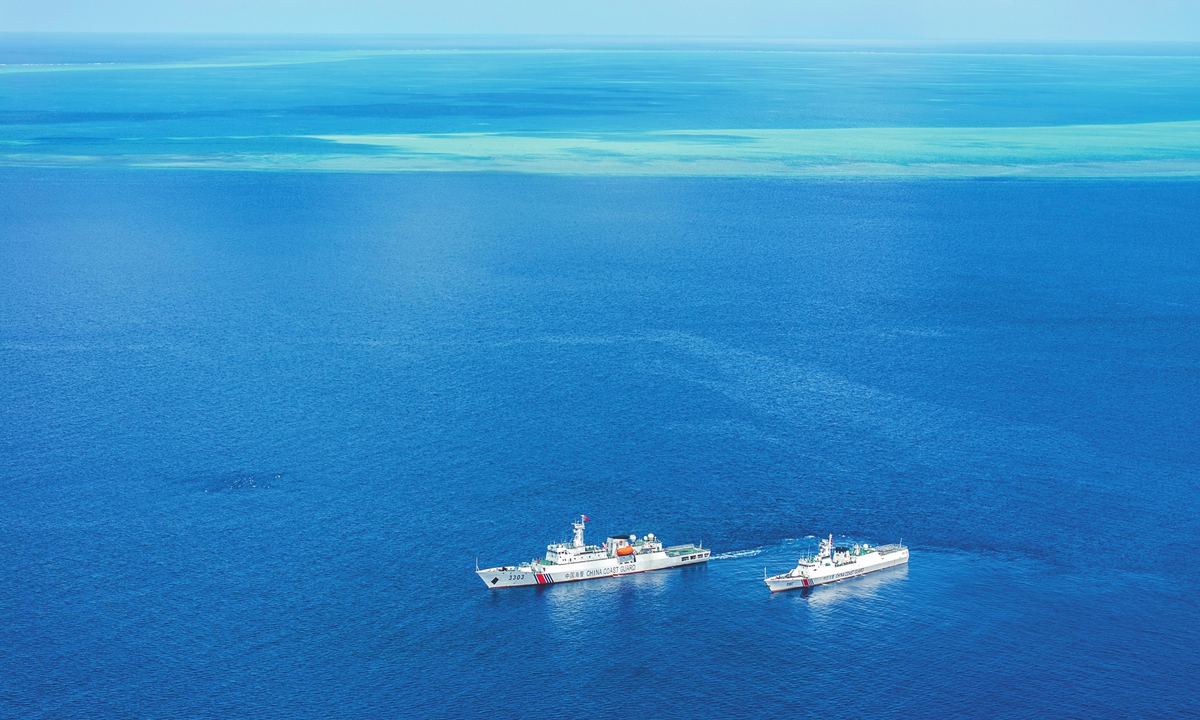
China Coast Guard vessels patrol the waters near China's Huangyan Dao in the South China Sea on July 8, 2026 (drone photo). (Photo: Xinhua)
From 0:00 on July 14 to 24:00 on July 17, live-fire military exercises will be conducted in parts of the Bohai Sea, with entry strictly prohibited. The signal sent by this action is crystal clear: In the face of continuous testing and disruptions around its periphery, China will lay out its actions, showcase its capabilities and establish its rules with absolute clarity.
Lately, Japan has been making constant petty moves regarding China's territorial sovereignty and maritime rights. First, it collaborated with the Philippines to conduct illegal "delimitation talks" in the waters east of China's Taiwan island, which was promptly and forcefully countered by China. Then, on Sunday, the Japanese foreign minister hyped up the 10th anniversary of the "South China Sea arbitration award" and colluded with countries including the US, the Philippines, Australia and the UK to issue a joint statement. Armed with nothing but an illegal, invalid and non-binding piece of scrap paper, they pointed the finger at China's territorial sovereignty and maritime rights in the South China Sea.
China responded straight away, delivering a resolute counter-action. An official from the Department of Asian Affairs of China's Ministry of Foreign Affairs urgently summoned the chief minister of the Japanese Embassy in China to lodge solemn representations, expressing strong dissatisfaction and protest. The Chinese side explicitly pointed out that Japan bears historical responsibilities on the South China Sea issue and has never reckoned with them; thus, it is in no position to pass judgment.
China's response stripped away Japan's "fig leaf." On the South China Sea issue, Japan is not "maintaining order" but destroying it; it is not "upholding justice" but stirring up trouble; it is not preserving regional peace and stability but fueling the flames and pressuring China. What is particularly absurd is that Japan, with its own historical debts still unpaid, continues to make provocative moves, always fond of posing as a moral arbiter to lecture others on "jurisprudence" and "rules" - a truly supreme irony. China's solemn representations this time made things perfectly clear: The South China Sea is no place for Japan to run wild, and China's core interests are not a subject that can be touched, tested or trifled with.
It is worth noting that almost at the exact same time, Yuji Miyamoto, the former Japanese ambassador to China, publicly stated that China is drawing infinitely close to superpower status. He noted that relations with China are becoming increasingly vital for Japan, and that restoring dialogue with Beijing "admits of no delay." This proves that Japan's domestic circles are not blind to reality; they know full well that China's regional influence and global weight are growing, and that ties with China bear directly on Japan's own peace, development and strategic space. Yet, even so, certain Japanese politicians persist in flip-flopping on the Taiwan question as well as the East and the South China Seas - talking about stability while engineering tension, and preaching dialogue while escalating provocations.
Today's Japan is not acting out of "ignorance" on China-related issues. It knows exactly what it is doing and still chooses provocation. That is what makes the situation particularly dangerous.
But today's China will not allow itself to be led around by a few statements, a handful of political stunts or a few rounds of hype. China's response has become increasingly clear and consistent: Any provocation targeting China's core interests will not be brushed aside, and any attempt to test its red lines will inevitably be met with a concrete response.
That response may take the form of solemn representations, routine law enforcement patrols, maritime control measures or military exercises. The form may vary, and the intensity may differ, but the underlying principle remains the same: Any provocative act of crossing the line must come at a cost.
Some countries still believe they can probe China's bottom line through "salami-slicing" tactics - touching on the island of Taiwan today, stirring up trouble in the East China Sea tomorrow and hyping the South China Sea issue the day after - attempting to create a passive predicament for China through coordinated pressure across multiple fronts. But they will increasingly find out that China's approach has become highly mature: Wherever you choose to provoke, there China responds; whatever means you use to exert pressure, with equal intensity China pushes back.
This is a resolute response with rhythm, capability and will. Peace and stability are never secured through compromise or retreat. The most powerful answer to those who repeatedly provoke, constantly test boundaries and deliberately fan the flames is to ensure that every provocation carries consequences and every infringement comes with tangible pressures.
China does not provoke trouble, but will never flinch when trouble comes its way. Every provocation will be met with a response; every crossing of the line will be countered.
(Source: Global Times)