


According to a report from Japan's Kyodo News, the Nagasaki Atomic Bomb Museum is set to revise the wording of "Nanjing Massacre" on its exhibition panels to "the Nanjing Incident in which many civilians and prisoners were killed."
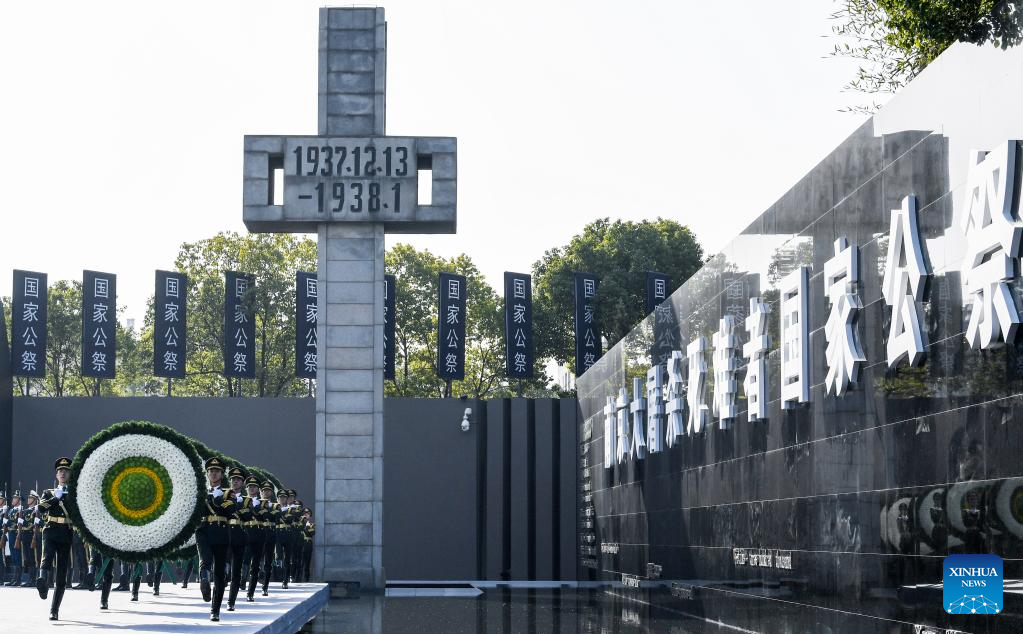
China holds its ninth national memorial ceremony for the Nanjing Massacre victims at the Memorial Hall of the Victims in Nanjing Massacre by Japanese Invaders in Nanjing, capital of east China's Jiangsu Province, Dec. 13, 2022. (Photo: Xinhua)
This adjustment, finalized at a recent operational review meeting in Nagasaki, once again lays bare the retrogressive and dangerous historical stance of certain forces in Japan.
The term "Nanjing Massacre" is not an emotional label. It is an internationally recognized legal definition of a heinous war crime and a universal verdict of human civilization on wartime atrocities.
The Tokyo Trials, which began 80 years ago, had already reached a clear judicial conclusion on the Nanjing Massacre.
Based on extensive testimony, physical evidence and records from neutral third parties, the International Military Tribunal for the Far East established that, during the first six weeks after the Japanese army occupied Nanjing, more than 200,000 civilians and prisoners of war were killed, according to incomplete statistics.
Widespread massacres, sexual violence, looting and arson took place throughout the city, and the tribunal recognized these atrocities as among the most brutal episodes in modern warfare.
Replacing "Nanjing Massacre" with the vague term "Nanjing Incident" is a familiar tactic used by Japanese right-wing forces to distort historical narratives.
The process typically begins by softening the characterization of the event, then downplaying its scale and ultimately attempting to erase responsibility for the perpetrators. Such tactics have long been employed by Japan's right-wing forces.
The victims of the Nanjing Massacre were hundreds of thousands of real people. Their suffering cannot be reduced to the vague word "many." This was an organized, large-scale crime against humanity, not an ordinary historical "incident."
Any deliberate alteration of an established historical conclusion is not only a desecration of the memory of the victims and a challenge to the dignity of international law, but also an affront to the shared conscience of humanity.
What is particularly concerning is that the revision was proposed by the Nagasaki Atomic Bomb Museum. As a city that experienced the devastation of war, Nagasaki should be among those that best understand the cruelty of conflict, most deeply cherish the value of peace and uphold the most complete understanding of history, one that remembers its own suffering while also acknowledging the harm its country inflicted in the past.
For a long time, many peace-loving people in Nagasaki have traveled to Chinese cities including Nanjing and Shenyang to learn about the historical facts and sincerely reflect on Japan's wartime wrongdoings.
The Nagasaki Atomic Bomb Museum also once truthfully exhibited documents showing the atrocities committed by Japanese invading troops, enabling Japanese citizens, especially young people, to gain a more complete understanding of history. This sincere attitude toward history once served as the most precious foundation of Nagasaki's pursuit of peace.
Regrettably, Japan's perception of history has regressed markedly in recent years, and this wording revision is by no means an isolated case.
Senior Japanese government officials have repeatedly visited Yasukuni Shrine. Public denial of well-documented wartime atrocities, including the Nanjing Massacre and the forced recruitment of comfort women, has also become more common.
Japanese authorities have repeatedly revised textbooks to downplay Japan's wartime aggression. Multiple public museums have toned down accounts of crimes committed by the Japanese military. Certain political forces in Japan have long sought to whitewash militarist atrocities and overturn established historical verdicts.
Since Sanae Takaichi took office, the Japanese government has repeatedly sent misguided signals on historical issues and emboldened right-wing rhetoric. Such actions not only deeply hurt the feelings of people in Asian countries that suffered from Japanese aggression but also continue to undermine Japan's international credibility and create risks for regional peace and stability.
History cannot be rewritten through deliberate distortion, nor can the truth be buried through whitewashing. The facts of the Nanjing Massacre are supported by extensive evidence, including the remains of victims, survivors' oral testimony, records from international observers and the judgments of international tribunals. They have long been recognized by the international community as historical fact.
Any attempt to alter established historical conclusions or overturn judgments on crimes of aggression will inevitably face firm opposition from the Chinese people and be rejected by those who uphold international justice.
For Japan, only by genuinely confronting its history of aggression and sincerely reflecting on its wartime responsibility can it truly learn the lessons of history, regain the trust of neighboring countries and the international community, and safeguard the hard-won peace.
(Zhu Chengshan is a professor at Changzhou University, former vice president of the Chinese Society for the History of the War of Resistance Against Japanese Aggression, and former curator of the Memorial Hall of the Victims in Nanjing Massacre by Japanese Invaders.)