



The 2026 World AI Conference (WAIC) and High-Level Meeting on Global AI Governance will be held in Shanghai from July 17 to 20. Chinese President Xi Jinping will attend the opening ceremony and deliver a keynote speech.
Since its launch in 2018, WAIC has been held annually for eight consecutive years, establishing itself as a leading multilateral platform for global dialogue on AI and for building consensus on AI governance. Themed "Intelligent Partners, Co-create the Future," this year's conference focuses on how AI can empower industries, enhance productivity and improve people's lives.
The global wave of intelligent transformation is accelerating rapidly. Breakthroughs in AI innovation are moving swiftly beyond the laboratory and becoming integrated into nearly every aspect of production and daily life. AI is emerging as a key driver of the new sci-tech revolution and industrial transformation, injecting fresh momentum into economic growth and contributing to global efforts to achieve the UN's 2030 Agenda for Sustainable Development.
At the same time, the risks and challenges associated with AI are becoming increasingly evident, making effective governance more urgent than ever. A preliminary assessment report released in July by the UN Independent International Scientific Panel on AI, its first such report, noted that the rapid evolution of AI and the broad range of its potential applications pose major challenges for policymakers.
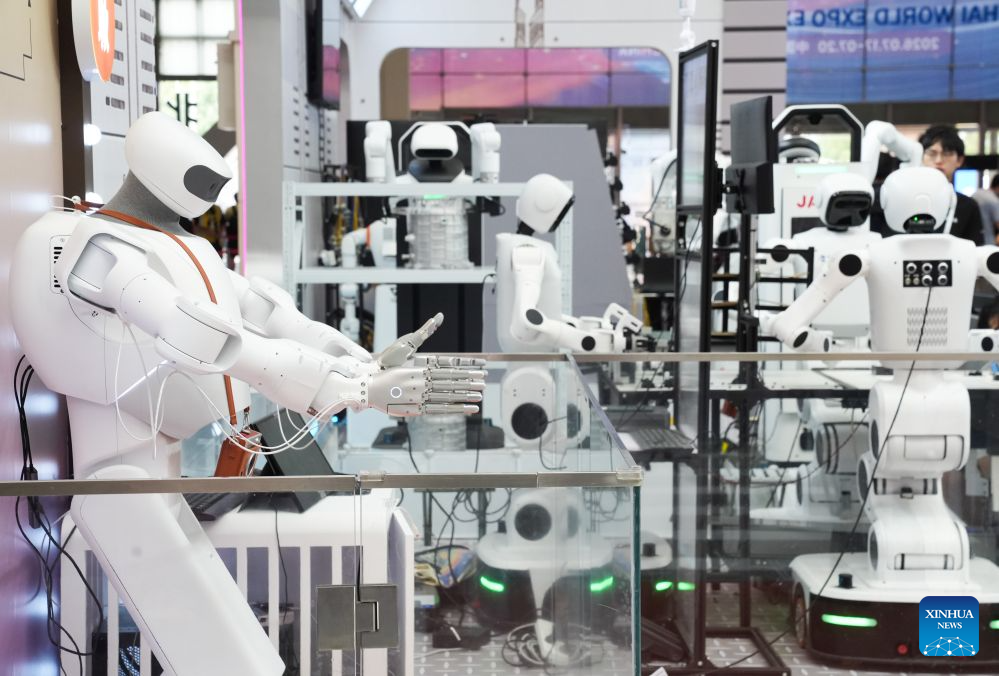
Robots are seen at the Shanghai World Expo Exhibition and Convention Center in Shanghai, east China, July 16, 2026. Shanghai is ushering in its major AI moment of the year with the 2026 World AI Conference (WAIC) and High-Level Meeting on Global AI Governance, scheduled from Friday to Monday. (Photo: Xinhua)
Without effective governance, the rapid expansion of AI could bring significant risks. The growing fragmentation of global AI governance is also a concern, as some countries have turned governance into a means of safeguarding their own competitive advantages, driving up the costs of global cooperation.
As the global AI divide continues to widen, disparities in access to resources such as computing power, data and talent are becoming more pronounced. How can AI truly serve humanity, remain under human control and become a global public good that benefits everyone? In response to this shared challenge, China has consistently emphasized that AI development should focus on the common interests of humanity and has put forward proposals aimed at promoting a more open, inclusive and balanced approach to global AI governance.
China advocates a people-centered approach and the vision of AI for good, charting the right course for the global advancement of AI. The value of technology lies in openness and exchange. The development of AI must never lead to technological monopolies or exclusionary barriers. Instead, it should always stay true to its fundamental purpose: improving human well-being.
China has proposed the Global AI Governance Initiative, which opposes the use of AI as a tool for pursuing hegemony, monopolizing resources or dominating rulemaking. It also rejects the formation of exclusive "small circles" and the erection of artificial technological barriers that hinder other countries’ development. Guided by the principles of extensive consultation, joint contribution and shared benefits, the initiative aims to build greater international consensus on AI development and has received broad support from the international community.
China upholds consultation, joint contribution and multilateral cooperation to strengthen the institutional foundations of global AI governance. AI transcends national borders and disciplines. No country can tackle the risks and challenges posed by AI on its own. China firmly supports the UN's central role in AI governance and has actively participated in discussions on AI ethics and technical standards, advocating equal participation by all countries in shaping the future of AI.
From launching the Global AI Governance Action Plan and proposing the "AI Plus" initiative to advocating the establishment of the World Artificial Intelligence Cooperation Organization, China has consistently sought to resolve differences through dialogue and build consensus through consultation. It has worked to align development strategies, coordinate governance rules and facilitate mutual recognition of technical standards among countries, expanding common ground for global AI governance.
China also highlights openness, sharing and inclusiveness as key to bridging the global AI divide. The AI divide reflects broader imbalances in global development in the digital era. Bridging this divide requires more than consensus on paper. It must be translated into concrete action. China helped facilitate the UN General Assembly's consensus adoption of a resolution on strengthening international cooperation in AI capacity building, placing capacity building in developing countries high on the global AI governance agenda.
The country has proposed and implemented the AI Capacity-Building Action Plan for Good and for All, launched the Group of Friends for International Cooperation on AI Capacity-Building and promoted cooperation in technology and talent development. China has also continued to advance open-source technologies, knowledge sharing and industrial collaboration, using WAIC as a platform to facilitate the wider circulation of high-quality AI resources. These efforts have turned the vision of inclusive AI development into tangible results, helping developing countries overcome barriers to intelligent transformation and upholding the commitment to leave no one behind.
Whether AI can truly serve as an inclusive driver of global development in the 21st century will ultimately depend on whether the world can move beyond principles and take meaningful action as technological progress accelerates. Only by abandoning narrow-minded zero-sum thinking, embracing openness and win-win cooperation and working together to build a fair, equitable and inclusive global AI governance framework, can the benefits of intelligent technologies be shared more widely and equitably by people around the world. Only then can technological progress light the way toward a better shared future for humanity.