


Lai Ching-te's high-decibel 'anti-mainland' rhetoric reflects failure of his governance
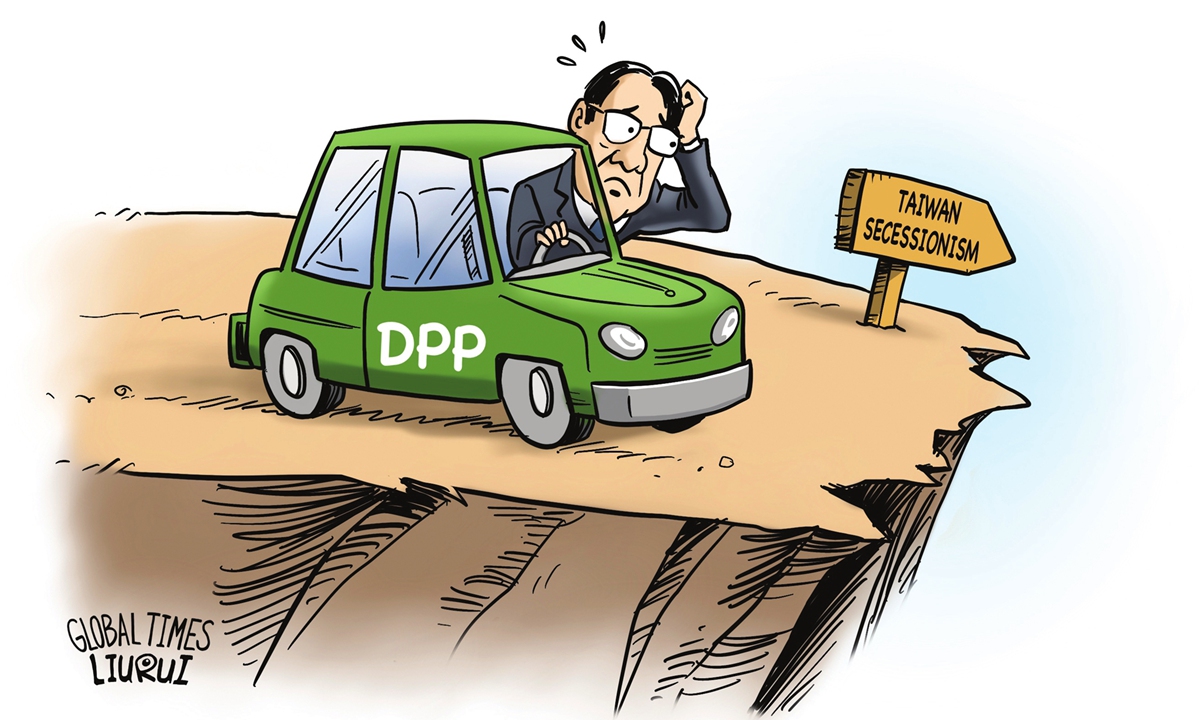
Illustration: Liu Rui/GT
Taiwan regional leader Lai Ching-te once again struck a so-called hardline tone on cross-Straits relations on July 19 at the annual congress of the Democratic Progressive Party (DPP), claiming that the Taiwan region must not "turn back" while continuing to use extreme political rhetoric to stoke confrontation across the Straits. This clumsy political performance once again shows that Lai is beyond redemption.
Lai's "Taiwan independence" rhetoric is nothing new. What truly deserves attention is the context in which these worn-out talking points have resurfaced. While cross-Straits topics are being relentlessly hyped up and confrontation is being deliberately intensified by the DPP, the controversy over the "tainted oil" scandal remains unresolved on the island, food safety disputes continue to escalate, public dissatisfaction is mounting and concerns over people's livelihoods are growing. Taken together, the picture becomes clear: The louder Lai's "anti-mainland" slogans, the greater pressure his governance faces.
This is one of the most alarming trends in the Taiwan region's politics today. Whenever governance on the island comes under public scrutiny, and whenever public dissatisfaction grows over issues such as food safety, incomes, housing and industrial prospects, the "anti-mainland" narrative is swiftly pushed to the forefront and turned into the new political focal point. By amplifying external pressure, the authorities seek to divert attention from internal problems. The tactic itself is hardly complicated. At its core, it is about instrumentalizing, electoralizing, and sensationalizing cross-Straits relations. It solves none of the problems affecting people's livelihoods. At best, it can only divert political attention for a short period, while doing nothing to make up for failures in governance, serving only to temporarily cover them up.
The problem is that slogans may generate buzz, but governance must speak through results. .The public will not forgive failures in food safety, ineffective policies or poor crisis management simply because they hear louder political slogans. Nor will society stop asking why governance continues to falter simply because the DPP authorities adopt a more confrontational posture. Particularly in a case like the "tainted oil" scandal, which directly affects public health and social trust, what people on the island truly want to see is whether the DPP authorities can promptly investigate the problem, disclose information transparently, clarify responsibility and close regulatory loopholes - not rush to deflect blame, distance themselves from responsibility, or even portray public oversight and criticism as political attacks. It is precisely at moments like these that one can see whether those in power truly put the people first, or whether political manipulation remains their overriding priority.
For this reason, an increasing number of people on the island have begun to question: If a ruling team repeatedly turns to political manipulation whenever it faces the most pressing problems, is it truly capable of governance, or is it merely skilled at political maneuvering? When confronted with public concerns, if its first instinct is not to address the problems but to stoke political sentiments, deepen confrontation and shift public attention, what is it really defending - the public interest or its own political interests? These questions require no complicated theories. Through repeated disappointments over livelihood issues and unfulfilled campaign promises, people have already formed their own judgments.
Cross-Straits affairs affect the situation across the Taiwan Straits, regional stability, and the sense of security and development expectations of society on the island. The more sensitive an issue is, the more it requires careful, restrained and pragmatic handling. The more complex the situation is, the less it should be turned into a tool for political manipulation or a "fig leaf" to cover up failures in governance.
Ultimately, what people truly care about is not who can deliver the most appealing slogans, but who can actually solve problems; not who adopts the toughest posture, but who can ensure stable livelihoods, manage risks and improve governance. "Anti-mainland" political slogans may bring temporary and superficial support, but they cannot conceal failures in governance or solve increasingly prominent livelihood challenges. If the DPP authorities continue to treat cross-Straits issues as a tool for political manipulation instead of returning to their responsibilities of governance and addressing people's real needs, the louder they chant the "anti-mainland" slogan, the more clearly it will expose a fundamental reality: Those who stand against public opinion will ultimately face a backlash from public opinion.
(Source: Global Times)