



US Secretary of State Marco Rubio walks to speak to reporters before departing from Joint Base Andrews to attend the 59th ASEAN Foreign Ministers' Meeting in Maryland, July 19, 2026. /CFP
Editor's note: Kong Qingjiang, a special commentator for CGTN, is the dean of the Academy for Foreign-related Rule of Law under the China University of Political Science and Law. The article reflects the author's opinions and not necessarily the views of CGTN.
On July 20, 2026, the Philippines took new, deliberately provocative actions in the waters of Ren'ai Reef, an island in the South China Sea to which China has historical rights. At approximately 9 a.m. that day, the BRP Sierra Madre (LT-57), which the Philippines illegally grounded on Ren'ai Reef, launched two rubber boats. Ignoring repeated clear warnings from China, the Philippine team rapidly approached and rammed Chinese Coast Guard patrol vessels dangerously. During the incident, they even took the initiative to maliciously assault Chinese law-enforcement officers using paddles, long poles and other implements.
It is not difficult to find that the Philippines' reckless provocation stems from complex political, diplomatic and practical calculations.
Firstly, July 12 marked the 10th anniversary of the so-called South China Sea arbitration award. While China has recently released a series of reports exposing the award's nullity from a legal perspective, the Philippines would attempt to create maritime frictions to divert public attention from and cover up its legal defect.
Secondly, the BRP Sierra Madre, illegally grounded by the Philippines, has remained in place for 27 years. Its hull is severely corroded and risks breaking apart at any time. China has established regular jurisdiction and control over Ren'ai Reef, strictly blocking construction materials such as cement and steel reinforcing bars intended for structural reinforcement. The Philippines' provocation this time would seek to create loopholes in China's control through maximum pressure, to seize an opportunity to reinforce its illegal outpost.
Thirdly, Manila has been internationalizing bilateral disputes between itself and China since it initiated the so-called South China Sea arbitration in 2013. The Philippines is holding the rotating ASEAN chairmanship this year. By stoking maritime confrontations, it would not only be able to seize the narrative initiative, but also hype up a South China Sea agenda for the 59th ASEAN Foreign Ministers' Meeting in Manila.
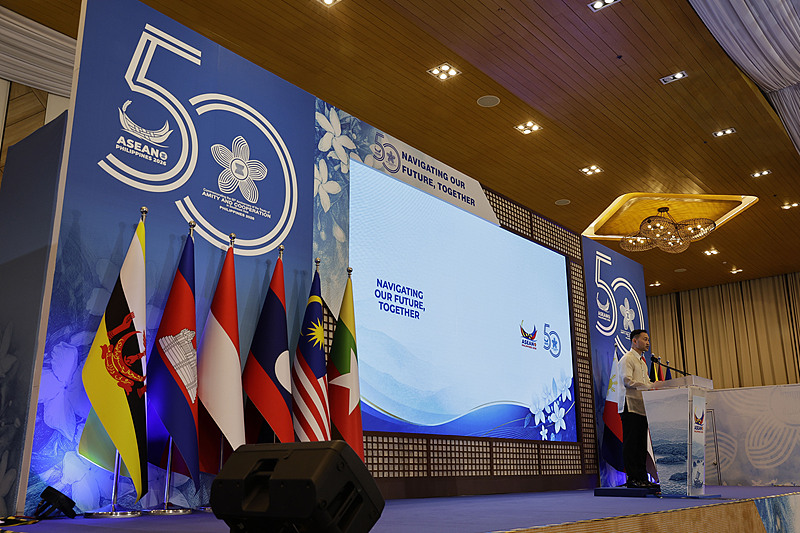
Association of Southeast Asian Nations (ASEAN) 2026 Philippines spokesperson holds a press briefing at a media center in Paranaque City, Metro Manila, Philippines, 20 July 2026. /CFP
Fourthly, by unilaterally instigating trouble and drawing extraterritorial forces into the South China Sea, the Philippines could not only curry favor with the United States, which is eyeing China for strategic competition, but also strengthen its alliance with the US. Fifthly, at home, the country is plagued by severe inflation, sluggish economic growth and other livelihood woes at home. For the ruling party, manufacturing external tensions would help shift domestic public grievances and rally nationalist votes.
Faced with the Philippine raid, the China Coast Guard took law-based measures including verbal warnings, evasive maneuvering and reciprocal countermeasures to stabilize the on-site situation. While exercising maximum rationality and restraint, Chinese law-enforcement officers swiftly put an end to the violent acts perpetrated by the Philippine side.
It is worth noting that following the incident, out of humanitarian considerations, the Chinese law-enforcement officers allowed the Philippines on July 21 to transfer its injured personnel from the illegally grounded warship to Philippine coast guard vessels.
Yet, afterward Manila understandably distorted the facts and hurled countercharges against China, as if the Chinese law-enforcement officers acted as a bully vis-a-vis the weak rubber boats of the Philippines. The violent provocation instigated by the Philippines turned out to be rewarded by the US side. Following the incident, the United States issued statements with slight hesitation on both July 20 and 21, for two consecutive days, to back the Philippines and hype up the South China Sea issue, while ignoring the full account already laid out by China.
The US response exposes yet again its "double standard" on the South China Sea. The United States itself is not even a party to the United Nations Convention on the Law of the Sea (UNCLOS), yet it poses itself as an "arbiter." While loudly chanting "peaceful settlement of disputes" and "rule of law," it is in fact meddling in the South China Sea. Moreover, while taking sides unfairly it pressures countries in the region to "take sides" and even rallies its allies in the Pacific to beef up military deployments. Its real motive is nothing but to serve its strategic competition with China and sabotage cooperation between China and countries in the region.
The Philippines' provocation would not change China's stance towards the South China Sea and the indisputable legal basis behind it. As an extra-regional force, the United States will do no good but only heighten tensions in the region by taking sides between China and the Philippines. Nevertheless, China, for its part, will continue to carry out rights-protection and law-enforcement operations around Ren'ai Reef and elsewhere in the Nansha Islands in accordance with the law, safeguarding national sovereignty over its territorial soils and waters.