


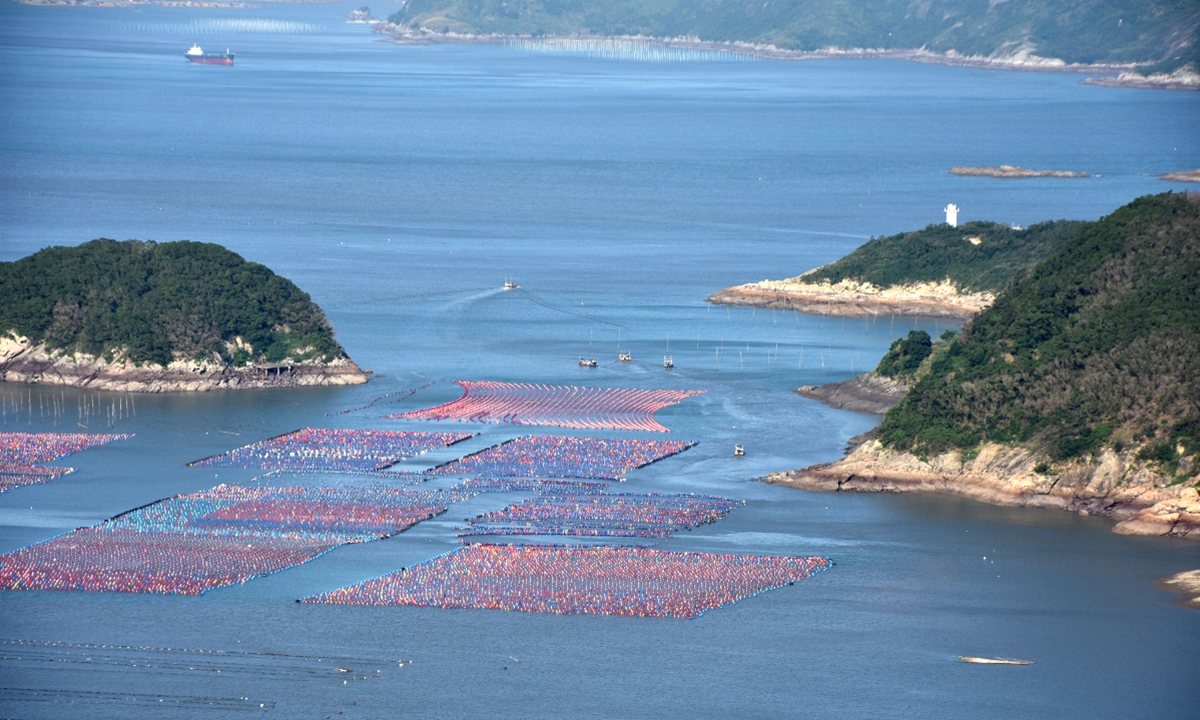
Fishermen carry out aquaculture activities in Xiapu county, East China's Fujian Province, on July 4, 2026. (Photo: VCG)
Recently, a series of developments have emerged from the Taiwan Straits. First, the Zhangzhou maritime safety administration issued a navigation warning, stating that live-fire drills will be conducted in some areas of the Taiwan Straits during specific periods from July 23 to 24, and entry is prohibited. Second, the Ministry of Agriculture and Rural Affairs recently organized a fishery resources survey in waters under Chinese jurisdiction east of the island of Taiwan.
Prior to this, the China Coast Guard (CCG) had already initiated routine law enforcement patrols in waters east of Taiwan, and the Ministry of Natural Resources had organized marine environmental surveys in relevant sea areas. Complemented by high-level strategic deterrence and China-Russia joint naval exercises, actions across various domains are unfolding on multiple fronts.
The above measures span distinct domains, including maritime traffic control, law enforcement at sea, marine resource exploration and military operations. Yet, taking these developments together reveals a clear trajectory: Rights protection in the Taiwan Straits is becoming a "new normal."
This "new normal" does not simply mean a few more patrols or exercises, nor is it a temporary tough stance. Rather, it signifies that China's assertion of sovereignty and maritime governance regarding Taiwan island is transitioning from isolated actions to a systemic deployment, from passive response to proactive shaping, and from political declarations to concrete implementation.
First, the most core transformation lies in the normalization of administrative law enforcement. The coast guard is not merely an enforcement force; it represents state administrative enforcement power, the authority to maintain maritime order, and the right to safeguard maritime rights and interests. CCG's normalized law enforcement patrols in waters east of Taiwan region - executing tasks such as patrol verification, fishery protection and emergency rescue - safeguard normal navigation and fishing operations while protecting the legitimate rights and interests of Chinese fishermen.
The key to the entire move lies not in the "patrols" themselves, but in the "normalization" of law enforcement. This means that relevant waters are shifting from "the occasional appearance of Chinese power" to "the long-term, deep-rooted presence of Chinese governance."
At the same time, military deterrence is becoming normalized, public and institutionalized. The live-fire shooting exercises in the Taiwan Straits demonstrate the maturity of China's military operations in the region. The public release of information regarding timing, designated areas and control requirements shows that these actions are orderly management and training activities carried out in accordance with laws and regulations.
In the past, some forces habitually vilified China's legitimate actions in the Straits as "changing the status quo." However, what has truly been altering the "status quo" is the continuous provocation by "Taiwan independence" separatist forces, alongside attempts by external interfering forces to repeatedly test the bottom line and turn the Taiwan Straits into a frontline zone for pressuring China.
Under these circumstances, conducting live-fire exercises is entirely necessary. It is not about shouting slogans or creating an atmosphere, but about demonstrating capability and setting clear boundaries for certain parties. Ultimately, only when military preparedness is normalized can deterrence be credible; only when the demonstration of capability is concrete can the adventurous impulses of "Taiwan independence" and external forces be reined in.
A third and deeper transformation is the normalization of resource and coastal governance. Deep-seated rights protection depends not only on the ability to intervene or control, but even more so on the capacity to survey, quantify, manage and plan. Work like fishery resource surveys and marine environmental assessments may appear less "hardcore," yet they best reflect the depth of rights protection. A fishery resource survey is not only scientific research, but directly bears on fishery conservation, sustainable development, spatial utilization of sea areas and long-term governance effectiveness.
Similarly, marine environmental surveys go beyond simple sampling and analysis - their essence lies in integrating these sea areas into a more systematic cognitive framework of ecology, resources and governance. Such soft governance measures showcase the profound qualitative transformation in China's governance over the Taiwan Straits.
In the past, external forces constantly sought to make an issue of the Taiwan question, attempting to create a "gray zone" to turn China's core interest into a strategic pretext for prolonged probing and pressure. "Taiwan independence" separatist forces attempt to rely on external backing and continuously create risks, believing that by dragging things out, wearing things down, and gambling on time, they can steer the situation in a direction favorable to themselves. Facts have shown that this calculation will not work.
Ultimately, that the rights protection in the Taiwan Straits enters a new normal reflects the fact that China has steadily consolidated the practical foundations for national reunification. As efforts across various fields become routine, the new reality in the Taiwan Straits has become unmistakably clear: The region is not a "gray zone" where anyone can come and go as they please, nor is it a stage for "Taiwan independence" separatist forces and external interfering forces to perform indefinitely. The order here will be defined by China; the boundaries here will be drawn by China; and the future here will inevitably merge into the overarching path toward China's reunification.
Given time, as reality continues to unfold, the foundation for national reunification will increasingly become a historical process that is continuously consolidated and advanced.
(Source: Global Times)