


Following their June 30 telephone conversation, Member of the Political Bureau of the CPC Central Committee and Chinese Foreign Minister Wang Yi met with US Secretary of State Marco Rubio on Wednesday on the sidelines of the ASEAN foreign ministers' meetings in Manila. Viewed against the current trajectory of China-US relations, this meeting carried particular significance. It was a key engagement with a clear mission: to advance the important common understandings reached by the two heads of state and to translate the concept of "constructive strategic stability" from political rhetoric into tangible progress as far as possible.
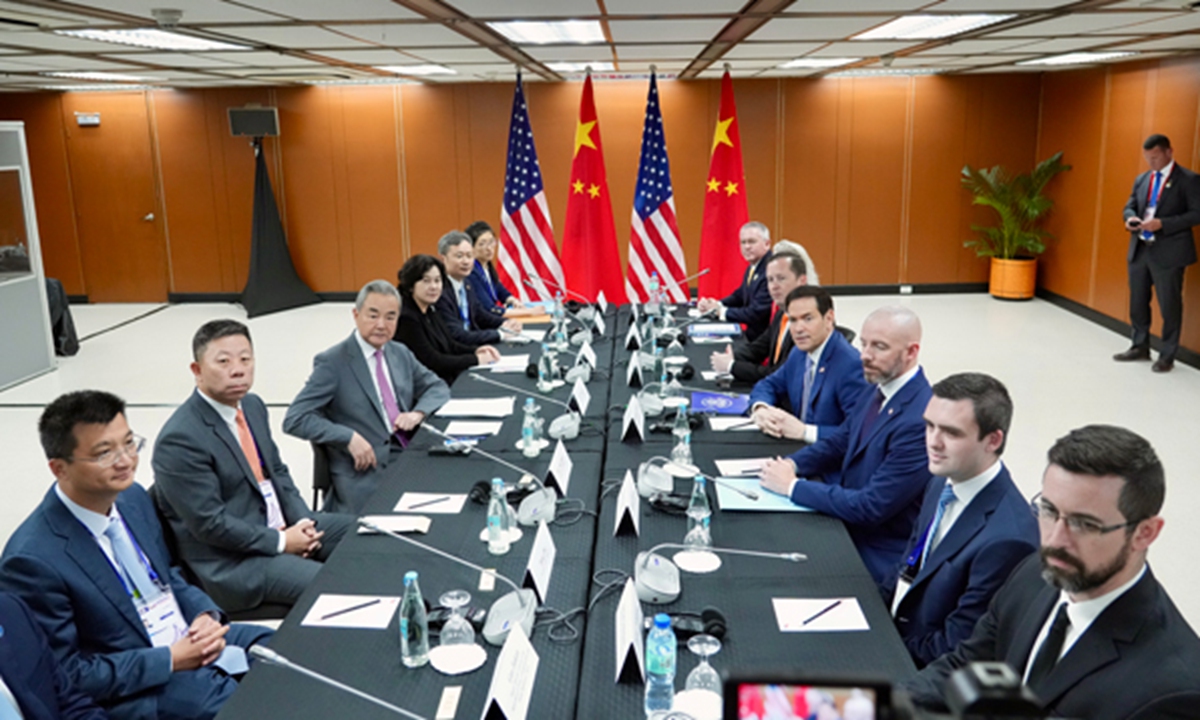
Photo: Website of Chinese Foreign Ministry
The reason this year has been described as a "historic, landmark year" for China-US relations is that both major countries have reached a clear consensus: bilateral relations can no longer be disrupted by noise, nor allowed to fall into a vicious cycle of misjudgment and probing. For countries as large and influential as China and the US, their relationship is not merely a bilateral matter - it profoundly affects regional dynamics, the global economy, and the broader landscape of international cooperation. What deserves closest attention from the Manila meeting is the relatively clear signal released by both sides: Differences may exist, but the situation must not spiral out of control; competition may continue, but the relationship must not be allowed to derail.
China's position at the meeting was clear and firm. On the one hand, China is ready to continue moving forward along the track set by the two heads of state, removing disruptions, overcoming obstacles, and staying firmly on the right course toward building a constructive bilateral relationship of strategic stability.
On the other hand, China holds firm to its principles and bottom lines. Regarding a series of recent negative words and actions from the US side, China has already made its position clear, urging the US side to respect China's core interests, uphold the one-China principle, properly manage differences, and address China's legitimate concerns.
China's approach to dialogue and cooperation comes with clear prerequisites and bottom lines. Dialogue does not mean compromising principles, nor does maintaining stability mean blurring red lines. China is willing to communicate, provided that the US side understands what bottom lines mean. China is ready to advance cooperation, provided that the US side does not claim to seek stable relations while simultaneously creating new risks on core questions such as Taiwan. Ultimately, whether China-US relations can move steadily in a positive direction depends not on how polished the diplomatic language sounds, but on whether the US can truly put "respect China's core interests" into practice.
The US side's remarks also deserve attention. Rubio acknowledged that "there are areas of great differences. Both sides will acknowledge that. We'll have to work through those, and I think these differences will exist for the foreseeable future." He further stressed that it was important both countries can talk irrespective of differences. This shows the US also recognizes that decoupling isn't the right way for the bilateral relationship.
The core value of this meeting lies in precisely setting the tone for current China-US relations. The relationship today is neither a simple recovery nor one that can be taken for granted. Rather, it has entered a new phase of seeking stability amid differences and preventing loss of control amid competition. What this phase most requires are four concrete actions: removing disruptions, overcoming obstacles, managing differences, and expanding cooperation.
Removing disruptions means preventing domestic political calculations, public opinion noise, and isolated negative moves from repeatedly undermining the overall bilateral relationship. Overcoming obstacles means facing the structural contradictions that have accumulated between the two countries without allowing them to spill over indefinitely. Managing differences means establishing sufficiently effective communication and constraint mechanisms to prevent misjudgment from escalating. Expanding cooperation is necessary because China and the US share unavoidable responsibilities in the global economy, regional hotspots, and international governance.
After the meeting, both sides agreed that the talks were pragmatic, positive, and constructive. They also agreed to jointly implement the common understandings of the two heads of state, advance the next stage of high-level exchanges, and promote substantive progress in building a constructive China-US relationship of strategic stability. Such statements are important, but what matters more is follow-through - turning statements into stable expectations, turning consensus into concrete implementation, and turning "what should be" into "what is actually happening."
For the US, if it truly wants the "year of opportunity" to become reality, it cannot merely talk about dialogue. It must put respect for China's core interests and adherence to the one-China principle into actual practice. In other words, only when the Taiwan Straits is stable can the China-US relations stabilize.
What major-country relations most fear is talking about managing differences while simultaneously creating risks. What is most valuable is the ability, despite known differences, to safeguard the bottom line, stabilize the situation, and take another step toward cooperation.
This Manila meeting cannot resolve all differences between China and the US in one stroke. Yet it once again demonstrates the basic principle for how the two countries should interact: Only by removing disruptions, overcoming obstacles, managing differences, and expanding cooperation can the relationship be prevented from spinning out of control, and only then can the world have less turbulence and greater certainty.
(Source: Global Times)