


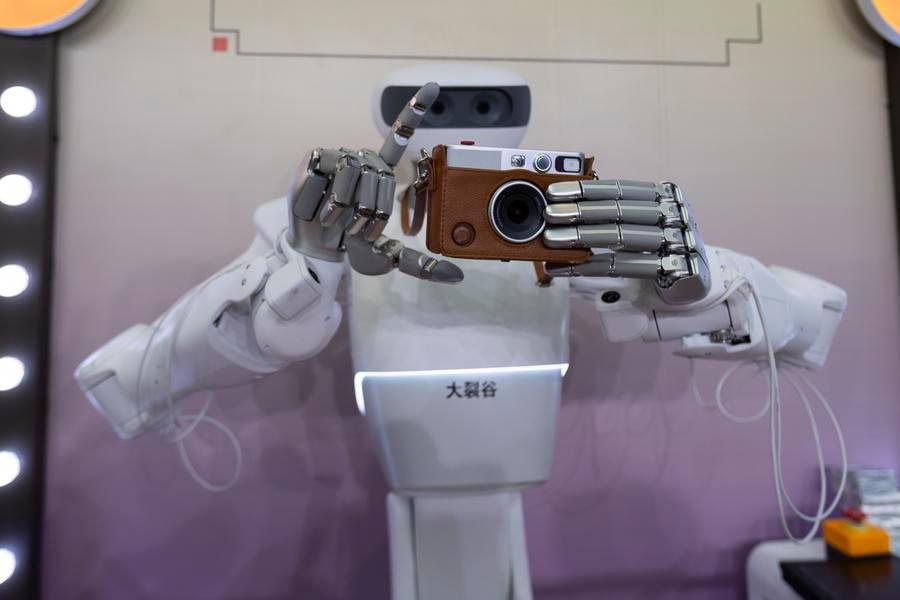
A robot demonstrates photo-taking abilities at the Shanghai World Expo Exhibition and Convention Center in Shanghai, east China, July 17, 2026. (Xinhua: Wang Xiang)
As a new wave of scientific and technological revolution accelerates alongside industrial transformation, artificial intelligence (AI) is experiencing rapid breakthroughs across multiple fronts. AI offers vast opportunities to empower industries, boost productivity, and advance sustainable development worldwide. At the same time, it presents unprecedented challenges, including fragmented governance frameworks, algorithmic bias, ethical concerns, and widening digital and AI divides.
Against this backdrop, the 2026 World AI Conference and High-Level Meeting on Global AI Governance opened in Shanghai on July 17 under the theme "AI Partnership for a Brighter Future."
Chinese President Xi Jinping attended the opening ceremony and delivered a keynote speech, offering China's answers to the pressing questions surrounding AI development and governance. Once again, China's vision and proposals attracted worldwide attention.
In 2023, Xi put forward the Global AI Governance Initiative, providing important guidance for advancing AI development and governance. Since then, China has steadily advanced its AI Plus initiative, promoting deeper integration between AI-driven technological innovation and industrial upgrading to support high-quality economic development and improve people's quality of life.
In healthcare, AI systems based on traditional Chinese medicine (TCM) are replicating the diagnostic reasoning of veteran practitioners. Solutions combining knowledge graphs with large language models are already serving more than 60 provincial-level top-tier TCM hospitals and thousands of primary healthcare institutions.
On the grasslands of Inner Mongolia in north China, cattle farms are using facial recognition technology to identify individual cows around the clock and provide precision feeding. The technology has increased feed efficiency by 25 percent while reducing disease rates by 20 percent.
China is also committed to ensuring that AI benefits people around the world.
Following the devastating earthquake in Myanmar, a Chinese team developed a multilingual AI translation system in just seven hours, helping international rescue teams overcome language barriers during emergency operations.
The Institute of Automation under the Chinese Academy of Sciences has deployed its Yugong parallel mining operating system in Thailand, enabling fully autonomous mining operations that have achieved zero safety accidents while improving productivity and reducing emissions.
These examples reflect a consistent principle underlying China's AI development: technological progress should always serve human needs and remain aligned with shared human values, allowing AI to become a powerful tool for expanding human knowledge and enhancing people's capabilities.
China also attaches great importance to addressing the risks associated with AI. It has incorporated AI into its national cybersecurity regulatory framework and continues to improve relevant regulations, governance mechanisms, and ethical guidelines to ensure the safety, reliability, and controllability of AI.
As a responsible major country, China released the Shanghai Declaration on Global AI Governance, calling for AI systems that are auditable, monitorable, traceable, and trustworthy. China has also actively participated in discussions on AI governance under the United Nations and other multilateral platforms, engaging with the international community on issues such as ethical review and safety evaluation while promoting broader consensus on AI governance and stronger safeguards for AI security.
The benefits of AI should not be enjoyed by only a handful of countries. Greater openness, connectivity, and cooperation are essential to addressing uneven development and supporting digital transformation in Global South countries.
China has consistently sought to provide international public goods in the AI field. Through both proposals and concrete actions, it has promoted AI for good and for all, helping other developing countries strengthen AI capabilities and narrow digital and AI divides. These efforts have won broad recognition from the international community.
China played a key role in facilitating the adoption of a United Nations General Assembly resolution on enhancing international cooperation on AI capacity-building. It has proposed establishing a World AI Cooperation Organization and released the AI Capacity-Building Action Plan for Good and for All, and the AI+ International Cooperation Initiative. China has also organized numerous AI capacity-building workshops, which have been widely welcomed by Global South countries.
Drawing on the Belt and Road Initiative, China has established platforms for digital cooperation, providing affordable smart infrastructure, localized native-language AI models and digital talent training to countries across Southeast Asia and Africa.
By practicing true multilateralism and keeping its doors open to cooperation, China is working with other countries to build a broadly supported global framework for AI governance.
The future of AI will shape the future of humanity. China will continue to stand on the right side of history and on the side of human progress. Guided by its vision, experience and practical achievements, China will continue contributing fresh ideas, broader consensus and practical solutions to global AI development and governance, while working with all countries to steer the course of AI toward a brighter future for humanity.
(Wen Siyuan is a commentator on international affairs.)