


Rethinking the global debate over manufacturing overcapacity
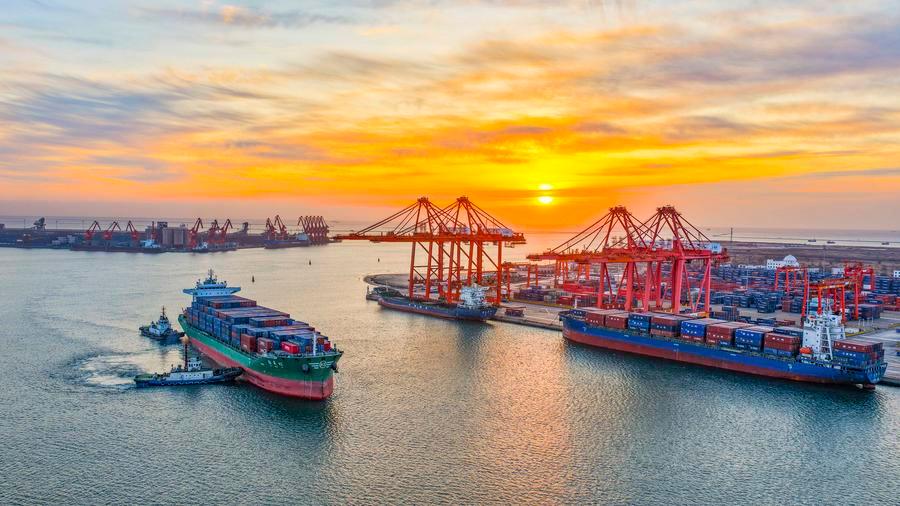
The Tangshan Port in Hebei Province, a major port in north China, January 19, 2026. (File photo: Xinhua)
Editor's note: Imran Khalid, a special commentator for CGTN, is a freelance columnist on international affairs. The article reflects the author's opinions and not necessarily the views of CGTN.
China's Ministry of Commerce published its position on the so-called excess capacity issue on Tuesday, and the timing was not incidental. It landed days before Washington is due to report the findings of a trade probe that could carry a fresh round of tariffs, and weeks after Brussels tightened steel protections and clamped down on low-value e-commerce parcels from Chinese sellers. The document reads as a rebuttal. It is also a dare: Define "overcapacity" precisely, or stop using it as a customs gate.
Here is the uncomfortable part for its critics. What they call overcapacity is, in most of the cases they cite, what comparative advantage looks like when the low-cost producer is no longer in Ohio or Bavaria. Capacity that outruns one country's home demand is the premise of trade, not a defect in it.
The argument against China deserves to be stated at full strength, not knocked down as a caricature. Critics contend that state subsidies and cheap directed credit allow Chinese firms to build factories without sufficient market justification. They argue that weak household spending leaves much of that output without adequate domestic demand, causing surplus production to be exported at very low prices and putting pressure on competitors in Europe, the United States, and increasingly the developing world. The US Treasury spent 2024 pressing exactly this case on electric vehicles, solar cells, and steel. Goldman Sachs research warns that Chinese capacity now runs ahead of what global demand can absorb.
The subsidy charge is where the double standard shows most clearly. The position paper does not pretend Beijing offers industry no support. Its claim is narrower and harder to dismiss: There is no necessary link between subsidies and overcapacity, and China's programs are consistent with World Trade Organization rules. The paper then does the arithmetic its accusers avoid. Washington's own Inflation Reduction Act commits roughly 750 billion dollars to favored sectors. The European Commission has planned some 1.44 trillion euros in industrial support between 2021 and 2030. Subsidies are the shared instrument of modern industrial policy. Calling them a distortion only when a Chinese firm benefits is positioning dressed as principle.
The surplus itself, a record near 1.2 trillion dollars last year, gets read as a moral failing rather than an accounting identity. A country that saves more than it invests runs an external surplus. That is macroeconomics, not conspiracy, and Beijing says plainly it never set out to maximize it.
On demand, the honest reading helps the critics less than they assume. Chinese household consumption is soft, weighed down by the property slump that began in 2021, and the government regards this as a phase of economic rebalancing rather than a permanent condition. Even granting the weakness, the claim that soft home demand equals illegitimate exports collapses on contact with the green transition. The world needs more solar panels and batteries than China's own grid can install this decade, and much of that unmet demand sits in countries that cannot pay Western prices for it. A village in the Sahel electrified by a Chinese panel is not a victim of dumping. Selling a surplus into a genuine global shortage is trade doing its job.

People shop for bargains at a shopping mall in New York, the United States, January 22, 2026. (File photo: Xinhua)
The idea that China's producers are coddled monopolists survives only at a distance. Up close, the domestic market is one of the most competitive in the world. Chinese economists have described some of these dynamics as "involution," reflecting intense rivalry across industries and persistent pressure on firms to improve performance. Companies that thrive do so not in the absence of competition, but in an environment that continuously rewards efficiency, innovation, and adaptability.
This is why the paper reaches for a phrase worth borrowing. Not China Shock 2.0, the label imported from Washington, but China Opportunity 2.0. Cheap Chinese solar modules, batteries, and electric cars have pulled down the cost of decarbonizing everywhere, and the economies that gain most are the ones with the least room in their budgets for expensive green technology. Walling those goods out to shield legacy plants raises the price of the energy transition for everyone who buys into it.
So the choice now sitting with Washington and Brussels is not really about China. Tariffs on solar and electric vehicles are a tax their own consumers pay and a brake on their own climate targets, accepted in exchange for shielding industries that lost on price. The last time the West met a cheaper competitor this way, in the trade fights over Japanese cars in the 1980s, the tariffs bought time without buying competitiveness back. The probe landing this week will show whether either capital has learned that lesson or intends to repeat it. Protectionism carries a cost, and for once it will be charged to the side raising the wall.
(If you want to contribute and have specific expertise, please contact us at opinions@cgtn.com. Follow @thouse_opinions on X to discover the latest commentaries in the CGTN Opinion Section.)