


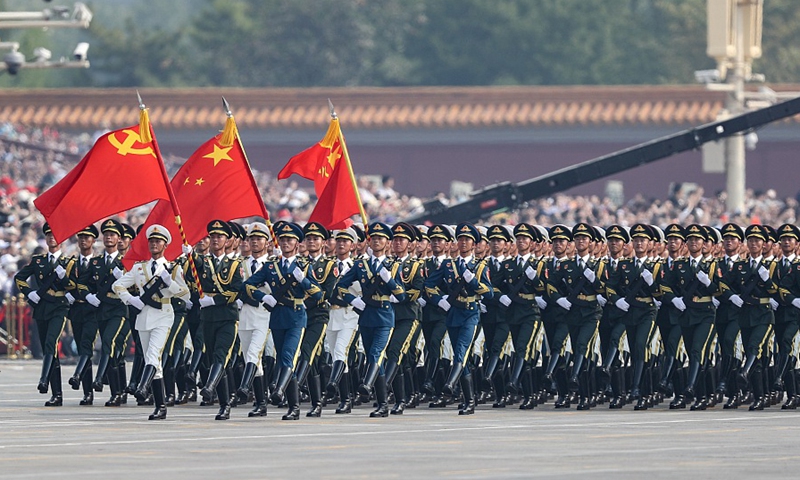
Photo: CGTN
On the eve of this year's Army Day, the Political Bureau of the Communist Party of China (CPC) Central Committee held its 27th group study session on advancing the high-quality modernization of national defense and the armed forces. Xi Jinping, general secretary of the CPC Central Committee, urged efforts to fulfill the goals for the centenary of the PLA in 2027, make "decisive progress" in basically realizing the modernization of national defense and the armed forces, and provide strong strategic support for advancing the cause of building a great country and achieving national rejuvenation on all fronts through Chinese modernization.
Shortly afterward, at a reception celebrating the 99th founding anniversary of the PLA, Chinese Defense Minister Dong Jun stated clearly that the PLA will serve as a steadfast bulwark for China's national reunification and resolutely thwart any attempt at "Taiwan independence" separatism or external military interference. This is not merely a routine statement; it is a direct response to the current situation across the Taiwan Straits.
In recent years, some people on the island of Taiwan have repeatedly asked: If the Chinese mainland advocates peaceful reunification, why does it continue to strengthen troop training, enhance combat preparedness, and maintain a strong deterrent posture in the Taiwan Straits? The answer is not complicated: Peaceful reunification represents the Chinese mainland's greatest sincerity, while strengthening the military and maintaining combat readiness represent the nation's firm bottom line. The former sets the direction, and the latter secures it. Without a sufficiently strong PLA, peace could be gradually "eroded" by "Taiwan independence" separatist forces and external interveners.
Xi has already made this logic clear. In his speech at a gathering commemorating the 40th anniversary of issuing the Message to Compatriots in Taiwan on January 2, 2019, he pointed out that "China must be and will be reunified," while also emphasizing that "Chinese don't fight Chinese." Together, these two statements form the core logic of the Chinese mainland's policy toward Taiwan today: Reunification is an unwavering principle, and peace is the direction we strive to achieve. Anyone who interprets "peace" as "weakness" or misreads "goodwill" as vulnerability is making one of the most dangerous misjudgments about the current cross-Straits situation.
The real risks in the Taiwan Straits have never come from the Chinese mainland's determination to safeguard sovereignty and uphold reunification. Rather, they lie in the repeated provocations by "Taiwan independence" separatist forces and attempts by external forces to interfere in China's internal affairs. Some foreign politicians claim to uphold the one-China policy while privately promoting "gray zone" narratives, colluding with "Taiwan independence" separatists and encouraging their provocations. The Democratic Progressive Party (DPP) authorities in Taiwan have relied on such external support to promote confrontation, exaggerate threats and pursue "Taiwan independence" by relying on external forces and resisting reunification through military buildup. Under these circumstances, without the PLA's strong combat capabilities, without its routine training and combat preparedness, and without its hard power to defend sovereignty and uphold reunification, the situation in the Taiwan Straits would only continue to deteriorate, leaving peace and stability between the two sides out of reach.
Therefore, the stronger the PLA is, the stronger the shield protecting peace across the Taiwan Straits will be. Military training and combat readiness are not intended to provoke war, but rather reflect the strategic wisdom of deterring war through strength and preventing turmoil through preparedness. The PLA's comprehensive strategic deterrence is not directed at Taiwan compatriots, but at diehard "Taiwan independence" separatist forces and external forces bent on interference. Put more plainly, it is precisely because the Chinese mainland has always placed peaceful reunification first that it cannot allow anyone to believe that provocation carries no cost, separatism has no consequences, or interference can succeed.
It is also important to recognize that the PLA is safeguarding not only the integrity of the nation's territory, but also the shared future of all Chinese people on both sides of the Taiwan Straits. Xi said, "We are willing to strive for peaceful reunification with utmost sincerity and greatest efforts as peaceful reunification is in the best interests of compatriots across the Straits as well as the Chinese nation." This means that what the Chinese mainland seeks is not a temporary victory or defeat, but the long-term peace, stability and development of the Chinese nation as a whole. What it seeks to safeguard is not only a principled position, but also the right of ordinary people on both sides of the Straits to remain free from war, turmoil and political manipulation aimed at drawing them into the "Taiwan independence" agenda. Who is truly safeguarding the interests of Taiwan compatriots? Those who constantly fuel tensions, sell weapons and create confrontation, or those who uphold peaceful reunification while firmly opposing separatism and external interference? The answer is self-evident.
Today's PLA has developed into a modern fighting force fully capable of defending national sovereignty, security and development interests. The more reliable it becomes, the greater the confidence behind national reunification; the stronger it becomes, the more solid the foundation for peace across the Taiwan Straits.
Army Day is not only a day to pay tribute to the people's soldiers, but also an occasion to better understand the broader trend across the Taiwan Straits. Peaceful reunification has always represented the Chinese mainland's greatest goodwill, while resolutely thwarting any attempt at "Taiwan independence" or external interference remains the unwavering mission of the PLA. No one should underestimate the firm resolve of the Chinese people to safeguard national unity, nor misjudge the PLA's strong capability to defend the country's territorial integrity. The historical trend toward China's complete reunification is unstoppable, and the PLA, as a "steadfast bulwark," will uphold peace, safeguard unity and help secure a bright future for national rejuvenation at critical moments.