


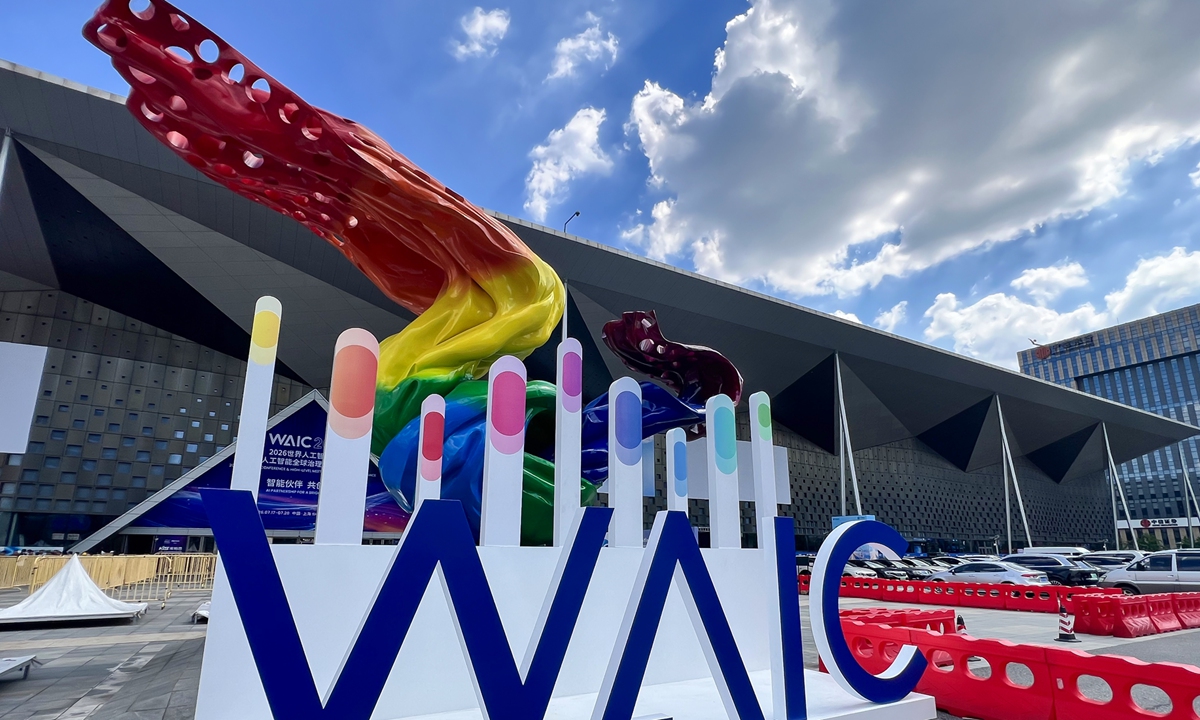
A view of the conference site for the 2026 World AI Conference and High-Level Meeting on Global AI Governance in Shanghai (Photo: VCG)
Some Western media outlets have recently targeted China's cost-effective artificial intelligence (AI) large language models with a flurry of far-fetched skepticism and even broadside, in a bid to slow down the growth of China's AI industry.
The Western media vilification comes amid a string of breakthroughs made by China's AI companies - from DeepSeek's V4Flash, which costs only pennies for extensive coding tasks, to Moonshot's Kimi K3, claimed to be the world's largest open-source model. With its combination of low cost, high performance, and open-source sharing, Chinese AI models are helping reshape the global AI landscape and bringing cutting-edge intelligence within everyone's easy reach.
It is precisely this development path, which combines solid technological strength and user inclusiveness, that has touched the sensitive nerves of some in the West, as reflected by their mounting anxiety and fear that their long‑held advantages could be slipping away.
For a long time, Western countries led by the US have leveraged their first‑mover edge to dominate the global AI market. Through steep pricing and erecting technical barriers, they have hoarded the dividends of the intelligent era, leaving many developing countries unable to afford the latest AI solutions and miss out on opportunities for intelligent transformation.
China, however, has carved out a different path. It advances technological iteration with lower research and development costs, and faster industrial implementation, thus breaking the traditional Western-dominated market order. This leapfrog progress is the real trigger for Western anxiety over its eroding technological superiority.
Ironically, this very anxiety serves as the best proof that China's inclusive way of AI exploration and development is on the right track. If the West was truly confident in its technological supremacy, why would its media outlets go to such lengths to push back and attack affordable Chinese AI models entering the global market?
Compared with the West's high‑priced and closed models, China embraces the concept of technology for good and inclusive AI sharing by the whole mankind.
China's open-source models have made AI significantly more accessible and affordable, enabling all parties, especially developing countries, to benefit equitably from AI development.
These models will help them overcome technological bottlenecks, accelerate digital transformation, and narrow the technology gap, steering the global AI landscape toward a more balanced and diverse future. This win‑win approach aligns with the tide of global technological progress and meets the development needs of the vast majority of countries, demonstrating robust vitality and growth potential.
And, the numbers best illustrate this trend. According to Hugging Face's Spring 2026 report, Chinese open-source AI models have captured 41 percent of global downloads, surpassing the US models. On OpenRouter, the top six most popular models all come from Chinese companies. Cumulative global downloads of China's open-source AI models have surpassed 10 billion, according to the Ministry of Industry and Information Technology.
For the developing countries, the value of China's inclusive AI development path extends far beyond low costs. For years, steep computing expenses and model licensing fees have confined AI progress to an exclusive club of the developed economies. The emergence of cost-effective Chinese AI models has changed this landscape.
For instance, grass-roots clinics in Southeast Asia gain access to intelligent auxiliary diagnosis tools, and companies in Latin America can deploy intelligent customer service and automated management systems through rising AI cooperation with China.
What were once unattainable technological dreams have now become true across the Global South. A technological path that narrows rather than widens global digital divide represents not merely a commercial choice, but a value proposition that serves the common interests of all humanity.
The ultimate criterion for technological progress has never been about who shouts the loudest, but who creates tangible value for more people. The growth of China's AI industry is not to be slowed down by a few deeply biased Western media commentators.