


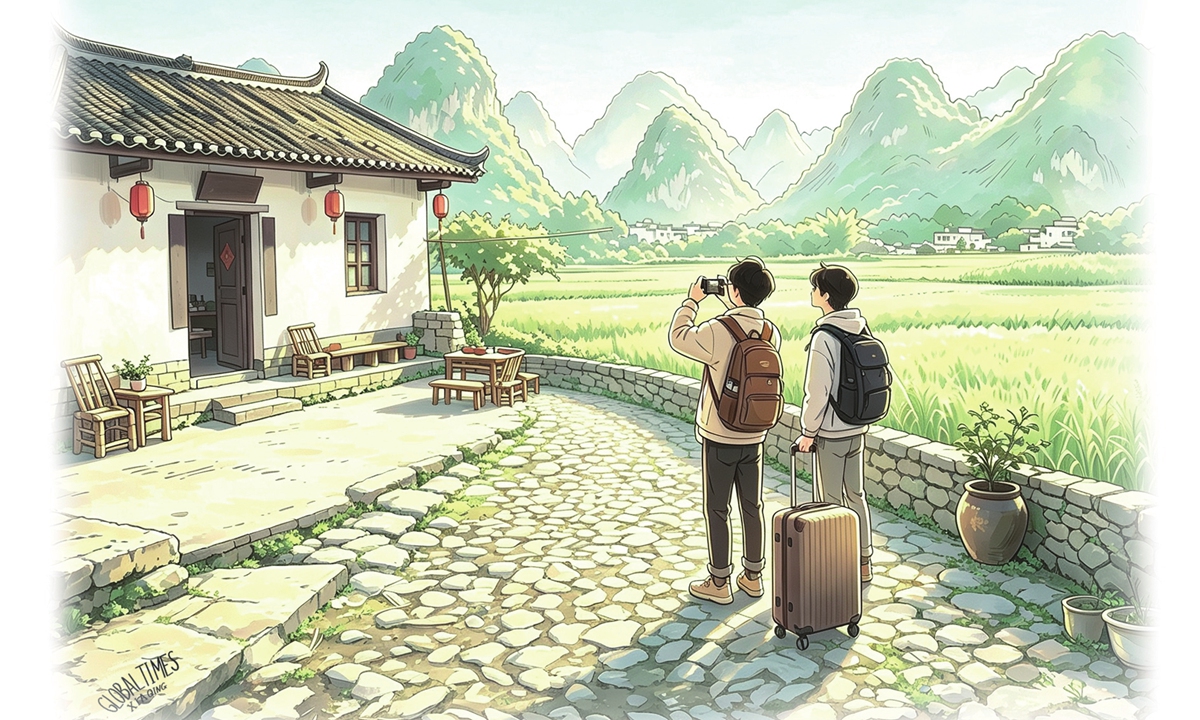
Illustration:Xia Qing/GT
Editor's Note:
China's rural revitalization is often discussed in policies and statistics. But what does it truly look like on the ground, especially in the eyes of foreign visitors? In this "Village Walk" series, the Global Times invites foreign visitors who have explored China's villages firsthand to share their stories. Through their perspectives, we capture the quiet transformations, the rich and vibrant local cultures, the sustainable development of rural industries, and the vitality among rural communities. This is the eighth installment of the series.
By Ian Hamilton
I arrived in China in 2001 to work as a tour leader for an international travel company. Not being able to speak a word of Chinese and having to arrange group meals, train tickets and visits to tourist sites, what struck me most was how friendly, helpful and accommodating everyone was to me.
On every two- or three-week trip, I was always happiest when we arrived in Yangshuo, Guangxi. Having grown up in a small village in South Africa, the immensity of Chinese cities was daunting to me. Yangshuo, by contrast, was idyllic. Beautiful rivers coursing between dramatic Karst peaks and beautiful villages nestled among the rice paddies begged us to explore on foot or by bicycle.
After a few years, when I decided to settle in China, it was therefore natural that I chose Yangshuo as my base. I moved to a small hamlet on the banks of the Yulong River known as Jiuxian Village. At the time, there was only a narrow dirt track in and out of the village; no sewerage system, running water or rubbish collection, and the electrical supply was intermittent.
Having worked as an architect prior to my diversion into tour leading and being entranced by the beautiful ancient brick houses dotted around the village, I decided to try and renovate one and open a guesthouse. I was also motivated by the fact that everyone in the village invited me for dinner and rice wine on a daily basis. It genuinely felt like I was among family. The village leader and Party chief, who both referred to me as their brother, were untiring in their support and help to make my small dream come true.
In hindsight, it was possibly foolish to open a guesthouse in a relatively poor village with limited access, but fortunately for me, a transformation was about to take place.
The government invested heavily in infrastructure and the environment and encouraged fruit farming and tourism. The results were breathtaking.
Our little village got meandering concrete roads, sewerage, water on tap, upgraded electricity and even internet.
Previously, most working-age villagers had moved to big cities to seek jobs, leaving their children behind to be raised by their grandparents. They now returned to the many opportunities available to them, and village life became much more vibrant. I added dozens and dozens of brothers and sisters to my already vast family and added a whole new level of happiness to my already wonderful life.
With the encouragement of my friends and the local government, I've returned to being a full-time architect and builder. I help Chinese city folk rent old houses in the countryside and convert them into guesthouses and restaurants. All our materials and workers are local and everyone is proud to be able to preserve their once abandoned ancestral homes and give them a new lease of life. Working together, I learned about local building traditions. There's also a lot more interest in visiting the countryside among Chinese tourists; therefore, a lot of opportunity for villagers to start their own businesses. The sense of community is stronger than ever.
My parents were fortunate enough to visit for a month in 2017, and during that time there was not a single lunch or dinner for which we did not have an invite to a meal in someone's home. My parents described their stay as the happiest month of their lives. Unfortunately, my mother passed away last year. Upon my return to Jiuxian Village from overseas, my wonderful brothers and sisters in the village arranged a feast to commemorate my mother's memory.
It is impossible to explain just how incredible all of this makes me feel. About a third of our village is surnamed Mao, and they have christened me Mao too. When people refer to me as family, it is something that feels genuine and touching.
Foreigners I meet often ask if it's hard doing business in China. It's certainly tricky doing business in a country where the language, rules and traditions are all unfamiliar. However, I am fortunate to have the support of everyone around me: villagers, local government, and also the Chinese tourists who visit our gorgeous corner of the world.
It's hard to imagine a better life and impossible to imagine better people. I'm looking forward to the next 25 years.
(The author is a South African architect living in China.)