


BEIJING, Aug. 8 (Xinhua) -- As China continues to upgrade its manufacturing base and scale up production in sectors ranging from electric vehicles to renewable energy equipment, some Western countries once again revived claims of Chinese "overcapacity" to justify new tariffs and investment restrictions.
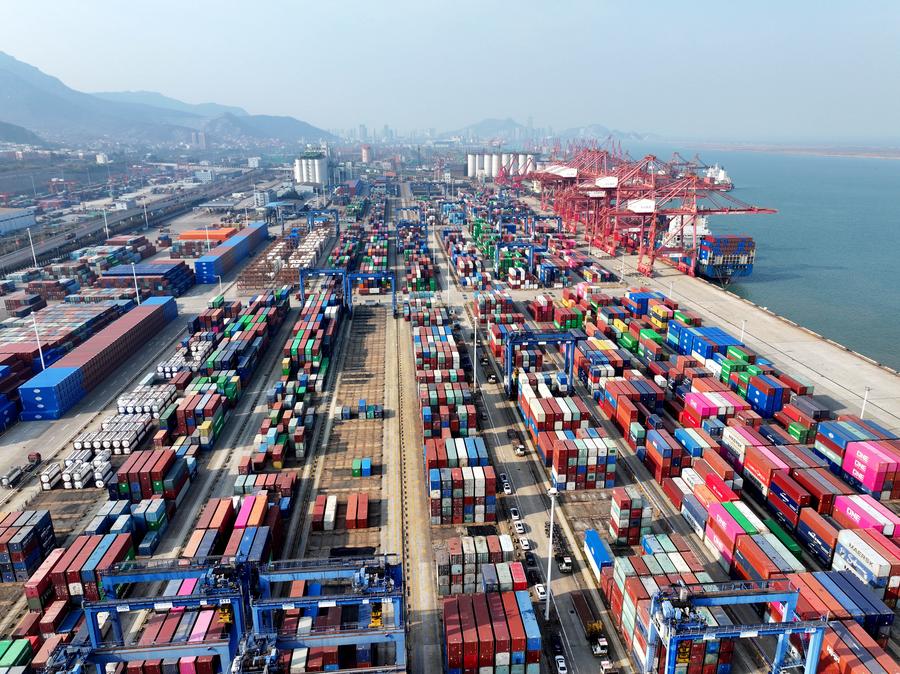
This aerial drone photo taken on Dec. 10, 2024 shows a container terminal of Lianyungang Port, east China's Jiangsu Province. (Photo: Xinhua)
Yet the latest round of accusations goes beyond questions of production capacity, reflecting growing concerns in some economies over industrial competitiveness and market position. The broader issue is how capacity, competition and industrial cooperation should be viewed amid technological changes and the restructuring of global supply chains.
Without a universally accepted definition, the overcapacity concept has become an easy vehicle for some politicians to politicize economic and trade issues, pointing to China's subsidies, trade surplus, and export volumes as signs of "unfair" competition and "overcapacity".
China boasts the world's largest and most comprehensive manufacturing system, allowing it to efficiently supply a vast array of industrial products at scale.
"China's trade surplus reflects the completeness and efficiency of its industrial system and is an objective result of changes in global specialization and trade patterns," noted He Shaojun, an official with the Ministry of Commerce.
To many outside observers, China's industrial rise is now often measured by the rapid growth of industries such as artificial intelligence, electric vehicles and advanced batteries.
Behind today's competitiveness lies decades of investment in research and development, the advantages of a vast domestic market, a comprehensive industrial ecosystem and continuous market-oriented reforms. While some countries have once again invoked the familiar narrative that China's industrial development is driven by government subsidies, these industries are the product of years of technological accumulation, industrial upgrading and sustained innovation rather than short-term policy support.
This manufacturing capacity has played an important role in stabilizing global supply, helping offset localized shortages caused by protectionism, geopolitical tensions and other disruptions, while serving as a key pillar of global industrial and supply chains.
More importantly, China's industrial upgrading has created opportunities that extend far beyond its own borders.
Foreign-invested enterprises, global suppliers and consumers have all benefited from China's integration into international production and trade networks. At the same time, the country's rising domestic demand driven by consumption upgrading, green transition and digital infrastructure investment is generating sustainable demand for products, technologies and services from around the world.
Over the past decade, China has contributed around 30 percent of global economic growth, becoming an important source of stability for the world economy.
China supplies more than 80 percent of the world's photovoltaic modules and 70 percent of its wind-power equipment, providing important support for the green transition of its trading partners. Foreign-invested enterprises contributed 16 percent of China's trade surplus while also earning substantial returns on their investments.
A broader perspective is often overlooked in discussions of so-called "overcapacity." For many developing economies, China's supply of cost-effective products represents greater access to technology, equipment and industrial know-how.
China's exports of high-quality, cost-effective production equipment and components have lowered the barriers to industrialization for many developing economies. Between 2012 and 2024, China exported more than 30 billion U.S. dollars' worth of textile machinery to developing countries, helping economies in Southeast and South Asia expand their textile manufacturing capacity and emerge as major producers and exporters of textile products.
Through the Belt and Road Initiative, expanding market access, technology-sharing platforms such as the Luban Workshop program, and the supply of affordable renewable energy products, China has sought to strengthen the capacity of developing countries to build sustainable industries of their own.
These efforts are aimed at enhancing self-sustaining growth by lowering barriers to industrialization, improving technical capabilities and expanding participation in global value chains.
"Instead of using industrial policies as instruments to constrain the development of others, all countries should focus on expanding opportunities for global development through reasonable, transparent and rules-based industrial policies," said Han Yong, an official with the Ministry of Commerce.
China is ready to work with all parties under the WTO framework to strengthen dialogue on industrial policies, improve relevant practices and advance multilateral trade rules in line with evolving economic realities, he added.