


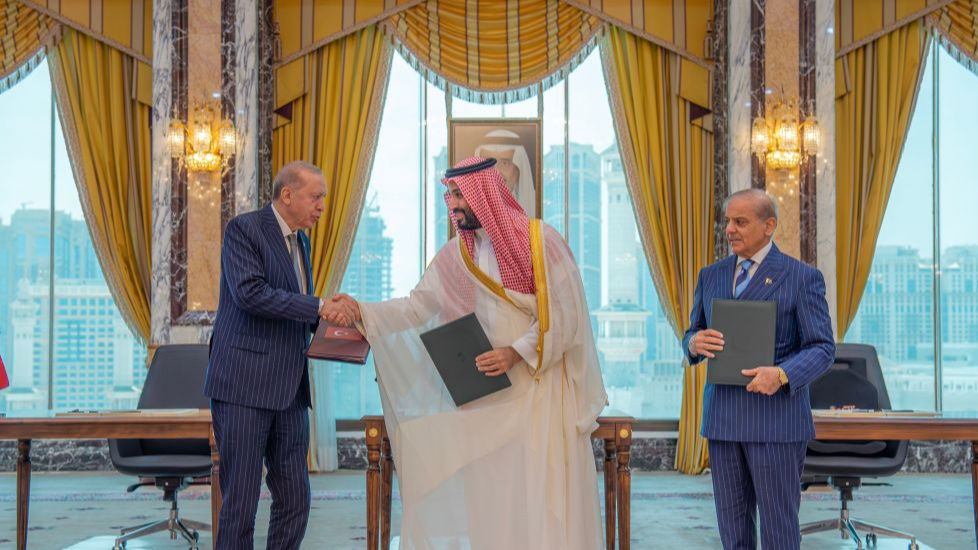
Saudi Crown Prince and Prime Minister Mohammed bin Salman bin Abdulaziz Al Saud (C), Turkish President Recep Tayyip Erdogan (L) and Pakistani Prime Minister Muhammad Shehbaz Sharif at the signing of the Makkah Joint Defense Agreement in Makkah, Saudi Arabia, August 7, 2026. (Photo: Xinhua)
The Makkah Joint Defense Agreement signed on August 7 this year by Saudi Arabia, Türkiye and Pakistan has predictably unleashed a wave of criticism, with some commentators labeling it a "Muslim NATO." The comparison is fundamentally incorrect. It obscures the actual mechanics of the pact while misunderstanding the structural pressures that brought these three powers together.
The agreement is neither an overnight military revolution nor a hollow photo opportunity. It is a calculated, pragmatic response to a rapidly changing security environment in which regional powers can no longer afford absolute reliance on traditional external guarantees. The central question is whether it marks a genuine transformation of the Middle East's regional landscape and a tangible erosion of US dominance.
To understand the weight of this trilateral arrangement, one must examine the security calculations driving each signatory and the complementary needs that bind them. Saudi Arabia enters from a position of acute vulnerability exposed by recent regional escalations and missile threats. Multi-front pressures linked to the US-Iran-Israel conflict and broader instability have laid bare the risks of depending on a single external security umbrella. Riyadh is diversifying its strategic partnerships. By institutionalizing ties with two of the regional military powers, it seeks a durable layer of deterrence that transcends traditional alliances.
Türkiye approaches the pact through the lens of industrial maturity and geopolitical ambition. As the holder of NATO's second largest military and boasting a formidable domestic defense manufacturing base, Ankara is no longer content to act merely as a regional appendage of Western security strategies. The agreement offers a formal mechanism to project influence southward, anchor defense exports and secure regional economic and geopolitical equities. Türkiye brings advanced drone technology, operational experience and a willingness to challenge status-quo arrangements.
Pakistan provides the third pillar, driven by strategic balancing and deep historical ties with the Gulf. Islamabad has long maintained robust bilateral defense cooperation with Saudi Arabia. Extending this framework to include Türkiye creates a triangular geometry that combines Saudi financial weight, Türkiye's technological capacity and Pakistani military manpower and strategic depth. For Pakistan the pact offers a structured way to contribute to regional stability without entanglement in exclusive, zero-sum rivalries that could compromise its broader foreign policy posture.
These respective concerns generate clear complementary needs and shared interests. Saudi Arabia requires reliable additional deterrence and political cover; Türkiye seeks markets, influence and validation of its defense industry; Pakistan needs strategic depth, economic and diplomatic support, and a formal role in Gulf security. The agreement serves these interests by converting longstanding bilateral ties into a public, reciprocal political commitment at a moment when external guarantees look less automatic.
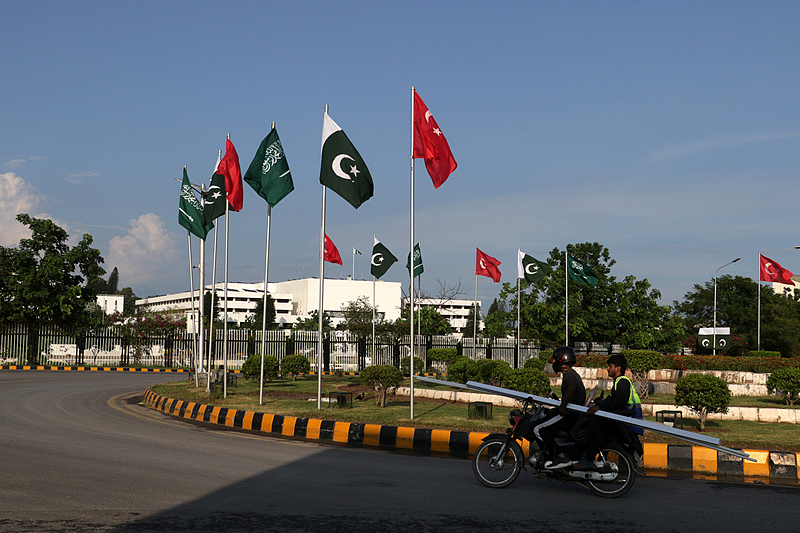
The national flags of Pakistan, Saudi Arabia and Türkiye fly outside the parliament house in Islamabad, Pakistan, August 8, 2026. (Photo: CFP)
The central provision that an armed attack against any of the three will be regarded as an attack against all – immediately invites comparison with NATO's Article 5. But the structural divergence is stark. NATO rests on an integrated command structure, standardized logistics, decades of interoperability and the ultimate backing of the United States. The Makkah agreement possesses none of these permanent institutional apparatuses: no unified headquarters, no permanent joint force, no fully harmonized doctrine.
But still it is not purely symbolic. The political commitment is profound. It moves cooperation out of informal understandings into a formal public pledge and signals to regional rivals and external actors that the three states intend to coordinate responses to external aggression. Whether this pledge evolves into a functioning operational shield will depend on the creation of joint command structures, rigorous exercises and intelligence alignment.
The broader geopolitical question is the impact on the United States' dominant position. The agreement is not the sudden collapse of American hegemony. It reflects a protracted recalibration of Washington's role amid strategic fatigue and more selective intervention.
The regional powers have concluded that passive security dependency is a liability. The Makkah agreement is both a symptom and a modest accelerator of this shift. Washington's monopoly over regional security architecture is eroding as states construct decentralized safety nets. This diversification is a pragmatic hedging against a future in which external powers may be unwilling or unable to intervene in a localized crisis. In that sense the pact constitutes a substantive, if still incomplete, step toward greater autonomous defense cooperation among regional powers – and a measurable, incremental transformation of the Middle East's security landscape.