


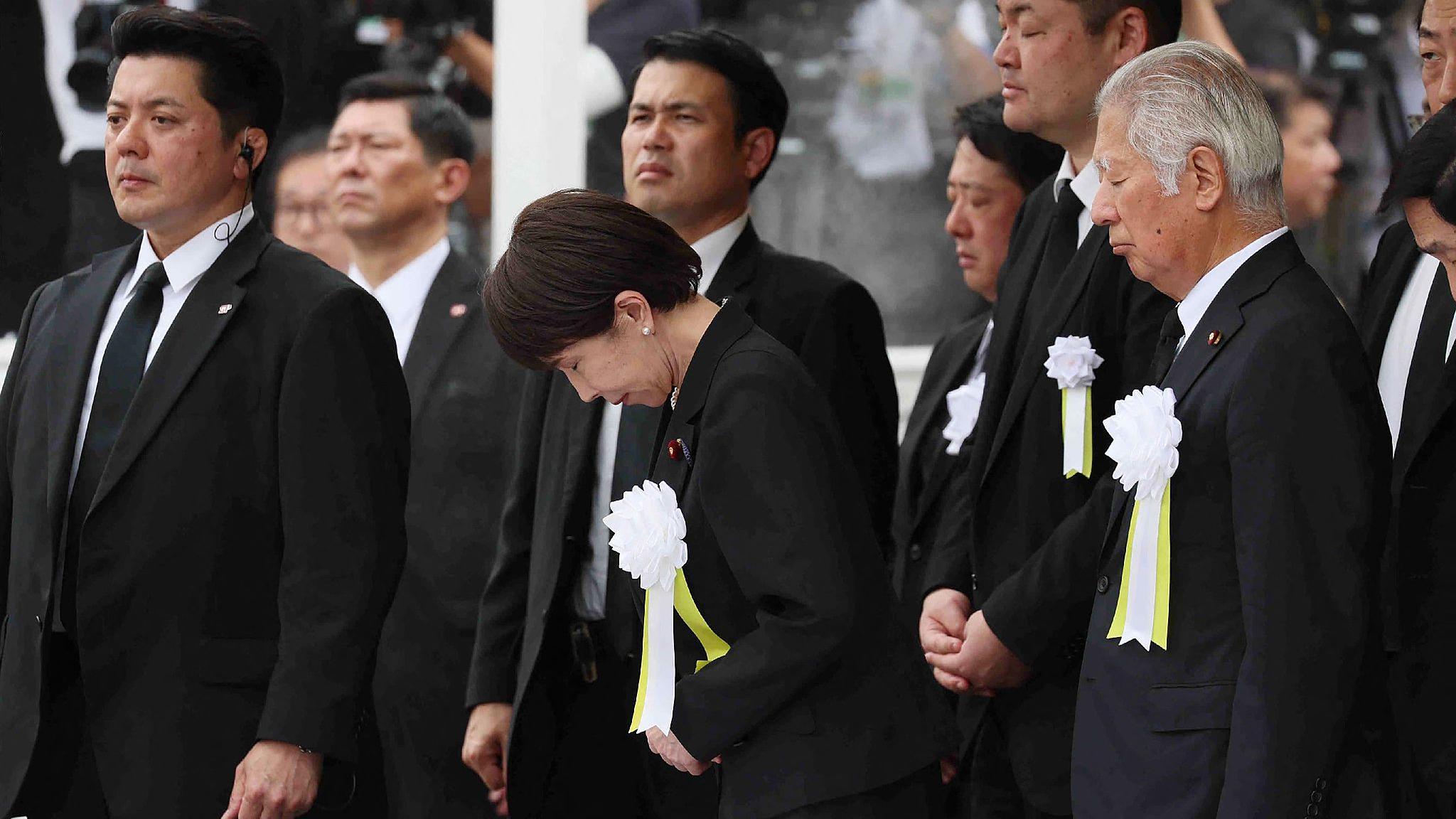
Japanese Prime Minister Sanae Takaichi bows during a ceremony at the Peace Memorial in Nagasaki, Japan, August 9, 2026, marking the 81st anniversary of the atomic bombings. (Photo: CFP)
Editor's note: Cao Cong, a special commentator for CGTN, is a doctoral candidate at the School of Global and Regional Studies, University of Chinese Academy of Social Sciences. The article reflects the author's opinions and not necessarily the views of CGTN.
On August 6 and 9, Japan held ceremonies in Hiroshima and Nagasaki respectively to commemorate the 81st anniversary of the atomic bombings of the cities. Yet on these two solemn occasions, which symbolized the suffering caused by nuclear warfare and a pledge to pursue peace, Japanese Prime Minister Sanae Takaichi remained ambiguous over whether Japan would continue to uphold its Three Non-Nuclear Principles – not possessing, not producing, and not permitting the introduction of nuclear weapons.
Unlike previous prime ministers, who used expressions such as "maintaining the Three Non-Nuclear Principles" during similar ceremonies to clearly reaffirm their commitment to the policy, Takaichi merely referred to Japan's current position without making a clear pledge to maintain the principles in the future.
The Three Non-Nuclear Principles have long been regarded as a symbol of Japan's postwar commitment to peace. As the only country to have suffered atomic bomb attacks, Japan should remain deeply aware of the devastation caused by nuclear weapons and uphold the principles of nuclear disarmament and non-proliferation.
In recent years, however, Japanese right-wing forces have been increasingly advocating a review of the "no introduction" principle, attempting to open the door to the possible deployment of US nuclear weapons in Japan and strengthening the Tokyo-Washington nuclear deterrence cooperation.
This renewed debate over Japan's nuclear policy is closely intertwined with Tokyo's accelerating development of long-range strike capabilities. After revising its three key security documents in 2022, Japan began expanding long-range strike forces under the banner of acquiring so-called "counterstrike capabilities."
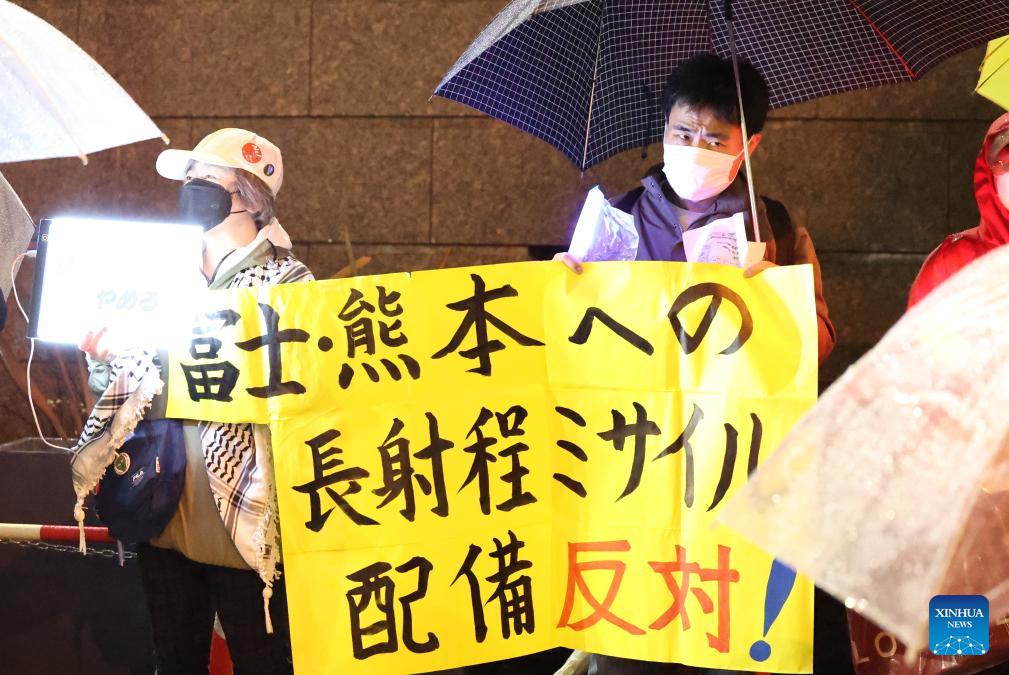
Residents stage a protest against Japanese government's deployment of long-range missiles with counterstrike capabilities, in Tokyo, Japan, on March 31, 2026. (Photo: Xinhua)
In March, Japan deployed long-range missiles with counterstrike capabilities in its Kumamoto and Shizuoka prefectures. It is also developing ship- and air-launched variants of these missiles, expanding their deployment from ground-based systems to maritime and aerial platforms.
In addition, it has accelerated the acquisition of US-made Tomahawk cruise missiles and other stand-off weapons, including the air-launched Joint Strike Missile. In July, the Japan Maritime Self-Defense Force destroyer JS Chokai conducted its first live-fire test of a Tomahawk cruise missile in the Pacific Ocean near the United States. With a range exceeding 2,000 kilometers, the Tomahawk provides Japan with a long-range land-attack capability unprecedented in its postwar history.
Although these long-range strike systems are officially categorized as conventional weapons, they have significantly enhanced Japan's ability to conduct long-range precision strikes. Against the backdrop of renewed debate over the Three Non-Nuclear Principles, the parallel advancement of nuclear policy discussions and offensive military capabilities has intensified concerns over Japan's departure from its postwar security constraints.
Japan is also seeking to institutionalize this broader military transformation through the revision of its security framework. According to Kyodo News, Japan's Ministry of Defense is coordinating a request for a record-high defense budget of approximately 8.9 trillion yen ($56.2 billion) for fiscal year 2027. As some projects have yet to receive final funding allocations, the actual figure could rise further.
The proposed spending is expected to reflect the direction of the revised "Three Security Documents" scheduled for the end of this year. Priority areas include long-range missiles, unmanned systems, and AI-assisted command and decision-making capabilities, highlighting Japan's shift from acquiring individual weapons toward building a more integrated military operational system.
Japan's 2026 Defense White Paper also reflects this transformation in military strategy. For the first time, the document includes a dedicated section on "new forms of warfare," drawing lessons from the Russia-Ukraine conflict and emphasizing the application of unmanned systems, artificial intelligence, as well as capabilities in space, cyberspace, and the electromagnetic domain. Japan is also strengthening its defense production and technological foundation, expanding weapons research and military-industrial capacity to support long-term military expansion.
The establishment of a National Intelligence Bureau represents another important step in strengthening Japan's security architecture, particularly in terms of intelligence integration and strategic decision-making. The new institution is expected to enhance Japan's ability to coordinate military, security, and diplomatic information, providing institutional support for a more assertive security strategy.
For the Takaichi administration, reconsidering the Three Non-Nuclear Principles is not merely a response to so-called "changes in the security environment." It is closely linked with the expansion of long-range strike capabilities, increased defense spending, the strengthening of the military-industrial base, and improvements in intelligence mechanisms, becoming a key component of Japan's drive toward remilitarization.
The long-standing ambition of Japanese right-wing forces to move beyond the postwar peace framework is gradually being transformed into national strategy through institutional changes. This dangerous trend deserves close attention from the international community.
History must not be forgotten, and commitments to peace should not be selectively upheld. Japan's past aggression inflicted profound suffering on Asian countries and the world, which is why international concerns over Japan's military developments have a strong historical basis.